Instructor
CDL Study Buddy Team
Understanding blind spots — also known as "no-zones" — is essential for safe commercial vehicle operation. This video provides a comprehensive overview of where blind spots exist around your tractor-trailer and how to manage them effectively.
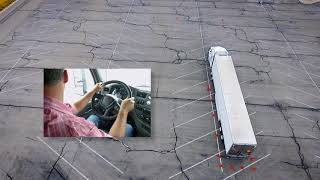
Large trucks have significant blind spots that passenger vehicle drivers often don't appreciate. This video identifies all four main blind spot zones around a tractor-trailer: the front no-zone extending approximately 20 feet ahead of the bumper, the rear no-zone extending approximately 30 feet behind the trailer, the left-side no-zone covering the lane to your immediate left (though smaller than the right side due to the driver's window), and the most dangerous — the right-side no-zone that can extend across multiple lanes.
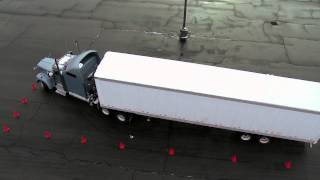
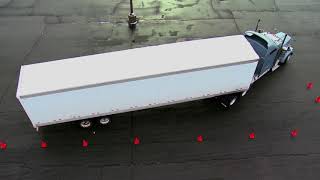
The instructor uses an actual tractor-trailer with passenger vehicles positioned in each blind spot to demonstrate exactly where other vehicles disappear from view. You will see both the driver's eye view and exterior camera views simultaneously so you understand what you can and cannot see from the driver's seat.
The front blind spot is particularly dangerous for smaller vehicles. The instructor demonstrates how a car directly in front of the tractor can become completely invisible if it's too close, and why maintaining proper following distance is a defensive driving necessity, not just a courtesy.
The right-side no-zone receives the most detailed coverage because it's the largest and most dangerous. The instructor shows how a vehicle can be invisible in both your flat and convex mirrors while positioned in the adjacent right lane. You will learn proper mirror-checking technique and the importance of verifying blind spots visually (leaning forward to check the convex mirror) before lane changes to the right.
Lane change procedures are demonstrated with a systematic approach: signal early, check mirrors (flat then convex), check the blind spot by leaning to check the convex mirror angle, and only then begin the lane change. The instructor emphasizes that truck drivers should never rely solely on mirrors — a head turn or lean is essential.
Defensive driving around blind spots is covered from both perspectives. For truck drivers: how to position the vehicle to minimize blind spot risk, how to use turn signals earlier than cars do, and how to anticipate when other vehicles are entering your blind spots. You will also learn the importance of making eye contact (when possible) with drivers in adjacent lanes.
This video is essential viewing for all CDL students and experienced drivers alike. For official FMCSA guidance on blind spot awareness and defensive driving, visit https://www.fmcsa.dot.gov/. Pair this video with our CDL practice tests for complete safety knowledge.