Section 1 of 13
Introduction
Introduction





Schedule your test online: www.dojmt.gov/driving Department of Justice Motor Vehicle Division Driver Services Bureau 302 North Roberts P.O. Box 201430 Helena, MT 59620-1430

Revised
March 2023
dojmt.gov/driving/ commercial-driver-licensing/ (406) 444-3933 Montana-Specific Rules and Regulations vehicle(s) being towed is in excess of 4,536 kilograms (10,000 pounds). •Heavy Straight Vehicle (Class B) is any single vehicle with a GVWR of 11,794 kilograms or more (26,001 pounds or more) or any such vehicle towing a vehicle not in excess of 4,536 kilograms (10,000 pounds) GVWR. Note: A semi-tractor is not considered a Class B vehicle and cannot be used as such for testing. •Small Vehicle (Class C) is any single vehicle, or combination of vehicles, that meets neither the definition of Class A nor that of Class B as contained in this section, but that either is designed to transport 16 or more passengers including the driver, or is used in the transportation of materials found to be hazardous for the purposes of the Hazardous Materials Transportation Act and which requires the motor vehicle to be placarded under the Hazardous Materials Regulations. •Non-Commercial Vehicle (Class D) is any noncommercial vehicle authorized to be driven with a regular driver license (Class D). PROOF OF SOCIAL SECURITY NUMBER AND IDENTITY CONFIRMATION Your identity is important. Identity theft is now the top-reported form of crime in the United States. The name and birth date on your application for a commercial driver license must match the primary document you provide and will be checked with the Social Security Administration. This is to help protect you against fraud. It’s important to fix discrepancies now to avoid problems in the future for you and your family. Please make sure the full legal name and date of birth you’re going to use on your application for a CDL matches what is on file with the Social Security Administration. You must also provide your Social Security Number on your CDL application. [See FMSCR 383.153(d)1.] The Social Security Number you use on your CDL application must match the number on file with the Social Security Administration. Commercial License Permit (CLP) are permits you can get for any class of commercial license. If you are a first-time applicant, you must pass the vision and written tests, present a valid medical examiner's certificate (MEC) (formerly known as a DOT card), plus fulfill all other requirements for the class of vehicle you want to drive. Once all requirements are met, the CLP is issued and valid for 180 days from the issue date. CLP holders operating a commercial motor vehicle requires an accompanying driver, licensed and endorsed for operating the class of vehicle you are driving. The CLP is renewable one time on or before the CLP expiration date for an additional 180 days. There is no charge to renew a CLP. A pre-trip and/or skill test that was passed during the first 180 days are forfeited if the permit is renewed. All CLP permits must be held for a minimum of 14 days before taking the pre-trip, basic skills and road test. (may test on the 15th day) HOW SAFE IS YOUR VEHICLE? Pre-Trip. Drivers should all be familiar with checking the vehicle for safety before starting on a trip. As part of Commercial Driver License testing, you will be required to perform and pass a pre-trip inspection exam conducted by the driver license examiner. Steps that can help you perform a successful inspection are outlined in section 11 of this manual. The pre-trip inspection requires you to be very familiar with your vehicle. The pre-trip must be passed before a Commercial Vehicle Operator’s License is issued.
ABOUT THIS MANUAL SUPPLEMENT Commercial Motor Vehicle (CMV) means a vehicle or combination of motor vehicles used in commerce to transport passengers or property if the motor vehicle: has a gross combination weight rating of 11,794 kilograms or more (26,001 pounds or more) inclusive of a towed unit with a gross vehicle weight rating of more than 4,536 kilograms (10,000 pounds); or has a gross vehicle rating of 11,794 or more kilograms (26,001 pounds or more); or is designed to transport 16 or more passengers, including the driver; or is of any size and is used in the transportation of materials found to be hazardous for the purpose of the Hazardous Materials Transport Act and which require the motor vehicle to be placarded under the Hazardous Materials Regulations. This supplement to the driver manual is intended to help beginning drivers of trucks and buses prepare for the written and behind-the-wheel road tests for a Class A, B, or C Commercial Driver License. Experienced drivers who may need to obtain a Class A, B, or C license should also review the material in the manual. The manual can also help remind all drivers of trucks and buses of their responsibilities as professional drivers of the biggest vehicles on the highway. Truck safety has become a growing national concern. One way to address these concerns is to improve the knowledge and skills of the people who drive large commercial motor vehicles. The Commercial Motor Vehicle Safety Act, passed in 1986, was an attempt to assure that those who are issued a commercial driver license have the minimum knowledge, skills, and ability to safely operate on public streets and highways. All commercial drivers and especially new applications should study both the regular and commercial driver manuals. The written tests are designed to test the knowledge covering the movement of traffic, equipment, and driver responsibilities, as well as operating characteristics, federal laws, and regulations. Double/Triple Trailers endorsement is required for drivers who pull double or triple trailers in Vehicle Class A, B, or C. Endorsement means authorization to an individual’s Commercial Driver License required to permit the individual to operate certain types of Commercial Motor Vehicles. All persons who operate or expect to operate the type of motor vehicle described in the endorsement shall take and pass specialized tests.
Exception: The GCWR of the power unit will not be used to define a commercial motor vehicle when the power unit is not towing another vehicle. In determining whether the vehicle is a representative vehicle for the skills test and the group of CDL for which the applicant is applying, the vehicle's gross vehicle weight rating or gross combination weight rating must be used, not the vehicle's actual gross vehicle weight or gross combination weight. COMMERCIAL LICENSE REQUIREMENTS Montana’s Commercial license became effective Jan. 1, 1988. The license is based on where the vehicle is driven, Interstate or Intrastate (Montana Only), and is classified by the size of the vehicle driven (Class A, B, C and necessary endorsements can be added). Gross combination weight rating (GCWR) is the greater of: (1) A value specified by the manufacturer of the power unit, if such value is displayed on the Federal Motor Vehicle Safety Standard (FMVSS) certification label required by the National Highway Traffic Safety Administration, or (2) The sum of the gross vehicle weight ratings (GVWRs) or the gross vehicle weights (GVWs) of the power unit and the towed unit(s), or any combination thereof that produces the highest value. DEFINITIONS Air Brake Restriction is a restriction placed on a Commercial Driver License prohibiting the operation of airbrake equipped vehicles unless the driver has passed the required examinations (written, pre-trip, basic skills and road tests) to show that he is qualified to operate an airbrake equipped vehicle. Classifications Each Interstate or Intrastate license will be classified as to the type of vehicle driven as follows: Hazardous Materials endorsement is required of placarded hazardous materials haulers operating commercial vehicles in Vehicle Class A, B, or C. In compliance with federal law, drivers wishing to obtain, transfer or renew a Hazardous Materials endorsement must first have a Security Threat Assessment (STA) completed by the Transportation Security Administration (TSA). This •Combination Vehicle (Class A) is any combination of vehicles with a Gross Combination Weight Rating (GCWR) of 11,794 kilograms or more (26,001 pounds or more) provided the GVWR of the assessment includes but is not limited to fingerprinting and a criminal background check. For TSA office locations, fees, and appointment information, logon to www.hazprints.com or call toll free 1-877-429- 7746. Those who have previously had a security threat assessment completed within the past two years of applying to renew or transfer their CDL may not be required to complete another STA at this time. You may call 1-800-648-1854 to check on your status. Keep your MEC Current Commercial drivers must maintain a valid Medical Examiner’s Certificate (MEC) on their Montana driving record. If you do not maintain a current MEC with the Motor Vehicle Division, your
commercial
driver license will be downgraded to a noncommercial license. Interstate Commercial Driver License (nationwide) authorizes operation of a Commercial Motor Vehicle in interstate commerce. You must provide a copy of your new MEC to the Montana Motor Vehicle Division prior to the expiration of your current certificate. You may do this by mailing or faxing a legible copy of your MEC to the Montana Motor Vehicle Division. No Manual Transmission Restriction (NM) will be added to every license that is taken in a CMV with an automatic transmission. This prohibits the operation of a commercial vehicle that is equipped with a manual transmission unless the driver has passed the required examinations (written, pre-trip, basic skills and road tests) to show that he is qualified to operate a manual transmission equipped vehicle. Mail to: Motor Vehicle Division Attn: CDL Help Desk P.O. Box 201430 Helena, MT 59620-1430 Non-domiciled CLP or Non-domiciled CDL means a CLP or CDL respectively, issued to an individual domiciled in a foreign county. An individual who has established legal presence in the United States is eligible to apply for a CLP or CDL. The word “Non-Domicile” will be printed on the qualified applicant’s credentials. Fax: 406-444-1987 For more information call the CDL Help Desk at 406-444-3244 SELF-CERTIFICATION NT Restriction will be placed on every Class A license if an applicant performs the skills test in a combination vehicle for a Group A CDL with the power unit and towed unit connected with a pintle hook or other non-fifth wheel connection. NT restriction prohibits the operation of a tractor/trailer unit (i.e., No Tractor/Trailer). Self-certification categories are: •Interstate non-excepted: You are an Interstate non-excepted driver and must meet the federal MEC requirements. •Interstate excepted: You are an Interstate excepted driver and do not have to meet the federal MEC requirements. •Intrastate non-excepted: All Montana-only drivers are required to meet/attempt to meet the medical requirements. Those drivers who cannot meet these requirements may qualify for a medical exemption. See Physical Qualifications section. Note: Most CDL holders who drive CMVs in interstate commerce are non-excepted interstate commerce drivers. If you operate in both excepted interstate and non-excepted interstate commerce, you must choose non-excepted interstate commerce to be qualified to operate in both types of interstate commerce. Passenger Vehicles endorsement is required in Class A, B, or C vehicles that are designed to transport sixteen or more passengers including the driver. School Bus endorsement is required in Group A, B, or C vehicles that are designed or used to transport sixteen or more passengers, including the driver, that are pre-primary, primary or secondary school students from home to school, from school to home, or to and from school sponsored events. School bus drivers must also have a Passenger endorsement. If you believe that you operate solely in an excepted status, refer to the following checklist to assist you in your decision: Tank vehicle: (1) Means any commercial motor vehicle transporting, or designed to transport, any liquid or gaseous materials within: •Exception Checklist: Compliant with Montana law, you operate in excepted interstate commerce when you drive a CMV in interstate commerce ONLY for the following excepted activities: o As federal, state or local government employees o To transport human corpses or sick or injured persons o Fire truck or rescue vehicle drivers during emergencies and other related activities o Primarily in the transportation of propane winter heating fuel when responding to an emergency condition requiring immediate response, such as damage to a propane gas system after a storm or flooding o In response to a pipeline emergency condition requiring immediate response, such as a pipeline leak or rupture o In custom harvesting on a farm or to transport farm machinery and supplies used in the custom harvesting operation to and from a farm, or to transport custom harvested crops to storage or market o Beekeeper in the seasonal transportation of bees o As a private motor carrier of passengers for nonbusiness purposes o To transport migrant workers (i) A tank that is either permanently or temporarily attached or secured to the vehicle or chassis and has a rated capacity of 1,000 gallons or more; or (ii) Multiple tanks either permanently or temporarily attached or secured, when the aggregate rated capacity of those tanks is 1,000 gallons or more, as determined by adding the capacity of each individual tank with a capacity of more than 119 gallons. (2) If a commercial motor vehicle transports one or more tanks that are manifested either as empty or as residue and that are actually empty or contain only residue, those tanks shall not be considered in determining whether the vehicle is a tank vehicle. MINIMUM DRIVER AGES / CERTIFICATION AGE To apply for an Interstate license, you must be at least 21 years old and be able to meet the qualifications to obtain a Commercial Driver License (see qualifications in this manual). To apply for an Intrastate license, you must meet the Montana qualifications and be at least 18 years old. FEES
INTRASTATE Commercial Driver Licenses* | | |
| | Total Fee With a | Valid for
Customer | | | This
| Fee | Motorcycle |
Age | | | Many
| | Endorsement |
| | | Years
| | |
18 | $26.78 | $28.33 | 3
19 | $18.33 | $19.06 | 2
20 | $9.27 | $9.79 | 1
21-71 | $35.54 | $37.60 | 4
72 | $26.78 | $28.33 | 3
MEDICAL CERTIFICATION REQUIREMENTS FOR MONTANA COMMERCIAL DRIVER LICENSE HOLDERS As of May 21, 2014, all physical examinations to obtain a Medical Examiner’s Certificate (formally known as a DOT card) must be performed by a medical professional listed on the National Registry of Certified Medical Examiners. https://nationalregistry.fmcsa.dot.gov/NRPublicUI/home.seamHome • A Medical Examiner’s Certificate issued on or after May 21, 2014, is only valid and acceptable if completed by a medical professional listed on the national registry. commercial license, Class A, B or C, all endorsements and Air Brake Restriction. If you only need a Non-Commercial Driver License, obtain the manual titled “Montana Driver License Manual.” Information for motorcycles may be obtained from the “Motorcycle Supplement Manual.”
73 | $18.33 | $19.06 | 2
74 | $9.27 | $9.79 | 1
75 & older | $35.54 | $37.60 | 4
INTERSTATE Commercial Driver Licenses* | | |
| | Total Fee With a | Valid for
Customer | | | This
| Fee | Motorcycle |
Age | | | Many
| | Endorsement |
| | | Years
| | |
21-71 | $41.72 | $43.78 | 4
72 | $31.42 | $32.96 | 3
73 | $21.12 | $22.15 | 2
74 | $10.82 | $11.33 | 1
75 & older | $41.72 | $43.78 | 4
If you are unsuccessful on a written or endorsement test, you must wait until the next working day that the exam station is open to try again. A total of three attempts to pass any combination of written and road tests are allowed on each set of receipts within one year from the purchase date of the receipts. VISION TEST You must pass a vision-screening exam at the time you apply for a license (see physical qualifications for vision requirements). MILITARY CDL TEST WAIVER *Fees in this manual are subject to change. For a current and complete list of fees, go online to https://dojmt.gov/driving/commercial-driver-licensing/ or call 406-444- 3933. This waiver allows a qualified military service member to apply for a CDL without testing. Qualification is determined by the commanding officer, who typically certifies the qualification before the service member is discharged. For complete information and the application, go online to dojmt.gov/driving/commercial-driver-licensing/. New Commercial Applicants Upon original application for a Commercial Driver License, an applicant must present proper identification, proof of authorized presence, and evidence of Montana residence. DRIVING DEMONSTRATION You must hold a CLP for a minimum of 14 days prior to the driving demonstration (may test on the 15th day). The Driving Demonstration consists of three steps: a pre-trip vehicle inspection, basic control skills test, and on-road drive test. You must successfully complete each step in this order before moving on to the next. The test will be ended if a step is failed and you will be required to reschedule a minimum of 1 week later. If the applicant is a foreign national whose presence in the United States is temporary, the expiration date of the driver license will expire on the date of Immigration documents. The word “Non-Domicile” will be printed on the qualified applicant’s credentials. Please refer to pages MT-10 - MT-12 for the lists of acceptable documents to fulfill the authorized presence, proof of identity and evidence of Montana residency requirements. The driving test includes a pre-trip inspection test to make sure that you can identify truck and bus operating systems, and that you know how to inspect them for safety. If you are unsuccessful on the pre-trip test, you may not continue with the basic skills or road test. Before your commercial license can be issued you must successfully complete the pre-trip vehicle inspection, basic control skills, and road test. New Residents If you have a valid Commercial Driver License issued by the jurisdiction from which you moved you can still use it up to 30 consecutive days, after which time you must surrender it and qualify for a Montana Commercial Driver License. Out-of-state commercial applicants presenting a valid Commercial Driver License may not be required to take the written/skills test. Applicants will be required to: fill out a Montana Commercial Driver License application, take a vision test, present valid medical examiner's certificate (MEC) (formerly known as a DOT card), and pay required fee. If a hazardous endorsement is on an out-of-state license, a written test will be required to transfer that endorsement. Additional federal requirements may be required if applying for a hazardous endorsement (see Hazardous Materials Endorsement definition on page MT-2). The basic control skills test includes three basic control tests: (1) 90-degree alley docking; (2) straight line backing; or (3) offset backing. The test used is determined by the space available at the testing site. The road test will include starting, stopping, braking, turning, observing traffic signs and signals, using vehicle controls, observing other traffic, maintaining lane positions, downgrade, railroad crossing, upgrade, downgrade stopping, upgrade stopping, bridge and underpass clearance, and general observance of traffic laws and safe driving practices for trucks or buses. If you are unsuccessful on the road test, you must wait a minimum of seven days before attempting again. Any additional endorsements or upgrade in the class of vehicle driven will require testing (written and road). Written tests include questions on Federal Motor Carrier Safety Regulations and state laws. Each applicant must provide a vehicle in good operating condition, currently registered and insured, for the driving test. The vehicle must be within the vehicle class, which the applicant has applied, be equipped with seatbelts, and have a seat provided for passenger(s). Driver must also show a valid medical examiner's certificate (MEC) (formerly known as a DOT card) to Examiner. Appointments are needed for Class A, B, and C driving tests. You may make an appointment only after passing the required written test(s). If an applicant has held a valid driver license or commercial driver license in any jurisdiction other than Montana in the previous 10 years, the applicant must provide a list of those jurisdictions. Applicants who may lack functional ability to safely operate a motor vehicle on the highway may be required to complete written and driving assessments. You may have only one valid license in your possession at any time. If you fail to appear for a scheduled appointment, and have not informed the exam station of your inability to keep the appointment prior to the scheduled time, a reappointment fee of $20.00 may be required to establish another appointment. COMMERCIAL DRIVER LICENSE TESTING WRITTEN TEST UPGRADING / ADDING ENDORSEMENTS TO A COMMERCIAL LICENSE All first-time applicants must pass the vision and written tests, present a valid medical examiner's certificate (MEC) (formerly known as a DOT card), plus fulfill all other requirements for the class of vehicle you want to drive. UPGRADING The holder of a current Montana Commercial Driver License may upgrade to a higher vehicle class or Interstate license by taking the appropriate written or driving tests and presenting a valid medical examiner's certificate (MEC) (formerly known as a DOT card). The written test includes questions on Federal Motor Carrier Safety Regulations and state laws. This manual has the information you need to know to apply for and pass the tests for an Interstate or Intrastate Upgrading to a higher class or adding a passenger and/or school bus endorsement will require the issuance of a CLP and it must be held for a minimum of 14 days prior to the pre-trip, basic skill and road test being taken (may test on the 15th day). If upgrading from an Intrastate to an Interstate license, you must also pay a prorated fee for the remainder of the life of your current license. condition has not caused driving problems within the previous 12 months. (Intrastate CDL)
- 10. A driver is not qualified to obtain a CDL if they have a clinical diagnosis of respiratory problems such as asthma, emphysema or chronic bronchitis or other respiratory dysfunction likely to interfere with his or her ability to operate a Commercial Motor Vehicle safely. (Interstate and Intrastate CDL) ENDORSEMENTS
- 11. A driver is not qualified to obtain a CDL if they have a clinical diagnosis of a mental, nervous or psychiatric disorder likely to interfere with his or her ability to operate a Commercial Motor Vehicle safely. (Interstate and Intrastate CDL) Adding: Endorsements may be added to a Commercial Driver License by successfully passing the required written and/or skills test. The passenger and school bus endorsements require pre-trip, basic skills, and road testing in a vehicle representative of the vehicle class you will be driving.
- 12. A CDL driver must have at least 20/40 vision (best corrected) in each eye. (Interstate CDL) Renewal: You must pay a renewal fee and provide a valid medical examiner's certificate (MEC) (formerly known as a DOT card) in order to renew your driver license. The Hazardous endorsement written test is required upon renewal, as well as any additional federal requirements (see Hazardous Materials Endorsement Definition on page MT-2).
- 13. However, a driver may be able to obtain an Intrastate CDL if they have at least 20/40 vision (best corrected) in either eye. (Intrastate CDL)
- 14. A restricted seasonal CDL may be issued to qualified employees working in farm-related service industries. An applicant must complete application, pay CDL fee, meet physical qualifications. Written and road tests for a qualified applicant are waived. Good driving record is required. A Seasonal CDL is valid only for period of March 15 through September 10 of a calendar year while operating commercial vehicles within a 150-mile radius from place of business or farm only. Other restrictions apply. Contact the Driver Exam Office for more information. PHYSICAL QUALIFICATIONS All applicants for a Class A, B, or C, Interstate or Intrastate, Commercial Driver License will be required to have a valid medical examiner's certificate (MEC) (formerly known as a DOT card). “EXEMPTION” TO PHYSICAL QUALIFICATIONS If the Interstate driver cannot meet the DOT requirements, but they can meet the Montana medical requirements, they will be issued a Montana medical card allowing them to drive in the State of Montana only. Contact your local driver license office for information. A driver in possession of an Intrastate Commercial Driver License cannot be involved in hauling products involved in interstate commerce. These applicants may be required to fill out additional medical statements as part of their application. DRIVER DISQUALIFICATIONS Significant penalties exist for commercial drivers who are convicted of certain offenses. See Major Offenses – Disqualifications for One Year, Serious Traffic Violations and Railroad Grade Violations. Employers must not knowingly allow, require, permit or authorize a driver who is disqualified to drive a commercial vehicle. Penalties include, but are not limited to, loss of commercial driving privileges and heavy fines. Drivers must meet the medical qualifications for a Commercial Driver License (CDL): Commercial employers and employees must meet federal requirements pertaining to employment, valid licenses, etc. Commercial traffic violations carry many penalties for the driver (See Keeping Your Commercial Driver License section of this manual).
- 1. A CDL driver must be able to hear a loud whisper at five feet with the better ear. (Interstate & Intrastate CDL)
- 2. A driver is not qualified to obtain a CDL if they have a physical impairment that limits or impairs their ability to safely operate a Commercial Motor Vehicle. (Interstate CDL) Out of Service: If you continue to drive after being placed out-of-service, you will have your CDL suspended for six months (first offense) or one to three years (subsequent offense). Suspension penalties increase if the driver is transporting hazardous materials or operating a vehicle designed to transport more than 15 passengers.
- 3. A federal waiver may be given for impaired or missing limbs, diabetes or vision problems. For information on this process go to www.fmcsa.dot.gov. Under “Rules & Regulations”, click on “Medical Program” and then select your topic under “Forms”. (Interstate CDL) Fraudulent Applications: Your CDL will be canceled and you will be unable to reapply for a CDL for sixty days if you falsified information or certification when applying for a license.
- 4. Some persons with a physical impairment may obtain an Intrastate CDL if they can demonstrate their ability to safely operate a Commercial Motor Vehicle. (Intrastate CDL) Testing: You may take written and vision tests at any Driver Exam Station. Actual road tests for Class A license will be given on an appointment basis at selected sites.
- 5. A CDL driver must not have a current clinical diagnosis of high blood pressure likely to interfere with his/her ability to operate a Commercial Motor Vehicle safely. (Interstate and Intrastate CDL) KEEPING YOUR COMMERCIAL DRIVER LICENSE
- 6. A CDL driver cannot use certain drugs that may keep a driver from driving safely. This includes all illegal drugs and some drugs prescribed for medical conditions - if that drug has been deemed to have a potential impact upon safe driving. (Interstate CDL) COMMERCIAL MOTOR VEHICLE SAFETY There are Commercial Motor Vehicle Safety laws that affect drivers. • You cannot have more than one license. If you break this rule, a court may fine you up to $5,000 or put you in jail. Keep your Montana license and return any others to the state of issuance. •You must notify your employer within 30 days of a conviction for any traffic violation (except parking). This is true no matter what type of vehicle you were driving. •Your employer may not let you drive a Commercial Motor Vehicle if you have more than one license or if your CDL is suspended or revoked. A court may fine the employer up to $5,000 or put him/her in jail for breaking this rule. •You must notify the Motor Vehicle Division within 30 days if you are convicted in any other state of any traffic violation (except parking). This is true no matter what type of vehicle you were driving.
- 7. Diabetics may be able to obtain an Intrastate CDL if they can provide a report from a physician documenting that the condition is controlled without requiring the use of insulin and that the condition has not caused driving problems within the previous three years. (Intrastate CDL)
- 8. A driver is not qualified to obtain a CDL if they have a clinical diagnosis of heart disease that causes chest pain, shortness of breath or fainting. (Interstate CDL)
- 9. However, some persons with heart disease that causes chest pain, shortness of breath, or fainting may obtain an Intrastate CDL if they can provide a report from a physician documenting that the •Improper or erratic traffic lane changes. •Following the vehicle ahead too closely. •A violation of State or local law relating to motor vehicle traffic control (other than a parking violation) arising in connection with a fatal accident. Serious traffic violations also exclude vehicle weight and equipment violations. •Operating a Commercial Motor Vehicle without a CDL. •Driving a Commercial Motor Vehicle without a CDL in the driver’s possession. Any individual who provides proof to the enforcement authority that issued the citation, by the date the individual must appear in court or pay any fine for such a violation, that the individual held a valid CDL on the date the citation was issued shall not be guilty of this offense. •Refusing to display a CDL upon request. •Driving a Commercial Motor Vehicle without the proper vehicle class of CDL, and/or endorsements for the specific vehicle class being operated or for the passengers or type of cargo being transported. •You must notify your employer if your license is suspended, revoked, cancelled, or if you are disqualified from driving. •You must give your employer information on all driving jobs you have held for the past 10 years. You must do this when you apply for a commercial driving job. •Since April 1, 1992 no one can drive a Commercial Motor Vehicle without a CDL. •All states are connected to one computerized system designed for the purpose of sharing information about CDL drivers. Montana will check your driver record in other jurisdictions to see if you are licensed in another state, suspended, revoked, or have had accidents. A person whose Commercial Driver License is suspended under this section is not eligible for a restricted commercial probationary license; and May not operate a Commercial Motor Vehicle until the suspension is lifted and the person’s Commercial Driver License is restored. Railroad Grade Crossing Violations: Any suspension, revocation or cancellation of your Commercial Driver License due to violations occurred in a noncommercial vehicle will affect your ability to operate a Commercial Motor Vehicle. 60 days upon a first conviction. 120 days upon a second conviction within a three-year period. 1 year upon a third or subsequent violation within a three-year period. You will lose your CDL for at least one year for a first time Major Offense: •For drivers who are not required to always stop: Failing to slow down and check that the tracks are clear of an If a person who holds a Commercial Driver License (or who is required to have a Commercial Driver License) is convicted of a Major Offense in a Commercial Motor Vehicle, or noncommercial vehicle, that person’s Commercial Driver License shall be suspended. approaching train. Failing to stop before reaching the crossing if the tracks are not clear. •For drivers who are always required to stop: First Offense = 1 Year Suspension If Transporting Placardable Hazardous Materials = 3 Year Failing to stop before driving onto the crossing. Suspension Second or Subsequent Offense = Life Suspension •For all drivers: The term “Major Offense” includes: Failing to have sufficient space to drive completely through the crossing without stopping. Failing to obey a traffic control device or the directions of an •Refusing to take a test under an Implied Consent law in Montana or any other jurisdiction. •Driving or being in actual physical control of a motor vehicle while under the influence of alcohol, a drug, or a combination of the two. •Driving or being in actual physical control of a noncommercial vehicle and having an alcohol concentration of 0.08% or more; or a Commercial Motor Vehicle and having an alcohol concentration of 0.04% or more. •Leaving the scene of an accident involving death or personal injury or failing to give information and render aid. •Using a motor vehicle in the commission of a felony; however, a conviction for a felony involving a controlled substance and a Commercial Motor Vehicle mandates suspension for life for a first conviction. •Operating a Commercial Motor Vehicle while the person’s Commercial Driver License is revoked, suspended, canceled or the person is disqualified from operating a Commercial Motor Vehicle. •Causing a fatality through negligent or criminal operation of a Commercial Motor Vehicle. enforcement official at the crossing. Failing to negotiate a crossing because of insufficient undercarriage clearance. It is your responsibility as a CDL driver to be aware of all laws and regulations in any state in which you are driving. SUSPENDED OR REVOKED DRIVERS If your privilege to operate a vehicle is currently suspended, revoked or cancelled in any other state, you may be ineligible to be licensed to drive in Montana. Since 1994, the State of Montana has linked to two nationwide systems that are utilized to detect individuals who are suspended, revoked, disqualified or denied a license to drive in another state. These links are called the Commercial Driver License Information System (CDLIS) and Problem Driver Pointer System (PDPS). You will lose your CDL for life for a second or subsequent offense. You will also lose your CDL for life if you use a Commercial Motor Vehicle to commit a felony involving controlled substances. When you apply for or renew a driver license, the driver examiner will access this computerized system in order to see if you are “ineligible” due to action in another state. If you are ineligible, the system will list the state or states where the action exists. The Motor Vehicle Division will obtain your driving status from those states. If your status is suspended, revoked or otherwise ineligible, Montana will not allow you to obtain or renew a license until the suspension or revocation is cleared and the driver status is returned to eligible. If your blood alcohol concentration is less than 0.04%, but you have any detectable amount, you will be put out of service for 24 hours. “Serious traffic violations” means conviction, when operating a CMV: Safety Awareness: Two serious traffic violations within a three-year period involving a Commercial Motor Vehicle = 60 day suspension. Three serious traffic violations within a three-year period = 120 day Montana state law, with respect to Montana Code Annotated 61-8- 346, requires that all non-emergency vehicles, in the presence of an emergency vehicle making use of audio and visual signals, yield the right-of-way and shall immediately drive to a position parallel and as close as possible to the right-hand edge or curb of the road. suspension. •Excessive speeding, involving any single offense for any speed of 15 miles per hour or more above the posted speed limit. •Reckless driving, as defined by State or local law or regulation, including but not limited to offenses of driving a Commercial Motor Vehicle with a willful or wanton disregard for the safety of persons or property. On highways with a posted speed limit of 50 MPH or more, vehicles in a lane directly next to a stationary emergency or police vehicle displaying emergency signals must slow down to a speed of at least 20 miles below the posted speed limit. When possible, vehicles Primary Documents can include: •a color photo driver license or identification card, not expired for more than four years, issued by a U.S. or Canadian jurisdiction, certified birth certificate issued by a U.S. or Canadian jurisdiction should switch to a lane farther away from the lane that the stationary vehicle is in. PROOF OF AUTHORIZED PRESENCE, IDENTITY, AND RESIDENCE o Note: a certified birth certificate typically has the registrar's unique seal (e.g., raised, embossed, impressed or multicolored), the registrar's signature and the date the certificate was filed with the registrar's office a certification from the U.S. Department of State or a U.S. embassy of the birth abroad of a U.S. citizen (Consular Report of Birth Abroad, form FS-240 or Certification of Report of Birth, form DS-1350) •a digital identification card issued to the applicant by a federally recognized Indian tribe whose reservation is located in Montana, that contains the applicant's digitized image, date of birth and tribal enrollment number •an unexpired military identification card issued by the U.S. Department of Defense (active duty, reserve, retired personnel or dependent of active duty personnel) that contains a color photo or digitized image of the applicant and the applicant's date of birth •a valid, unexpired passport issued by the U.S. Department of State or the Canadian government •a valid, unexpired passport card issued by the U.S. Department of State •a valid, unexpired passport issued by a jurisdiction other than the U.S. or Canada and either: All applicants for a Montana commercial driver license must provide the required documents from each of the following three categories. For a current list of acceptable documents, visit dojmt.gov/driving and click Required Documents.
- 1. PROOF OF AUTHORIZED PRESENCE Applicants for a Montana commercial driver license must provide proof that their presence in the United States is authorized under federal law
- – that is, they must prove that they are either a U.S. citizen or legally authorized to be in the U.S. A driver license issued to a person who is a foreign national and whose presence in the U.S. is temporarily authorized must expire no later than the expiration date of the official document issued to the person by the U.S. Citizenship and Immigration Services (USCIS). Below is a list of acceptable documentation: •an original or certified copy of a birth certificate issued by a U.S. jurisdiction. (To obtain a certified copy of your birth certificate, contact VitalChek [www.vitalchek.com] or, for Montana birth certificates, the Office of Vital Statistics [www.dphhs.mt.gov].) •a certification from the U.S. Department of State or a U.S. embassy of the birth abroad of a U.S. citizen (Consular Report of Birth Abroad, form FS-240 or Certification of Report of Birth, form DS- 1350) •a valid, unexpired passport issued by the U.S. Department of State •a valid, unexpired passport card, issued by the U.S. Department of State •a valid, unexpired passport issued by a jurisdiction other than the U.S. with: oan attached U.S. Citizenship and Immigration Services (USCIS) o an attached U.S. Citizenship and Immigration Services (USCIS) record of arrival and departure, form I-94 (same name with an un-expired endorsement of the nonimmigrant status) or o an un-expired permanent resident I-551 stamp •one of the following valid, un-expired documents issued by the USCIS: o certificate of naturalization, form N-550, N-570 or N-578 o certificate of citizenship, form N-560, N-561 or N-645 o Northern Mariana card, form I-551 with "Northern Mariana" imprinted instead of "permanent resident" o American Indian card, form I-551 with "American Indian" imprinted instead of "permanent resident" o U.S. citizen identification card, form I-179 or I-197 o permanent resident card, form I-551 o temporary resident identification card, form I-688 o U.S. re-entry permit, form I-327 o refugee travel document, form I-571 o employment authorization card, form I-688A, I-688B or I-766, or o record of arrival and departure, stamped "refugee", form I-94 without a valid passport but stamped "refugee" with a photo affixed •a U.S. or Canadian-issued instruction, learner's driving permit or receipt of driver license or permit, if it is current and contains the applicant's photo and date of birth •a prison inmate identification card issued to the applicant by the Montana Department of Corrections that contains a photo or digitized image of the applicant and the applicant's date of birth and adult offender number •an emergency identification photo issued and certified by the driver licensing authority of a U.S. or Canadian jurisdiction that includes the applicant's name and date of birth - not acceptable for mail renewals or mail duplicate record of arrival and departure (form I-94) (same name with an unexpired endorsement of the nonimmigrant status) OR oan unexpired permanent resident I-551 stamp •a valid, unexpired certificate of naturalization (form N-550, N-570 or N-578) •a valid, unexpired certificate of citizenship (form N-560, N-561 or N- 645) •a valid, unexpired Northern Mariana card (form I-551) with "Northern Mariana" imprinted instead of "permanent resident" •a valid, unexpired American Indian card (form I-551) with "American Indian" imprinted instead of "permanent resident" •a valid, unexpired U.S. Citizen identification card (form I-179 or I- 197) •a valid, unexpired permanent resident card (form I-551) •a valid, unexpired temporary resident identification card (form I-688) •a valid, unexpired U.S. re-entry permit (form I-327) •a valid, unexpired refugee travel document (form I-571) •a valid, unexpired employment authorization card (form I-688A, I- 688B or I-766) •a valid, unexpired record of arrival and departure, stamped "refugee" (form I-94) without a valid passport but stamped "refugee" with a photo affixed •a digital identification card issued to the applicant by a federally recognized Native American Tribe whose reservation is located in Montana, that contains a digitized image of the applicant, the applicant's date of birth and tribal enrollment number Secondary Documents can include: •a second primary document •an original U.S. social security card or Canadian social insurance card •a certified copy of a marriage certificate or license issued by a government jurisdiction •a U.S. or Canadian driver license or identification card that has been expired for more than one year but not more than five years •a current U.S. or Canadian government jurisdiction employee photo identification card •a U.S. or Canadian driver license or identification card that is current but does not have a color photograph •a certified copy of a court order or judgment from a U.S. or Canadian court of competent jurisdiction containing the applicant's full legal name and date of birth •any USCIS document approved as a primary document, but that is not expired for more than one year
- 2. PROOF OF IDENTITY If you are applying for a Montana ID card or commercial driver license, you will need to bring in the following documentation to prove FULL LEGAL NAME, DATE OF BIRTH, and MONTANA RESIDENCE: Proof of Full Legal Name and Date of Birth You must provide two documents—either two primary documents, or one primary and one secondary document listed—to an examiner at a Montana driver license station to show proof of Full Legal Name and Date of Birth. driver license, or state identification card. If under 18 years of age, but at least 15 years of age, an individual must be provided an opportunity to be registered by the selective service system upon attaining 18 years of age. •a certified copy of a birth certificate issued by a jurisdiction other than by a state, territory or possession of the United States, the District of Columbia, or the Commonwealth of Puerto Rico or a province or territory of Canada •a certification of release of discharge issued by the U.S. Department of Defense •a Medicare, Medicaid or health insurance card with the applicant's name and individual Medicare, Medicaid or health insurance identification number •an un-expired, color photo firearm or concealed weapon permit issued by a chief of police in an organized, full-time police department or the county sheriff in a local jurisdiction within the U.S. •a current pilot's license issued by the U.S. Department of Transportation, Federal Aviation Administration •a certified copy of school records or a transcript containing the applicant's full name and, preferably, date of birth and issued by an elementary, secondary or postsecondary school •a certificate of completion of a Montana department-approved traffic or driver education course containing the applicant's name and date of birth •a current school photo identification card with the student's name and student identification number •a certified copy, fax or photocopy of a certified copy of the birth certificate of the applicant's child, if the certificate lists the applicant's name and date of birth as parent You will have the opportunity to register with the federal Military Selective Service when you make application at a Montana Driver Service station. VOTER REGISTRATION Anyone wishing to register to vote may do so at any Montana Driver License office. The Voter Registration Form will be forwarded to the proper Election Administrator and a Voter Registration Card will be provided to the applicant by mail. Anyone who did not vote in the last Presidential Election should fill out a Voter Registration Card. DONATE LIFE There are several reasons to be an organ donor, some of which are: • To save another’s life; • To improve the life of someone; and/or • To contribute to the advancement of medical science.
- 3. PROOF OF MONTANA RESIDENCE Upon original application for a commercial driver license, an applicant must present evidence of the applicant's Montana residence address. If the applicant does not receive mail at the residence or street address, a Montana post office box or mailing address also must be provided. The department accepts the following documents as evidence of a Montana residence address, provided the document shows the applicant's name and Montana residence address as it appears on the driver license application. (Bring in one of the following documents to prove your residential address.) •any primary or secondary document as listed in Administrative Rules of Montana 23.3.131 •a U.S. or Montana income tax return for the previous year •a Montana voter registration card •a receipt for personal or real property taxes paid within the last year to the state of Montana or a Montana county •a current automobile or life insurance policy or statement •a certified copy of school records issued by the school the applicant is attending or attended within four months of the application •a written statement from the applicant's parent, guardian or adult child that the applicant resides at the same address as the parent, guardian or adult child, along with a copy of a document permitted under this rule that shows the Montana residential address of the applicant's parent, guardian or adult child •the original copy of a rental agreement or rent payment receipt signed by the landlord or rental agent that includes the applicant's name and residential address •home mortgage or equity loan papers showing the applicant's name and residential address – a rural address will be accepted when there is no other physical address •any of the following, dated or issued not more than four months prior to application: Log on to www.donatelifetoday.com for more information and to register to become a donor. You may also request to have “Organ Donor” indicated on your driver license when you are in the driver exam station. Donate Life pamphlets are available in our driver exam stations or by calling 1-(877)-275-5269. LIVING WILL If you are 18 or older, you may choose to have your driver license or ID indicate that you have a living will. This driver manual paraphrases Montana’s motor vehicle laws and is not intended to be a complete legal reference. Courts go by the actual language of the Montana Code Annotated, not this text. Further information may be obtained from: a public library, law enforcement agency, or driver examiner; the web site at www.dojmt.gov/driving; or, the Motor Vehicle Division at P.O. Box 201430, Helena, MT 59620-1430 or 1-866-450-8034. o a payroll check or payroll check stub o a bank statement o a utility bill or utility hook-up order o canceled mail addressed to the applicant •if the applicant is homeless, a descriptive address of the location where the applicant actually resides, e.g., "under the west end of the East Street bridge." The applicant must also provide a separate mailing address and present a written statement from a social service agency on the agency's letterhead verifying the applicant's homeless status and the descriptive address given by the applicant OTHER SERVICES SELECTIVE SERVICE An individual who is under 26 years of age, but at least 15 years of age, who is required to register in compliance with the federal Military Selective Service Act, 50 App. USC 453, must be provided an opportunity to fulfill those registration requirements in conjunction with an application for an instruction permit, driver license, commercial

Commercial
Driver License


Manual


2005 CDL Testing System (Sections 11 & 12 updated March 2023)
CDL Driver’s Manual COPYRIGHT © 2005 AAMVA All Rights Reserved This material is based upon work supported by the Federal Motor Carrier Safety Administration under Cooperative Agreement No. DTFH61-97-X- 00017. Any opinions, findings, conclusions or recommendations expressed in this publication are those of the Author(s) and do not necessarily reflect the view of the Federal Motor Carrier Safety Administration.
COPYRIGHT © 2005 AAMVA. All rights reserved This material has been created for and provided to State Driver License Agencies (SDLAs) by AAMVA for the purpose of educating Driver License applicants (Commercial or Non-Commercial). Permission to reproduce, use, distribute or sell this material has been granted to SDLAs only. No part of this book may be reproduced or transmitted in any form or by any means, electronic or mechanical, including photocopying, recording, or by any information storage and retrieval system without express written permission from the author / publisher. Any unauthorized reprint, use, distribution or sale of this material is prohibited. Human trafficking is modern-day slavery. Traffickers use force, fraud and coercion to control their victims. Any minor engaged in commercial sex is a victim of human trafficking. Trafficking can occur in many locations, including truck stops, restaurants, rest areas, brothels, strip clubs, private homes, etc. Truckers are the eyes and the ears of our nation’s highways. If you see a minor working any of those areas or suspect pimp control, call the National Hotline and report your tip: 1-888-373-7888 (US) 1-800-222-TIPS (Canada) For law enforcement to open an investigation on your tip, they need “actionable information.” Specific tips helpful when reporting to the hotline would include: Descriptions of cars (make, model, color, license plate number, etc.) and people (height, weight, hair color, eye color, age, etc.) Take a picture if you can. Specific times and dates (When did you see the event in question take place? What day was it?) Addresses and locations where suspicious activity took place Trafficking Red Flags to Look for: Lack of knowledge of their community or whereabouts Not in control of own identification documents (ID/passport) Restricted or controlled communication--not allowed to speak for self Demeanor: fear, anxiety, depression, submissive, tense, nervous Questions to Ask: Are you being paid? Are you being watched or followed? Are you free to leave? Come and go as you please? Are you physically or sexually abused? Are you or your family threatened? What is the nature of the threats? Report by Email: Report@PolarisProject.org
Warning: Please do not approach traffickers. Call the hotline, and they will call the FBI and local police to deal with them and rescue the victims. Approaching traffickers is not only dangerous for you and their victims but could lead to problems in the eventual prosecution of traffickers. Go to www.truckersagainsttrafficking.org for more information.




Table of Contents
Introduction ........................................................................... 1-1
Driving Safely ....................................................................... 2-1
Transporting Cargo Safely .................................................... 3-1
Transporting Passengers Safely ........................................... 4-1
Air Brakes ............................................................................. 5-1
Combination Vehicles ........................................................... 6-1
Doubles and Triples .............................................................. 7-1
Tank Vehicles ....................................................................... 8-1
Hazardous Materials ............................................................. 9-1
School Bus .......................................................................... 10-1
Vehicle Inspection ............................................................... 11-1
Basic Vehicle Control Skills Test ......................................... 12-1
On-Road Driving .................................................................. 13-1
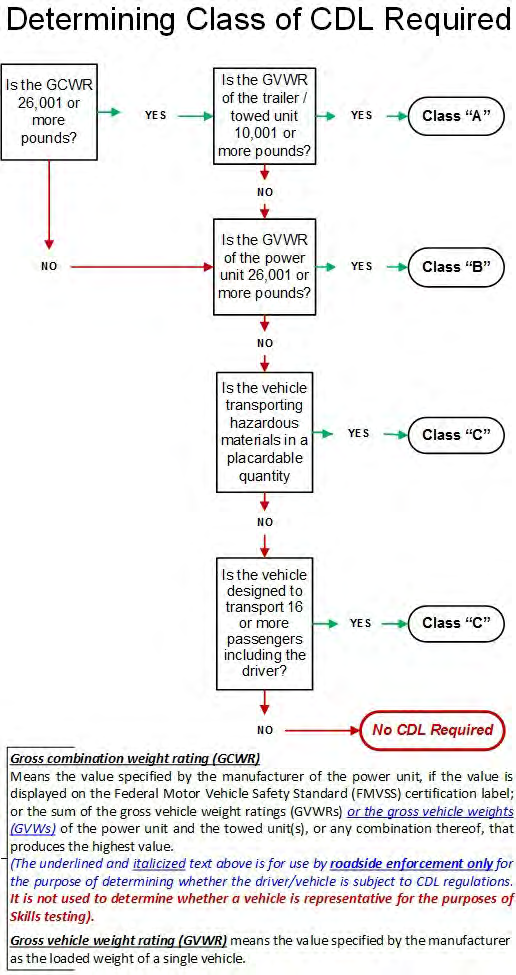
This Section Covers •Commercial Driver License Tests •Medical Requirements •Driver Disqualifications •Other Safety Rules •International Registration Program There is a federal requirement that each state have minimum standards for the licensing of commercial drivers. This manual provides driver license testing information for drivers who wish to have a commercial driver license (CDL). This manual does NOT provide information on all the federal and state requirements needed before you can drive a commercial motor vehicle (CMV). You may have to contact your state driver licensing authority for additional information. You must have a CDL to operate: Any single vehicle with a gross vehicle weight rating (GVWR) of 26,001 pounds or more. A combination vehicle with a gross combination weight rating (GCWR) of 26,001 or more pounds, provided the GVWR of the vehicle(s) being towed is in excess of 10,000 pounds. A vehicle designed to transport 16 or more passengers (including the driver). Any size vehicle which requires hazardous material placards or is carrying material listed as a select agent or toxin in 42 CFR part 73. Federal regulations through the Department of Homeland Security require a background check and fingerprinting for the Hazardous Materials endorsement. Contact your local department of driver licensing for more information. (Your state may have additional definitions of CMVs.) To get a CDL, you must pass knowledge and skills tests. This manual will help you pass the tests, however, it is not a substitute for a truck driver training class or program. Formal training is the most reliable way to learn the many special skills required for safely driving a large commercial vehicle and becoming a professional driver in the trucking industry. Figure 1.1 helps you determine if you need a CDL Figure 1.1 NOTE:A bus may be Class A, B, or C depending on whether the GVWR is over 26,001 pounds or is a combination vehicle.
INTRODUCTION
1.1.1 – Knowledge Tests
On-road Test. You will be tested on your skill to safely drive your vehicle in a variety of traffic situations. The situations may include left and right turns, intersections, railroad crossings, curves, up and down grades, single or multi-lane roads, streets, or highways. The examiner will tell you where to drive. You will have to take one or more knowledge tests, depending on what class of license and what endorsements you need. The CDL knowledge tests include: The general knowledge test, taken by all applicants. Figure 1.2 details which sections of this manual you should study for each particular class of license and for each endorsement. The passenger transport test, taken by all bus driver applicants. The air brakes test, which you must take if your vehicle has air brakes, including air over hydraulic brakes.
What Sections Should You Study? | | | | | | | | |
| | LICENSE TYPE | | | ENDORSEMENT | | | |
| | Class A | Class B | Class C | Hazardous Materials | Double / Triple | Tank Vehicles | Passenger | School Bus
Sections to Study | 1 | X | X | X | | | | |
| 2 | X | X | X | | X | X | X |
| 3 | X | X | X | | | | |
| 4 | | | | | | | X |
| 5* | X | X | X | | X | | |
| 6 | X | | | | X | X | |
| 7 | | | | | X | | |
| 8 | | | | | | X | |
| 9 | | | | X | | X | |
| 10 | | | | | | | | X
| 11 | X | X | X | | | | X | X
| 12 | X | X | X | | | | X | X
| 13 | X | X | X | | | | X | X
*Study section 5 if you plan to operate vehicles equipped with air brakes. | | | | | | | | |
The combination vehicles test, which is required if you want to drive combination vehicles. The hazardous materials test, required if you want to haul hazardous materials as defined in 49 CFR 383.5. In order to obtain this endorsement you are also required to pass a Transportation Security Administration (TSA) background check. The tank vehicle test, required if you want to haul any liquid or gaseous materials in a tank or tanks having an individual rated capacity of more than 119 gallons and an aggregate rated capacity of 1,000 gallons or more that is either permanently or temporarily attached to the vehicle or chassis The doubles/triples test, required if you want to pull double or triple trailers. The School Bus test, required if you want to drive a school bus. 1.1.2 – Skills Tests If you pass the required knowledge test(s), you can take the CDL skills tests. There are three types of general skills that will be tested: Vehicle inspection, basic vehicle control, and on-road driving. You must take these tests in the type of vehicle for which you wish to be licensed. Any vehicle that has components marked or labeled cannot be used for the Vehicle Inspection Test. Vehicle Inspection. You will be tested to see if you know whether your vehicle is safe to drive. You will be asked to do a Vehicle inspection of your vehicle and explain to the examiner what you would inspect and why. Basic Vehicle Control. You will be tested on your skill to control the vehicle. You will be asked to move your vehicle forward, backward, and turn it within a defined area. These areas may be marked with traffic lanes, cones, barriers, or something similar. Figure 1.2 – What to Study 1.1 – Commercial Driver License Tests The examiner will tell you how each control test is to be done. Starting January 30, 2012 and no later than January 30, 2014, if you are applying for a CDL Permit; or are renewing, upgrading, adding endorsements to a CDL; or transferring a CDL from another state, you are required to provide information to your State Driver’s License Agency (SDLA) regarding the type of commercial motor vehicle operation you drive in or expect to drive in with your CDL. Drivers operating in certain types of commerce will be required to submit a current medical examiner’s certificate and/or any medical variance documents that you have been issued (i.e. Vision, Skills Performance or Diabetic waivers, or other exemptions) to your SDLA to obtain a “certified” medical status as part of your driving record. You must contact your State Driver Licensing Agency (SDLA) to obtain information regarding the requirement for submitting these documents. If you are required to have a ”certified” medical status and fail to provide and keep up-to-date your medical examiner’s certificate you become ”not-certified” and may lose your CDL. For the purpose of complying with the new requirements for medical certification, it is important to know how you are using the CMV. The following information will help you decide how to self-certify: 1.2.1 – Interstate or Intrastate Commerce Do you, or will you, use a CDL to operate a CMV in interstate or intrastate commerce? Interstate commerce is when you drive a CMV: From one State to another State or a foreign country; Between two places within a State, but during part of the trip, the CMV crosses into another State or foreign country; or Between two places within a State, but the cargo or passengers are part of a trip that began or will end in another State or foreign country. Intrastate commerce is when you drive a CMV within a State and you do not meet any of the descriptions above for interstate commerce. If you operate in both intrastate commerce and interstate commerce, you must choose interstate commerce. Once you decide whether you will operate in interstate commerce or intrastate commerce, you must decide whether you will operate (or expect to operate) in a non-excepted or excepted status. This decision will tell you to which of the four types of commerce you must self-certify. Interstate Commerce: You operate in excepted interstate commerce when you drive a CMV in interstate commerce only for the following excepted activities: To transport school children and/or school staff between home and school; As Federal, State or local government employees; To transport human corpses or sick or injured persons; Fire truck or rescue vehicle drivers during emergencies and other related activities; Primarily in the transportation of propane winter heating fuel when responding to an emergency condition requiring immediate response such as damage to a propane gas system after a storm or flooding; In Response to a pipeline emergency condition requiring immediate response such as a pipeline leak or rupture; In custom harvesting on a farm or to transport farm machinery and supplies used in the custom harvesting operation to and from a farm or to transport custom harvested crops to storage or market; Beekeeper in the seasonal transportation of bees; Controlled and operated by a farmer, but is not a combination vehicle (power unit and towed unit), and is used to transport agricultural products, farm machinery or farm supplies (no placardable hazardous materials) to and from a farm and within 150 air-miles of the farm; As a private motor carrier of passengers for non-business purposes ; or To transport migrant workers. If you answered yes to one or more of the above activities as the only operation in which you drive, you operate in excepted interstate commerce and do not need a Federal medical examiner’s certificate. 1.2 – Medical Documentation Requirements 1.2.2 – Inter/Intrastate Commerce: Status Non-excepted or Excepted?
Intrastate excepted: I certify that I operate or expect to operate entirely in intrastate commerce, that I am not subject to the medical requirements for my State; and that I am not required to obtain a medical examiner’s certificate. If you operate in both excepted interstate commerce and non-excepted interstate commerce, you must choose non-excepted interstate commerce to be qualified to operate in both types of interstate commerce. 1.3 - CDL Disqualifications Intrastate Commerce: 1.3.1 – General You operate in excepted Intrastate commerce when you drive a CMV only in intrastate commerce activities for which your State of licensure has determined do not require you to meet the State’s medical certification requirements. (contact your SDLA about their requirements). You may not drive a commercial motor vehicle if you are disqualified for any reason. 1.3.2 – Alcohol, Leaving the Scene of an Accident, and Commission of a Felony You operate in non-excepted intrastate commerce when you drive a CMV only in intrastate commerce and are required to meet your State of licensure’s medical certification requirements (contact your SDLA about their requirements). It is illegal to operate a CMV if your blood alcohol concentration (BAC) is .04% or more. If you operate a CMV, you shall be deemed to have given your consent to alcohol testing. If you operate in both excepted intrastate commerce and non-excepted intrastate commerce, you must choose non-excepted intrastate commerce. You will lose your CDL for at least one year for a first offense for: Driving a CMV if your blood alcohol concentration is .04% or higher. 1.2.3 – Self-Certification Statements Driving a CMV under the influence of alcohol. When completing an application for your CDL, you will be required to check the box next to the statement that describes your status. The actual statements on your application may vary from those shown below: Refusing to undergo blood alcohol testing. Driving a CMV while under the influence of a controlled substance. Leaving the scene of an accident involving a CMV. Committing a felony involving the use of a CMV. Interstate non-excepted: I certify that I operate Driving a CMV when the CDL is suspended. or expect to operate in interstate commerce, that I am subject to and meet the Federal DOT medical card requirements under 49 CFR part 391; and that I am required to obtain a medical examiner’s certificate. Causing a fatality through negligent operation of a CMV. You will lose your CDL for at least three years if the offense occurs while you are operating a CMV that is placarded for hazardous materials. Interstate excepted: I certify that I operate or expect to operate in interstate commerce, but engage exclusively in transportation or operations excepted under 49 CFR §§390.3(f), 391.2, 391.68 or 398.3 from all or parts of the qualification requirements of 49 CFR part 391; and that I am not required to obtain a medical examiner’s certificate. You will lose your CDL for life for a second offense. You will lose your CDL for life if you use a CMV to commit a felony involving controlled substances. Intrastate non-excepted: I certify that I operate If you answered no to all of the above activities, you operate in non-excepted interstate commerce and are required to provide a current medical examiner’s certificate (49 CFR 391.45),commonly referred to as a medical certificate or DOT card, to your State Driver Licensing Agency (SDLA). Most CDL holders who drive CMVs in interstate commerce are non-excepted interstate commerce drivers. or expect to operate entirely in intrastate commerce, that I am subject to and meet the medical requirements for my State; and that I am required to obtain a medical examiner’s certificate. 1.3.3 – Serious Traffic Violations For drivers who are always required to stop, failing to stop before driving onto the crossing. Serious traffic violations are excessive speeding (15 mph or more above the posted limit), reckless driving, improper or erratic lane changes, following a vehicle too closely, traffic offenses committed in a CMV in connection with fatal traffic accidents, driving a CMV without obtaining a CDL or having a CDL in the driver’s possession, and driving a CMV without the proper class of CDL and/or endorsements. For all drivers failing to have sufficient space to drive completely through the crossing without stopping. For all drivers failing to obey a traffic control device or the directions of an enforcement official at the crossing. For all drivers failing to negotiate a crossing because of insufficient undercarriage clearance. You will lose your CDL: 1.3.6 – Hazardous Materials Endorsement Background Check and Disqualifications For at least 60 days if you have committed two serious traffic violations within a three-year period involving a CMV. If you require a hazardous materials endorsement you will be required to submit your fingerprints and be subject to a background check. For at least 120 days for three or more serious traffic violations within a three-year period involving a CMV. You will be denied or you will lose your hazardous materials endorsement if you: 1.3.4 – Violation of Out-of-Service Orders Are not a lawful permanent resident of the United States. You will lose your CDL: Renounce your United States citizenship. [For at least 90 days if you have committed your first violation of an out-of-service order. Are wanted or under indictment for certain felonies. For at least one year if you have committed two violations of an out-of-service order in a ten-year period. Have a conviction in military or civilian court for certain felonies. Have been adjudicated as a mental defective or committed to a mental institution. For at least three years if you have committed three or more violations of an out-of-service order in a ten-year period]. Are considered to pose a security threat as determined by the Transportation Security Administration. 1.3.5 – Railroad-highway Grade Crossing Violations The background check procedures vary from jurisdiction to jurisdiction. Your licensing agency will provide you with all the information you need to complete the required TSA background check procedures. You will lose your CDL: For at least 60 days for your first violation. For at least 120 days for your second violation within a three-year period. 1.3.7 – Traffic Violations in Your Personal Vehicle For at least one year for your third violation within a three-year period. The Motor Carrier Safety Improvement Act (MCSIA) of 1999 requires a CDL holder to be disqualified from operating a commercial motor vehicle if the CDL holder has been convicted of certain types of moving violations in their personal vehicle. These violations include violation of a federal, state or local law or regulation pertaining to one of the following six offenses at a railroad-highway grade crossing: For drivers who are not required to always stop, failing to stop before reaching the crossing if the tracks are not clear. You will be put out-of-service for 24 hours if you have any detectable amount of alcohol under .04%. For drivers who are not required to always stop, failing to slow down and check that the tracks are clear of an approaching train.
If your privilege to operate your personal vehicle is revoked, cancelled, or suspended due to alcohol, controlled substance or felony violations, you will lose your CDL for 1 year. If you are convicted of a second violation in your personal vehicle or CMV you will lose your CDL for life. All states are connected to one computerized system to share information about CDL drivers. The states will check on drivers' accident records to be sure that drivers do not have more than one CDL. You are not allowed to hold a mobile telephone to conduct a voice communication or dial a mobile telephone by pressing more than a single button when driving. If your license to operate your personal vehicle is revoked, cancelled, or suspended you may not obtain a “hardship” license to operate a CMV. You are not allowed to send or read text messages while driving. 1.4 – Other CDL Rules You must be properly restrained by a safety belt at all times while operating a commercial motor vehicle. The safety belt design holds the driver securely behind the wheel during a crash, helping the driver to control the vehicle and reduces the chance of serious injury or death. If you do not wear a safety belt, you are four times more likely to be fatally injured if you are thrown from the vehicle. There are other federal and state rules that affect drivers operating CMVs in all states. Among them are: You cannot have more than one license. If you break this rule, a court may fine you up to $5,000 or put you in jail and keep your home state license and return any others. You must notify your employer within 30 days of conviction for any traffic violations (except parking). This is true no matter what type of vehicle you were driving. Your state may have additional rules that you must also obey.
You must notify your motor vehicle licensing agency within 30 days if you are convicted in any other jurisdiction of any traffic violation (except parking). This is true no matter what type of vehicle you were driving. 1.5 – International Registration Plan International Fuel Tax Agreement If you operate a CDL required vehicle in interstate commerce, the vehicle, with few exceptions, is required to be registered under the International Registration Plan (IRP) and the International Fuel Tax Agreement (IFTA). These federally mandated programs provide for the equitable collection and distribution of vehicle license fees and motor fuels taxes for vehicles traveling throughout the 48 contiguous United States and 10 Canadian provinces. You must notify your employer within two business days if your license is suspended, revoked, or canceled, or if you are disqualified from driving. You must give your employer information on all driving jobs you have held for the past 10 years. You must do this when you apply for a commercial driving job. No one can drive a commercial motor vehicle without a CDL. A court may fine you up to $5,000 or put you in jail for breaking this rule. Under the IRP, jurisdictions must register apportioned vehicles which includes issuing license plates and cab cards or proper credentials, calculate, collect and distribute IRP fees, audit carriers for accuracy of reported distance and fees and enforce IRP requirements. If you have a hazardous materials endorsement you must notify and surrender your hazardous materials endorsement to the state that issued your CDL within 24 hours of any conviction or indictment in any jurisdiction, civilian or military, for, or found not guilty by reason of insanity of a disqualifying crime listed in 49 CFR 1572.103; who is adjudicated as a mental defective or committed to a mental institution as specified in 49 CFR 1572.109; or who renounces his or her U. S. citizenship; If your privilege to operate your personal vehicle is revoked, cancelled, or suspended due to violations of traffic control laws (other than parking violations) you will also lose your CDL driving privileges. Your employer may not let you drive a commercial motor vehicle if you have more than one license or if you’re CDL is suspended or revoked. A court may fine the employer up to $5,000 or put him/her in jail for breaking this rule.
- 1) Having two axles and a gross vehicle weight or registered gross vehicle weight exceeding 26,000 pounds or 11,797 kilograms; or
- 2) Is used in combination, when the weight of such combination exceeds 26,000 pounds or 11,797 kilograms gross vehicle or registered gross vehicle weight. Qualified Motor Vehicle does not include recreational vehicles. If the vehicle you operate is registered under IRP and you are a motor carrier licensed under IFTA, then you are required to comply with the mandatory record keeping requirements for operating the vehicle. A universally accepted method of capturing this information is through the completion of an Individual Vehicle Distance Record (IVDR), sometimes times referred to as a Driver Trip Report. This document reflects the distance traveled and fuel purchased for a vehicle that operates interstate under apportioned (IRP) registration and IFTA fuel tax credentials. The basic concept behind IFTA is to allow a licensee (motor carrier) to license in a base jurisdiction for the reporting and payment of motor fuel use taxes. Under the IFTA, a licensee is issued one set of credentials which will authorize operations through all IFTA member jurisdictions. The fuel use taxes collected pursuant to the IFTA are calculated based on the number of miles (kilometers) traveled and the number of gallons (liters) consumed in the member jurisdictions. The licensee files one quarterly tax return with the base jurisdiction by which the licensee will report all operations through all IFTA member jurisdictions. It is the base jurisdiction's responsibility to remit the taxes collected to other member jurisdictions and to represent the other member jurisdictions in the tax collection process, including the performance of audits. Although the actual format of the IVDR may vary, the information that is required for proper record keeping does not. An IFTA licensee must retain records to support the information reported on the IFTA quarterly tax return In order to satisfy the requirements for Individual Vehicle Distance Records, these documents must include the following information: The IRP registrant and the IFTA licensee may be the vehicle owner or the vehicle operator. Distance The requirement for acquiring IRP plates for a vehicle and IFTA license for a motor carrier is determined by the definitions from the IRP Plan and the IFTA for Qualified Vehicle and Qualified Motor Vehicle: Per Article IV of the IRP Plan (i) Date of trip (starting and ending) (ii) Trip origin and destination – City and State or Province (iii) Route(s) of travel (iv) Beginning and ending odometer or For purposes of IRP: hubometer reading of the trip (v) Total distance traveled (vi) In-Jurisdiction distance (vii) Power unit number or vehicle identification A Qualified Vehicle is (except as provided below) any Power Unit that is used or intended for use in two or more Member Jurisdictions and that is used for the transportation of persons for hire or designed, used, or maintained primarily for the transportation of property, and: number. Fuel Per Section P560 of the IFTA Procedures Manual .300 An acceptable receipt or invoice must (i)has two Axles and a gross Vehicle weight or registered gross Vehicle weight in (ii)excess of 26,000 pounds (11,793.401 kilograms), or (iii)has three or more Axles, regardless of weight, include, but shall not be limited to, the following: .005 Date of purchase .010 Seller's name and address .015 Number of gallons or liters purchased; .020 Fuel type .025 Price per gallon or liter or total amount of or (iv)is used in combination, when the gross Vehicle weight of such combination exceeds 26,000 pounds (11,793.401 kilograms). sale .030 Unit number or other unique vehicle identifier Registrant responsibilities under the Plan include applying for IRP registration with base jurisdiction, providing proper documentation for registration, paying appropriate IRP registration fees, properly displaying registration credentials, maintaining accurate distance records, and making records available for jurisdiction review. While similar, the Qualified Motor Vehicle in IFTA means a motor vehicle used, designed, or maintained for transportation of persons or property and: An example of an IVDR that must be completed in its entirety for each trip can be found in Figure 1 below. Each individual IVDR should be filled out for only one vehicle. The rules to follow when trying to determine how and when to log an odometer reading are the following: The IVDR serves as the source document for the calculation of fees and taxes that are payable to the jurisdictions in which the vehicle is operated, so these original records must be maintained for a minimum of four years. At the beginning of the day When leaving the state or province At the end of the trip/day Not only do the trips need to be logged, but the fuel purchases need to be documented as well. You must obtain a receipt for all fueling and include it with your completed IVDR. In addition, these records are subject to audit by the taxing jurisdictions. Failure to maintain complete and accurate records could result in fines, penalties and suspension or revocation of IRP registrations and IFTA licenses. Make sure that any trips that you enter are always filled out in descending order and that your trips include all state/provinces that you traveled through on your route. For additional information on the IRP and the requirements related to the IRP, contact your base jurisdiction motor vehicle department or IRP, Inc. the official repository for the IRP. Additional information can be found on the IRP, Inc. website at www.irponline.org. There is a training video on the website home page available in English, Spanish and French There are different routes that a driver may take, and most of the miles may be within one state or province. Whether or not the distance you travel is primarily in one jurisdiction or spread among several jurisdictions, all information for the trip must be recorded. This includes the dates, the routes, odometer readings and fuel purchases. For additional information on IFTA and the requirements related to IFTA, contact the appropriate agency in your base jurisdiction. You will also find useful information about the Agreement at the official repository of IFTA at http://www.iftach.org/index.php. Figure 1 – Individual Vehicle Mileage & Fuel Record (Example)
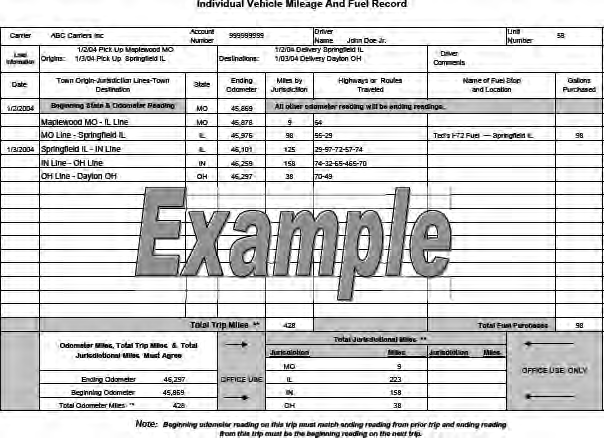
.035 Purchaser's name By completing this document in full and keeping all records required by both the IRP and the IFTA, you will have ensured that you and your company are in compliance with all State and Provincial laws surrounding fuel and distance record keeping requirements.