Section 1 of 13
Introduction
Introduction
Commercial
Drivers License Manual
Class A - Class B - Class C
2017 - 2019
Prepared by
NORTH DAKOTA DEPARTMENT OF TRANSPORTATION BISMARCK, NORTH DAKOTA www.dot.nd.gov
DRIVERS LICENSE DIVISION Glenn E. Jackson
DL0717 It is NDDOT's policy that all employees have the right to work in an environment free of harassment. An employee may discontinue service to a customer if the customer subjects the employee to conduct, communication, or sexually explicit paraphernalia which may interfere with the employee's work performance or create a hostile, intimidating, or offensive work environment. Under Title VI of the Civil Rights Act of 1964, and its related statutes and regulations, no person or groups of persons shall, on the grounds of race, color, national origin, sex, age, disability, or income status, be excluded from participation in, be denied the benefits of, or be otherwise subject to discrimination under any and all programs, services, or activities administered by the North Dakota Department of Transportation. North Dakota Information . . . . . . . . . . . . . . . . . . . . . . . . . . . . . . . . . . . . . . . . . . . . . . . . . 1 Introduction. . . . . . . . . . . . . . . . . . . . . . . . . . . . . . . . . . . . . . . . . . . . . . . . . . . . . . . . . . . . 1-1 Driving Safely . . . . . . . . . . . . . . . . . . . . . . . . . . . . . . . . . . . . . . . . . . . . . . . . . . . . . . . . . . 2-1 Transporting Cargo Safely. . . . . . . . . . . . . . . . . . . . . . . . . . . . . . . . . . . . . . . . . . . . . . . . . 3-1 Transporting Passengers Safely. . . . . . . . . . . . . . . . . . . . . . . . . . . . . . . . . . . . . . . . . . . . 4-1 Airbrakes. . . . . . . . . . . . . . . . . . . . . . . . . . . . . . . . . . . . . . . . . . . . . . . . . . . . . . . . . . . . . . 5-1 Combination Vehicles. . . . . . . . . . . . . . . . . . . . . . . . . . . . . . . . . . . . . . . . . . . . . . . . . . . . 6-1 Doubles and Triples. . . . . . . . . . . . . . . . . . . . . . . . . . . . . . . . . . . . . . . . . . . . . . . . . . . . . . 7-1 Tank Vehicles. . . . . . . . . . . . . . . . . . . . . . . . . . . . . . . . . . . . . . . . . . . . . . . . . . . . . . . . . . 8-1 Hazardous Materials. . . . . . . . . . . . . . . . . . . . . . . . . . . . . . . . . . . . . . . . . . . . . . . . . . . . . 9-1 School Buses. . . . . . . . . . . . . . . . . . . . . . . . . . . . . . . . . . . . . . . . . . . . . . . . . . . . . . . . . . 10-1 Pre-Trip Vehicle Inspection Test . . . . . . . . . . . . . . . . . . . . . . . . . . . . . . . . . . . . . . . . . . . . 11-1 Basic Vehicle Control Skills Test. . . . . . . . . . . . . . . . . . . . . . . . . . . . . . . . . . . . . . . . . . . . 12-1 On-Road Driving. . . . . . . . . . . . . . . . . . . . . . . . . . . . . . . . . . . . . . . . . . . . . . . . . . . . . . . . 13-1 Table of Contents The North Dakota commercial driver license require ments in compliance with the Commercial Motor Ve hicle Safety Act requires minimum testing standards for the licensing of commercial drivers. You must have a commercial drivers license (CDL) to operate:
- • A single vehicle with a gross vehicle weight rating or gross vehicle weight of 26,001 pounds or more, whichever is greater.
- • A combination vehicle with a gross combination weight rating or gross combination weight of 26,001 pounds or more, whichever is greater, provided the towed unit has a gross vehicle weight rating or gross vehicle weight of 10,001 pounds or more, whichever is greater.
- • A bus designed to transport 16 or more passengers, including the driver.
- • Any vehicle that transports hazardous materials re quiring placarding or any quantity of a material listed as a select agent or toxin in 42 CFR part 73. A special endorsement is also required to drive any:
- • Tank vehicle.
- • Passenger transport vehicle (bus).
- • Double/triple trailer combination.
- • Placarded vehicle transporting hazardous materials or wastes or material listed as a select agent or toxin in 42 CFR part 73.
- • School bus. LEGAL AGE
- • If you are less than 18 years of age you cannot be issued a Class A, B, or C license, except a Class A, B, or C license may be issued to a person at least 16 years of age for custom harvesting purposes only.
- • You must be at least 21 years of age to drive a com mercial vehicle across state lines (interstate). MEDICAL QUALIFICATIONS To continue to be medically qualified to operate a commercial motor vehicle, you must be medically examined by a US licensed health care provider ev ery 24 months, or less pending health care provider recommendations. North Dakota state law requires that if any licensed Class A, B, or C operator suffers permanent loss or damage of a hand, arm, foot, leg, or eye, he or she must make a report of explanation to the Drivers Li cense Division. MEDICAL CERTIFICATE REQUIREMENTS Federal Motor Carrier Safety regulations (49 CFR 383. 73) require certain Commercial Driver License (CDL) holders to mail, fax, or email a copy of their Medical Certificate to the Drivers License agency that issued the CDL. This must be done at least 10 days prior to visiting a driver license site for your CDL re newal or CDL testing. A medical certificate is also re quired even during times you are not actively driving commercial motor vehicles. If you are required to send a copy of your medical cer tificate to the Drivers License Division, failure to do so will result in downgrading your commercial driving privileges to noncommercial driving privileges only. Downgrading will also occur if you allow your medical certificate to expire. Please mail, fax, or email a copy of your medical certificate to: Drivers License Division 608 East Boulevard Avenue Bismarck, ND 58505-0750 or Fax to 701-328-0308 Email with a pdf attachment to: dotmedcerts@nd. gov NOTE: If sending medical certificates for more than one driver, use a separate fax or pdf attach ment for each driver. How do I know if this applies to me? There are four categories of CDL drivers. Only Cat egory 1 (Interstate and subject to 49 CFR part 391) drivers are required to mail or fax a copy of their medi cal certificate to our office. What is deemed Interstate transportation? Interstate is defined as: North Dakota tions that may disqualify an individual from obtaining a commercial permit or license are: heart condition, hearing impairment, worse than 20/40 visual acuity in either eye, insulin controlled diabetes, epilepsy, narco lepsy, and loss of (or impairment of) a limb. Information All commercial drivers (including bus drivers) must meet the federal commercial medical requirements in 49 CFR 391. This includes drivers of vehicles greater than 10,000 GVWR that are used in interstatecom merce, vehicles greater than 10,000 GVWR used in intrastate commerce if transporting hazardous ma terials requiring placards or if the vehicle is designed to transport 16 or more persons, including the driver, and vehicles greater than 26,000 GVWR that are used in intrastate commerce. Some of the medical condi
- • Trade, traffic, or transportation between a place in a state and a place outside of such state including a
- • Trade, traffic, or transportation between two places in a state as part of trade, traffic, or transportation origi nating or terminating outside the state or the United States. NOTE: Even though you may not actually be crossing state lines, you are still deemed an interstate driver if any part of your load originated or is terminating outside of North Dakota. To assist you in determining if you need to send a copy of your medical certificate to our office, see the Cat egory Chart CATEGORY CHART All Class A, B, or C (CDL) License holders and those applying for a Class A, B, or C permit that fall under Category 1 must send a copy of their medical certifi cate to the Drivers License Division in Bismarck. Category 1: Interstate and subject to 49 CFR part 391.A copy of the Medical Certificate must be mailed, faxed, or emailed to the North Dakota Drivers License Division.
- • All Class A, B, and C drivers who do NOT fall under any of the other categories.
- • All Class A, B, and C drivers granted a federal vision or diabetes exemption; or federal SPE-limb impair ment Skill Performance Evaluation. Category 2: Interstate, but operating exclusively in transportation or operations excepted under 49 CFR 390.3(f), 390.5, 391.2, 391.68, or 398.3.Medi cal monitoring may be required by the North Dakota Drivers License Division pending certain medical conditions.
- • School bus operations crossing state lines. Medical Certificate must be carried by the school bus driver. Do not send it to our office.
- • Transportation performed by the federal government, a state, or any political subdivision of a state.
- • Occasional transportation of personal property by individuals not for compensation, nor in the further ance of a commercial enterprise.
- • The transportation of human corpses or sick and in jured persons.
- • The operation of fire trucks and rescue vehicles while involved in emergency and related operations.
- • Farm custom operations (Custom Harvesters).
- • Non-articulated farm vehicle drivers operating within a 150-mile radius of the farm.
- • Covered Farm Vehicles displaying farm plates/CFV designation (straight trucks and articulated vehicles). If more than 26,001 pounds, the driver may operate within home state, and if crossing state lines, within a 150-mile radius of owner or operator’s farm or ranch. If 26,001 pounds or less, the driver may operate any where in the U. S.
- • Private motor carrier of passengers (nonbusiness). For example, organizations exempt from the Internal Revenue Code that provide transportation for their members.
- • Emergency delivery of propane winter heating fuel and pipeline response.
- • Drivers of migrant workers (must meet minimum medical standards only; 49 CFR 398. 3). Category 3: Intrastate and subject to State driver qualification requirements. Medical Certificate must be carried by the driver. Do not send it to our office.
- • North Dakota drivers granted a State Waiver for vi sion and insulin controlled diabetes (Restriction K; CDL is valid for Intrastate only).
- • In-state drivers of vehicles over 26,000 pounds, placarded hazardous material, vehicles designed to transport 16 or more persons including the driver, school vehicles designed to seat 10 or more passen gers, and school bus drivers who do not cross state lines (Restriction K; CDL is valid for Intrastate only). Category 4: Intrastate, but operating exclusively in transportation or operations excepted from all or part of the State driver qualification requirements. No medical certificate required. Medical monitoring may be required by the North Dakota Drivers License Division pending certain medical conditions.
- • Bonafide farmer operating articulated farm vehicles within a 150-mile radius of the farm and does NOT cross state lines (Restriction K; CDL is valid for Intra state only).
- • Farmer or rancher operating a covered farm vehicle displaying farm plates/CFV designation (straight trucks and articulated) within North Dakota only. (Re striction K; CDL is valid for Intrastate only). place outside of the United States; or ing less than 26,001 GVWR, and not for compensa tion.
- • Trade, traffic, or transportation between two places in a state through another state or a place outside of the United States; or
- • Apiarian industries (Beekeepers).
- • Business vehicles 10,001 to 26,000 pounds GVWR that do NOT cross state lines, do NOT transport
- • A 9 to 15 passenger van, including the driver, weigh NORTH DAKOTA DRIVER LICENSE CLASSES CLASS A Any combination of vehicles with a gross combination weight rating or gross vehicle weight of 26,001 pounds or more whichever is greater, provided the vehicle be ing towed has a gross vehicle weight rating or gross vehicle weight of 10,001 pounds or more, whichever is greater. (May also operate Class B, C, and D vehicle groups, but not a Class M unless endorsed. ) CLASS B Any single vehicle with a gross weight rating or gross vehicle weight of 26,001 pounds or more, whichever is greater. May tow a vehicle not in excess of 10,000 pounds. (May also operate Class C and D vehicle groups, but not a Class M unless endorsed. CLASS C Any single vehicle with a gross vehicle weight rating of 26,000 pounds or less that is designed to transport 16 or more passengers, including the driver or is trans porting hazardous materials under 49 CFR part 172 (placarded materials) and 42 CFR part 73. May tow a vehicle not in excess of 10,000 pounds. (May also operate a Class D vehicle but not a Class M unless endorsed. ) CLASS D (NONCOMMERCIAL DRIVER LICENSE) Any single vehicle less than 26,001 pounds gross ve hicle weight rating may tow trailers not over 10,000 pounds gross vehicle weight rating. Note: Must be 18 years of age or older if combined weight exceeds 26,000 pounds. Trucks towing trailers over 10,000 pounds provided the combined weight does not ex ceed 26,000 gross combination weight rating. (Holders of a Class D license may not operate a Class M vehicle unless endorsed. )
- • An operator with a Class D license may operate a farm tractor towing another vehicle having a gross weight in excess of 10,000 pounds.
- • A Class D license holder may operate a house car or vehicle towing a house trailer or mobile home used solely for personal rather than commercial purposes.
- • A Class D license holder may operate a fire truck or other emergency vehicle, vehicles during declared emergency snow and ice removal, and vehicles driven by active duty members for military purposes. A Class D license holder age 16 and older may oper ate a two-axle, tandem axle, or triple-axle truck towing a trailer (but not double or triple trailers) and if age 18 and older may operate a truck-tractor towing a trailer (but not double or triple trailers) transporting agricul tural products, farm machines, or farm supplies to or from a farm within 150 miles of the person’s farm. A Class D license holder may operate a farm vehicle if the vehicle is controlled and operated by a farmer and used to transport hazardous materials in the form of farm supplies within 150 miles of the farm and is not used in the operations of a common or contract carrier. Covered Farm Vehicle Exemption (49 CFR 390.5) A Class D license holder may operate a covered farm vehicle defined in 49 CFR 390.5. This is a vehicle op erated by an owner or operator of a farm or ranch, or by a family member or employee of the owner or op erator used to transport agricultural commodities, live stock, machinery, or supplies to or from a farm or a ranch, is not used in for-hire motor carrier operations, and is not transporting hazardous materials that re quire placarding. The vehicle must have a license plate or other designation specified by the state that clearly identifies it as a farm vehicle. A covered farm vehicle and its operator are exempt from the following federal regulations:
- • Part 382 (Controlled Substances and Alcohol Use and Testing)
- • Part 383 (Commercial Driver’s License Standard; Requirements and Penalties)
- • Part 391 (Subpart E- Physical Qualifications and Ex aminations)
- • Part 395 (Hours of Service of Drivers)
- • Part 396 (Inspection, Repair, and Maintenance) A covered farm vehicle with a Gross Vehicle Weight (GVW) or Gross Vehicle Weight Rating (GVWR), whichever is greater, of 26,001 pounds or less may be operated anywhere in the United States. A covered farm vehicle with a GVW or GVWR, which ever is greater, of more than 26,001 pounds may be operated within the state where it is registered, or if travelling outside of the state, within 150 air miles of the owner or operator’s farm or ranch. CLASS M Farm Exemption (NDCC 39-06.2-06; 39-06.2-09) hazardous material that requires placarding, and are NOT designed to transport 16 or more persons, including the driver. (Restriction K; CDL is valid for Intrastate only). A Class D license holder age 15 may operate a farm truck within 150 miles of the driver’s farm, having a gross weight of not more than 50,000 pounds, when transporting agricultural products or farm supplies. Any two- or three-wheeled motorcycle. All applicants for a Hazardous Materials endorse ment must provide proof of citizenship or immigration status as specified in Table 1 to 49 CFR 383.71 and are subject to a Transportation Security Administration security screening process that includes fingerprint and background record checks (USA Patriot Act). See page 11 for more information.
Status | Proof of Status
U.S. Citizen Lawful Permanent Resident | • Valid, unexpired U. S. Passport • Consular Report of Birth Abroad (CRBA) issued by the U. S. Department of State. • Certificate of Naturalization issued by the U. S. Department of Homeland Security (DHS). • Certificate of Citizenship issued by DHS. • Valid, unexpired Permanent Resident Card, issued by USCIS or INS.
ENDORSEMENTS Hazardous Material H - A hazardous material endorsement is required to operate a commercial motor vehicle transport ing hazardous material that requires placarding by federal regulation or any quantity of a material listed as a select agent or toxin in 42 CFR part
- 73. The federal background check and written test must be passed each time you renew your com mercial drivers license if you wish to retain this en dorsement. (Requires a knowledge test. ) Tank Vehicle Passenger Bus P - A passenger bus endorsement is required to op erate a passenger bus designed to transport 16 or more persons, including the driver. (Requires a knowledge test and road test in a representative vehicle. ) Doubles or Triples T - A doubles/triples endorsement is required to oper ate a commercial vehicle towing two or three trail ers. (Requires a knowledge test. ) School Bus S - A school bus endorsement is required to operate a school bus designed to transport 16 or more pas sengers, including the driver, and is used to trans port pre-primary, primary, or secondary school stu dents from home to school, from school to home, or to and from school-related events. School bus does not include a bus used as a common car rier. (Requires a knowledge test and road test in a representative school bus that is equipped with flashing red lights for loading and unloading school children. ) Additional Endorsement Information ENDORSEMENT/RESTRICTION DESCRIPTIONS to transport any liquid or gaseous material within a tank or tanks having an individual rated capacity of more than 119 gallons and an aggregate rated capacity of 1,000 gallons or more that is either per manently or temporarily attached to the vehicle or the chassis. A commercial motor vehicle transport ing an empty storage container tank, not designed for transportation, with a rated capacity of 1,000 gallons or more that is temporarily attached to a flatbed trailer is not considered a tank vehicle. In summary, if you are hauling multiple tanks each rated more than 119 gallons AND the combined volume of those tanks is 1,000 gallons or more, you need an N endorsement. If you are only haul ing one tank and that one tank is 1,000 gallon ca pacity or more, you need an N endorsement. (Re quires a knowledge test. ) All persons who operate a Class A, B, or C vehicle of a type or size having the following specialized equip ment, or vehicle transportation needs, must pass ad ditional knowledge and skill tests. The H and T endorsements are not allowed on Com mercial Learner’s Permits. The P and S endorsements are allowed on Commercial Learner’s Permits how ever no passengers, other than the supervising driver or driver examiner, are allowed. The N endorsement is allowed on Commercial Learner’s Permits, however it is restricted to “empty tanks only. ” If you pass the road test in a bus less than 26,001 gross vehicle weight rat ing, your license will be restricted to “No Class A or B buses. ” If you pass the road test in a single unit bus with a gross vehicle weight rating of 26,001 pounds or more, your license will be restricted to “No Class A buses. ” N - A tank vehicle endorsement is required to oper ate a commercial motor vehicle that is designed AIRBRAKES RESTRICTION Drivers of Class A, B, or C vehicle groups will be re stricted from operating commercial vehicles equipped with an airbrakes system, unless and until they suc cessfully pass an airbrakes knowledge test and a skill test in a vehicle equipped with either a full or partial airbrake system. CDL Specific Restrictions E No Manual Transmission Equipped CMV K CDL for Intrastate Only L No Airbrake equipped CMV M No Class A Passenger Bus N No Class A or B Passenger Bus O No Tractor-Trailer CMV P No passengers allowed on Learners Permit with P and/or S endorsement V Medical Variance X Only Empty Tanks are allowed on Learners Permit with the N endorsement Z No Full Airbrake Equipped CMV CDL RULES There are federal and state rules which affect com mercial driver license holders. See Section One for ad ditional driver disqualifications. For a first conviction of driving while under the influ ence of alcohol or being under the influence of a con trolled substance or refusal to be tested while operating a noncommercial motor vehicle, a commercial driver’s license or permit holder must be disqualified from op erating a commercial motor vehicle for one year. For a second or subsequent conviction for leaving the scene of an accident while operating a noncommercial motor vehicle, a commercial driver’s license or permit holder must be disqualified from operating a commer cial motor vehicle for life. For a first conviction for using a vehicle to commit a felony while operating a noncommercial motor vehicle, a commercial driver’s license or permit holder must be disqualified from operating a commercial motor vehicle for one year. For a second or subsequent conviction for using a vehicle to commit a felony while operating a noncom mercial motor vehicle, a commercial driver’s license or permit holder must be disqualified from operating a commercial motor vehicle for life. You will lose your CDL for life on a second or subse quent major offense. For a conviction for using a vehicle in the commission of a felony involving manufacturing, distributing, or dispensing a controlled substance while operating a commercial motor vehicle or a noncommercial motor vehicle, a commercial driver’s license or permit holder must be disqualified from operating a commercial mo tor vehicle for life. A person is disqualified from driving a commercial motor vehicle for a period of not less than 60 days if convicted of any combination of two serious traffic violations within a three-year period while operating a noncommercial motor vehicle, and either conviction results in the revocation, cancellation, or suspension of an operator’s license, including a commercial driv er’s license. A person is disqualified from driving a commercial mo tor vehicle for a period of not less than 120 days if convicted of any combination of three or more serious traffic violations within a three-year period while oper ating a noncommercial motor vehicle, and any of the convictions result in the revocation, cancellation, or suspension of an operator’s license, including a com mercial driver’s license. SERIOUS TRAFFIC VIOLATIONS
- • You will lose your CDL: > > For at least 60 days if you have committed two se rious traffic violations within a three-year period involving a CMV. > > For at least 120 days for three serious traffic vio Pursuant to the limitations imposed by 49 CFR part 383. 3, the holder of a Class A commercial driver’s li cense is exempt from the hazardous materials en dorsement, if the license holder is acting within the scope of the license holder’s employment, and within the State of domicile (or another State with a hazardous materials endorsement exemption) as an employee of a custom harvester operation, agrichemical business, farm retail outlet and supplier, or livestock feeder; and is operating a service vehicle that is transporting diesel in a quantity of 1,000 gallons (3,785 liters) or less; and is clearly marked with a “flammable” or “combustible” placard, as appropriate. For a first conviction for leaving the scene of an ac cident while operating a noncommercial motor vehicle, a commercial driver’s license or permit holder must be disqualified from operating a commercial motor vehicle for one year. For a second or subsequent conviction of driving while under the influence or being under the influence of a controlled substance or refusal to be tested while op erating a noncommercial motor vehicle, a commercial driver’s license or permit holder must be disqualified from operating a commercial motor vehicle for life. lations within a three-year period involving a CMV. IMPLIED CONSENT If you operate a CMV, you shall be deemed to have given your consent to alcohol testing for the above mentioned violations. Refusal to take such test will re sult in license revocation for a period of not less than one year. DRIVER’S LOG A driver’s log must be used to record all drivers’ hours. Drivers of commercial vehicles must be in compliance with the log requirements of CFR, Title 49, Section 395. 8. DEPARTMENT OF TRANSPORTATION REQUIREMENTS INTER-STATE AUTHORITY Hours of Service
- • Operations of commercial motor vehicles must stay within the limit of hours of service. Some exceptions apply.
- • For the most current Interstate hours of service and exceptions, visit www. fmcsa. dot. gov or contact: Federal Motor Carrier Safety Administration 1471 Interstate Loop Bismarck, North Dakota 58503 Telephone: (701) 250-4346
- • For the most current Intrastate hoursof service and exceptions, visit www. nd. gov/ndhp or contact the North Dakota Highway Patrol at (701) 328-2455. NORTH DAKOTA SIZE AND LOAD REQUIREMENTS WIDTH In general, the total outside width of any vehicle cannot exceed eight feet, six inches. No load may extend beyond the fender lines on the left side of your vehicle, nor more than 12 inches beyond the right fender lines. HEIGHT The maximum height for any vehicle is 14 feet. Resident farmers, ranchers, implement dealers, or farm machinery manufacturers may move implements of husbandry, with height limitations not exceeding 15 feet 6 inches, when traveling within a 60-mile radius, between sunrise and sunset, provided the move is not on an interstate highway. On the state highway system, there are several clear ances below the legal vehicle height limit. Contact the State Highway Patrol for the exact locations. LENGTH Length limitations depend on the type of vehicle involved.
- • A single unit vehicle with two or more axles cannot exceed a length of 50 feet including the load.
- • The length of a towed vehicle may not exceed a length of 60 feet or a trailer length of 53 feet.
- • A combination of three or four units may not exceed 75 feet in total length. A combination of three or four units may not exceed 75 feet in total length including the load. The only three- or four-unit combinations allowed are: > > A truck-tractor and semi-trailer pulling a trailer or semi-trailer. > > A vehicle pulling three motor vehicles attached by a triple saddle mount. > > A truck may draw two trailers, subject to any rules adopted by the director. > > A truck-tractor and semi-trailer may draw two trail ers, subject to any rules adopted by the director. > > A motor vehicle may draw two trailers or vehicles, subject to any rules adopted by the director. On specific highways in the state designated by the Department of Transportation director, a combination of two, three, or four units including the load may have a total length of 110 feet or less. All such combinations are subject to safety rules adopted by the director. Serious traffic violations committed in a CMV are excessive speeding (15 mph or more above the posted limit), reckless driving, improper or erratic lane changes, following a vehicle too closely, traffic of fenses in connection with fatal traffic accidents, driving a commercial motor vehicle without obtaining a com mercial driver’s license/permit, driving a commercial motor vehicle without a commercial driver’s license/ permit in the driver’s possession (an individual who provides proof to the enforcement authority that issued the citation, by the date the individual must appear in court or pay a fine for such violation, that the individual held a valid commercial driver’s license/permit on the date the citation was issued, is not guilty of this of fense), driving a commercial motor vehicle without the proper class of commercial driver’s license/permit or endorsement, or both, for the specific vehicle group being operated or for the passengers or type of cargo being transported, and texting while driving, and using a hand-held mobile telephone while driving. Special permits for overlength, overwidth, overheight, and overweight vehicles may be granted on an indi vidual basis by the North Dakota State Highway Patrol. WIDTH, HEIGHT, LENGTH, AND WEIGHT REQUIREMENTS Certain vehicles are exempt from the length restrictions:
- • Vehicles or equipment owned and operated by the armed forces of the United States or the North Da kota National Guard.
- • Structural material belonging to telephone, power, and telegraph companies. DRAWBAR The drawbar or connection between any two vehicles, one of which is towing or drawing the other on a high way, shall be of such design, strength, and construc tion so as to prevent the unintentional uncoupling of the vehicles. Safety chains must be used when towing in excess of 25 mph with the exception of fifth wheel coupling devices. WEIGHT Maximum weight limits vary according to the number of axles on your truck and the distance between them. Ax les 40 inches apart or less are considered to be one axle. Single axle vehicles may carry a maximum load of 20,000 pounds or a wheel load of 10,000 pounds. Axles spaced more than 40 inches and less than eight feet apart (tandem axles) are allowed 19,000 pounds per axle, but gross weight of a tandem grouping may not exceed 34,000 pounds or 48,000 pounds on a grouping of three or more axles. The maximum gross weight on the state highways is 105,500 pounds, unless posted for less. 80,000 pounds is the maximum gross weight on the interstate system without a permit. 80,000 pounds is the maxi mum gross weight on all other highways unless desig nated for more, not to exceed 105,500 pounds. The wheel load can never be more than 550 pounds per inch of tire width except that such limits may not be applied to tires on the steering axle. Steering axle weights are limited to 20,000 pounds or the axle ratings established by the manufacturer, which ever is lower. The Governor may permit and prescribe definite ex cess limitations as to size and weight for the operation of motor vehicles in emergencies and to meet unusual conditions for the general welfare of the public. Any police officer or state highway patrol officer may weigh vehicles, and the load carried thereon, by means of portable or stationary scales, and may require the ve hicle to be driven to the nearest scales for that purpose. LOAD REQUIREMENTS
- • No load may extend beyond the fender lines on the left side of your vehicle, nor more than 12 inches be yond the right fender lines. LOAD REQUIREMENTS FOR SCHOOL BUSES The number of passengers being transported on any passenger or school bus shall not exceed the number designed by the manufacturer. The operator of a school bus equipped with amber caution lights may activate those lights at a distance of not less than 300 feet, nor more than 500 feet before stopping to receive or discharge school children. The overhead red flashing lights on a school bus shall be activated whenever the bus is stopped on a high way outside the limits of a city for the purpose of re ceiving or discharging school children. The red flashing lights may be activated when permit ting school children to board or alight from a school bus within the city limits except when the bus is stopped at intersections controlled by traffic signals or police offi cers. The operator must also be sure that there are no city ordinances prohibiting the use of the red flashing lights. Whenever the school bus is stopped for the purpose of loading or unloading passengers, the vehicle shall be shifted into neutral gear (in the case of an automatic transmission, the vehicle shall be shifted into the park position), and the emergency brake shall be set. The entrance door may not be opened until the bus has made a complete stop. No passenger shall be permitted to get on or off the bus while it is in motion. The flashing red lights shall be activated only when it is observed that all oncoming or following traffic can stop safely before reaching the stopped bus. Indiscriminate use of the flashing red lights will defeat the purpose for which they are designed. It is unlawful to use the red flashing lights on any school bus for any purpose other than loading or un loading passengers. See School Bus Student Discharge in Section 13.1.10 of this manual. EQUIPMENT REQUIRED ON SCHOOL BUSES
- • Equipment designed to move buildings.
- • In daylight hours, tie a 12-inch square red cloth to the end of the load.
- • Emergency tow trucks towing legal combinations of vehicles to be repaired.
- • At night or in times of poor visibility, attach a red light on the end of the load. The light must be visible for 600 feet. The Department of Public Instruction may adopt rea sonable regulations as to the construction, design, op eration, equipment, and color of school buses. These Whenever a load projects four or more feet be yond the rear of your vehicle, you must take special precautions: BUS EQUIPMENT AND STANDARDS
- • Each school bus must have the standard school bus glossy yellow color on the exterior.
- • The words “School Bus” in letters eight inches in height must be printed on the front and rear of each school bus.
- • The words “School Bus” must be covered or re moved if the bus is used for any purpose other than transporting school children.
- • Every school bus must be equipped with a sign on the rear of the bus containing the words “THIS SCHOOL BUS STOPS AT ALL RAILROAD CROSSINGS. ”
- • Buses must not carry more passengers than the ve hicle is designed to transport. Each passenger must be comfortably seated.
- • All seats in the school bus must face forward.
- • Each passenger bus must be equipped with an emergency exit door. No passenger shall be allowed to use the emergency exit except in the case of an emergency or for the purpose of conducting an evac uation drill.
- • Studded tires may be used on any vehicle from Oc tober 15 to April 15 each year. A school bus may be equipped with studded tires at any time during the year when transporting school children.
- • School buses manufactured after July 31, 1998, must be equipped with safety strobe lights. The strobe light must be in operation whenever the school bus is being operated upon a highway for purposes of transporting children either to or from school or for a school-sanctioned activity. It is unlawful to operate a safety strobe light when the school bus is used for any other purpose. RAILROAD CROSSING STOPS
- • The operator of a bus carrying passengers, or any school bus, shall activate the hazard lights approxi mately 200 feet before the crossing.
- • The driver shall stop the bus between 15-50 feet be fore the nearest rail of the railroad crossing.
- • After stopping, the operator of a school bus must open the entrance door, look, and listen for any on coming train, and not change gears while crossing the tracks.
- • Read, write, and speak the English language.
- • Pass the required knowledge test or tests corre sponding to the type and class of vehicle to be driven.
- • Demonstrate your ability to operate your vehicle by passing a road test.
- • Must not be addicted to alcohol, narcotic drugs, or any other drug. You must have the appropriate license for the type of vehicle you are operating. The license must be signed by you to be valid. You must have your license in your possession every time you drive. DRIVER RECORD BACKGROUND CHECK When you apply for a Commercial Driver License, you will be asked to:
- • Certify that you do not have a drivers license from more than one state or country.
- • Surrender your current drivers license.
- • Certify that your drivers license is not suspended, re voked, canceled, or disqualified or subject to any of these actions.
- • Provide proof of your social security number. Every motor vehicle required to be registered in this state shall have a valid policy of liability insurance in effect. OFFICER’S INSPECTION Any law enforcement officer who has reason to believe that a commercial vehicle is not safely loaded, or that the height, width, length, or weight of a vehicle and load is unlawful, is authorized to require the driver to stop and submit to an inspection, measurement, or weighing of the load. The officer may have the driver stop in a suitable area and reload or remove any part of the load. EXAMINATIONS Cooperation With the Examiner
- • The applicant must at all times cooperate with the examiners by following their instructions.
- • License applicants must furnish their own vehicle for the road test properly registered and equipped.
- • If you fail any of the tests, you will not be allowed to retake the examination the same day. regulations apply only to those vehicles used for the transportation of school children. For more informa tion, it is recommended that each school bus operator obtain the School Bus Driver’s Guide by the Depart ment of Public Instruction, or school handbook. other tracks. REQUIREMENTS NECESSARY TO EARN A CLASS A, B, OR C LICENSE
- • Before crossing after a train has passed, be sure there isn’t another train coming in either direction on
- • Submit the Class A, B, or C vehicle to a safety inspec tion at the time of the road test. If the vehicle does not APPLYING FOR A COMMERCIAL LICENSE OR PERMIT The Federal Commercial Driver License Law requires that a driver of a commercial vehicle (Class A, B, or C) who moves from one jurisdiction to another, chang ing his or her domicile, must apply for a new commer cial drivers license within 30 days of residency. Each driver must surrender all drivers licenses held as a condition of receiving a new license. Proof of social security number is required for the Commercial Drivers License Information System (CDLIS). As authorized by NDCC 39-06-07, all applications for permit or license must contain the individual’s social security number. All commercial applicants and commercial drivers must provide proof of citizenship, lawful permanent residence, or legal presence (temporary status), and proof of North Dakota residence address (place of do micile). This documentation must be provided to the Drivers License Examiner prior to CDL testing or issu ance of a CDL permit or CDL license. Note: Individuals from Canada and Mexico are not eligible for a state issued CDL unless they present a U. S. Permanent Resident Card (49 CFR DOT Inter pretations- 383. 23). Both the 2 Year and 10 Year cards are acceptable. Applicants must also present a valid Class D (non commercial) license or valid out-of-state license prior to testing for a commercial permit or being issued a commercial license.
- 1. PROOF OF IDENTIFICATION IS REQUIRED. All applicants must present proof of current name, date of birth, and legal presence in the United States. Acceptable forms of identification are:
- • U.S. birth certificate (state certified; Government issued)
- • Valid, unexpired U. S. passport or valid, unexpired U. S. passport card
- • Report of Birth Abroad issued by the U. S. Depart ment of State
- • Certificate of Naturalization
- • Certificate of Citizenship
- • Valid, unexpired Permanent Resident Card No photocopies. No hospital certificates. All docu ments must be original or certified copies only. If your current name is different than the name on your identity document, you will need to bring ad ditional proof of your legal name. Acceptable docu ments for proof of name change are a certified marriage certificate, a certified adoption document, or a certified court order authorizing a name change (no photocopies, court seal required). You will not be allowed to test or obtain a North Dakota permit, license, or non- driver Identifica tion card without proper identification. Applicants born in North Dakota may obtain a copy of their certified birth certificate by contacting Vital Records at the North Dakota Department of Health (visit www. ndhealth. gov/vital for details). Applicants born in another state may access vi tal record offices through the National Center for Health Statistics at http://www. cdc. gov/nchs/w2w. htm
- 2. PROOF OF SOCIAL SECURITY NUMBER As authorized by NDCC 39-06-07 and 39-06-03. 1, all applications for permit, license, or identification card must contain the individual’s social security number. Proof is required by presenting one of the following documents:
- • Social Security Card (actual blue and white card)
- • W-2 Form
- • SSA 1099 Form
- • Non-SSA 1099 Form
- • Pay stub (must contain name and social security number)
- 3. PROOF OF NORTH DAKOTA RESIDENCE AD DRESS Proof of North Dakota residence address (place of domicile) is required by presenting one document from List A and one document from List B ORtwo documents from List A: pass the inspection, or if the driver fails the pre-trip inspection, the skill/road test will not be given. porary Status)
- • I-94 Card stamped Refugee or Asylee (Tempo rary Status)
- • A representative vehicle for the commercial vehicle group that the driver expects to operate must be used for the skill/road tests.
- • Valid, unexpired Employment Authorization Card (Temporary Status)
- • Valid, unexpired Foreign Passport with I-94 (Tem
- • Mortgage/Lease/Rental document
- • Homeowners/renter’s insurance policy
- • Utility bill (electricity, gas, water, sewer, cable, re cycle)
- • Non-cellular phone bill
- • Parent’s proof of address for a minor child List B
- • North Dakota Drivers License, ID Card, or Permit
- • Valid North Dakota Vehicle Registration or Vehi cle Title
- • Transcript or report card from accredited school
- • Statement from a financial institution (bank, credit union, or other financial institution)
- • Credit, debit, or charge card statement
- • Pay stub or statement from employer All documents must contain your name and physi cal residence address. Post Office boxes are NOT acceptable for residence address. You will not be allowed to test or be issued a commercial permit or commercial license with out proper proof of residence address. There is no appointment needed to take the re quired knowledge test and visual screen test. Arrive no later than one hour prior to noon, if testing at an office that closes for lunch, and no later than one hour prior to closing. Please note: You will receive a failed test score if you leave the testing area while your test is in progress. Allow yourself extra time if you will be taking more than one knowledge test. Children, pets (except medical alert/service ani mals), backpacks, purses, paper, pen, pencil, mark ers, cell phones, i-pods, notebooks, i-pads, tablets, etc. are not allowed in the knowledge testing area. IMPORTANT! You will receive a failed test score if you bring any of these items into the testing area. You are responsible for securing these items in a safe place prior to testing.
- 2. If your commercial vehicle is equipped with an au tomatic transmission, you will be restricted to an automatic transmission commercial motor vehicle.
- 3. Self-parking vehicles are not allowed. The appli cant must test in a different vehicle or deactivate the self-parking feature.
- 4. A restricted Class A license will be issued if the road test is taken in a truck/trailer combination in stead of a tractor/trailer combination.
- 5. To avoid an “airbrakes” restriction, you must test in a vehicle equipped with a full airbrakes system.
- 6. Practice the backing exercises in the vehicle you will be testing in.
- 7. Your permit must cover the type of vehicle you will be testing in; including endorsements (P, S, or N for tank vehicles). No placarded vehicles allowed.
- 8. Practice the walk-around pre-trip inspection (Sec tion 11) for the vehicle you will be testing in.
- 9. Double check that all vehicle equipment is in proper working order. The vehicle must be equipped with safety belts and the passenger seat securely fastened.
- 10. Arrive early for your appointment so you have time to fix any vehicle equipment that may have quit working on your way to the test site.
- 11. If you cannot keep your appointment, call to cancel it as soon as possible so another applicant can be scheduled. Drivers License Offices: For current office locations and hours, go to www. dot. nd. gov. Click on Driver. Click on Drivers License Information. For road test appointments dial toll-free at 1-855- 633-6835. TTY users may call: Relay North Dakota at 711. For services that can be done online, go to www. dot. nd. gov, click on Driver. Click on Online Services. General Information: All drivers license offices are ADA accessible. Language interpretation for general business is pro vided for people with limited English proficiency (LEP). PREPARING FOR THE ROAD TEST List A
- • A government issued property tax form
- 1. You must hold the commercial learner’s permit a minimum of 14 days to be eligible for the commer cial road test. You must have an appointment for the road test. Passengers, other than the licensing examiners, pets (except medical alert/service animals), and electronic devices are not allowed during the Pre- Trip Inspection, Basic Control Exercises, or Road Test. Additionally, the Request For Reasonable Accommo dations (SFN 60135) can be accessed at the follow ing NDDOT website location: http://www. dot. nd. gov/ forms/sfn60135. pdf. HOLIDAY SCHEDULE Offices are closed on the following holidays: New Years Day, January 1 – Martin Luther King, Jr. Day, the third Monday in January Presidents’ Day, third Monday in February – Good Friday, the Friday preceding Easter Sunday Memorial Day, the last Monday in May – Independence Day, July 4 Labor Day, the first Monday in September – Veteran’s Day, November 11 Thanksgiving Day, the fourth Thursday in November Christmas Eve, December 24 (offices close at noon) – Christmas Day, December 25 If January 1st, July 4th, November 11th or December 25th falls on a Sunday, the following Monday shall be the holiday. If these holidays fall on a Saturday, the preceding Friday is the holiday. Road tests: By appointment only. Knowledge tests: Arrive no later than one hour prior to noon if testing at an office that closes for lunch, and no later than one hour prior to closing. Allow yourself extra time if you will be taking more than one knowledge test. Tests are offered in English only. Audio testing is available at the Fargo, Jamestown, Bismarck, Dickinson, Willis ton, Minot, Devils Lake, and Grand Forks drivers license offices. No appointment needed. Please note: You will receive a failed test score if you leave the testing area while your test is in progress. For services that can be done online, go to www. dot. nd. gov, click on Driver. Steps to Get an H Endorsement not know which version you will take until just before the testing begins so be sure to practice inspecting the entire vehicle (see Pre-Trip Checklist on the next page and Section 11 of this manual).
- 1. Must obtain a North Dakota Commercial Permit or a North Dakota Commercial License.
- 2. Must complete the National Application for Hazmat. Do this by visiting www. universalenroll. dhs. gov or call the TSA Help Desk at 1-855-347-8371. All of the versions of the test include an engine start, an in-cab inspection, and an inspection of the coupling system. Then your test will require an inspection of the entire vehicle or only a portion of the vehicle. Your CDL examiner will explain this to you. If your ve hicle is equipped with airbrakes you must successfully demonstrate all three components of the airbrakes check. Failure to do so will result in a failed test.
- 3. Make an appointment at a TSA fingerprint collection site. Visit www. universalenroll. dhs. gov or www. dot. nd. gov for location of fingerprint collection sites and phone numbers.
- 4. North Dakota Commercial Permit holders must then obtain the North Dakota Commercial License and pass the Security Threat Assessment to be eligible for the Hazardous Material Knowledge test. If you are testing in a Class B or C vehicle, you will be required to perform one of the three versions of vehicle inspection that applies to a Class B vehicle (or Class C if testing in a Class C vehicle). You will not know which version you will take until just before the test ing begins so be sure to practice inspecting the entire vehicle (see Pre-Trip Checklist on the following pages and Section 11 of this manual).
- 5. When the Security Threat Assessment (fingerprint-based background check) is “Approved,” visit a Drivers License Site. Present the North Dakota Commercial License and pass the Hazardous ma terial knowledge test. All of the versions of the test include an engine start and an in-cab inspection. You will also have to inspect any special features of your vehicle, for example addi tional safety items if testing in a school bus. Then your test will require an inspection of the entire vehicle or only a portion of the vehicle. Your CDL examiner will explain this to you. If your vehicle is equipped with air brakes you must successfully demonstrate all three components of the airbrake check. Failure to do so will result in a failed test.
- 6. When the Hazardous material knowledge test is passed, the H endorsement will be put on the North Dakota Commercial License. CDL VEHICLE PRE-TRIP INSPECTION TEST LUNCH HOUR SCHEDULE All sites closed from 12-00-1:00 p.m. except Bismarck, Minot, Grand Forks, and Fargo. You must pass the vehicle inspection test prior to ad vancing to the basic control skills and road test. If you are testing in a Class A vehicle, you will be required to perform one of the four versions of vehicle inspection that applies to Class A vehicles (Class A CDL). You will Failure to perform an airbrakes check will result in an automatic failure of the vehicle inspection test. Air brakes safety devices vary. However, this procedure is designed to see that any safety device operates correctly as air pressure drops from normal to a low air condition. For safety purposes, in areas where an incline is present, you will use wheel chocks during the airbrake check. The three components for inspecting the airbrake system are:
- 2. With the engine off and the key in the “on” position, start fanning off the air pressure by rapidly apply ing and releasing the foot brake. Low air warning devices (buzzer, light, flag) should activate before air pressure drops below 60 psi.
- 3. Continue to fan off the air pressure. At approxi mately 40 psi on a tractor-trailer combination ve hicle, the tractor protection valve and parking brake valve should close (pop out). On other combination vehicle types and single vehicle types, the parking brake valve should close (pop out).
- 1. With the engine running, build the air pressure to governed cut-out (120-140 psi). Shut off the engine, turn key to “on” position so gauges work, release the tractor protection valve and parking brake (push Pre-Trip Checklist Vehicle Inspection Items TRUCK/TRACTOR-TRAILER All Vehicles
Airbrakes Check (1-2-3) or Hydraulic Brake Check | Wipers & Washers | Ammeter or Voltmeter
| Safety Belt | Air Gauge
Parking Brake | Emergency Equipment (F-E-T) | Lighting Indicators (L-R-4-H)
Service Brake / ABS | Temperature Gauge | Horn(s)
Safe Start | Oil Pressure Gauge | Heater & Defroster
Windshield & Mirrors | |
Coupling System (required on all combination vehicle tests)
Tractor/Truck Coupling | Semi-Trailer Coupling | Truck Coupling | Trailer Coupling
Air & Electric Lines/ Connectors | Air & Electric Lines/ Connectors | Air & Electric Lines/ Connectors | Air & Electric Lines/ Connectors
Mounting Bolts | Kingpin | Mounting Bolts | Mounting Bolts
5th Wheel Skid Plate | Apron | Pintle Hook | Safety Devices
Locking Jaws or Lever | Gap | Hitch Release Lever | Sliding Pintle
Platform | | Safety Devices | Tongue or Drawbar
Release Arm & Safety Latch | | | Tongue Storage Area
Airbrakes Check (Airbrakes-Equipped Vehicles Only) in), fully apply the foot brake and hold it for one min ute. Check the air gauge to see if the air pressure drops more than three pounds in one minute (sin gle vehicle) or four pounds in one minute (combi nation vehicle) TRUCK/TRACTOR-TRAILER (cont.) Randomized Sections (In addition to the above items, you will be required to inspect one or all of the following sections.)
Form A | Form B | Form C (combination only)
Front of Vehicle Lights & Reflectors: (L-R-4-HL-HB-C) Engine Compartment Oil Level Coolant Level Power Steering Fluid/Belt/Gear Water Pump Belt/Gear Alternator Belt/Gear Air Compressor Belt/Gear Leaks & Hoses Steering Steering Box & Hoses Steering Linkage Front Wheel Tires (I-C-D) Rims Lug Nuts Hub Oil Seal Front Suspension Springs & Shocks Spring Mounts U-bolts Front Brakes Hoses or Lines Brake Chamber Slack Adjustor & Push-rod Drum & Linings or Rotor & Pad | Driver/Fuel Area Door & Mirror Fuel Tank & Cap & Leaks Catwalk and Steps Lights & Reflectors (L-R-4-C) Under Vehicle Drive Shaft Exhaust System Frame Rear Wheel Tires (I-C-D) Rims Lug Nuts Hub Oil Seal Spacers or Budd Spacing Rear Suspension Springs & Shocks Spring Mounts U-bolts Rear Brakes Hoses or Lines Brake Chamber Slack Adjustor & Push-rod Drum & Linings or Rotor & Pad Rear of Vehicle Doors & Ties & Lift Splash Guards Doors & Tires & Lift Lights & Reflectors: (L-R-4-TL-BL-C)/ABS | Trailer Front Header Board or Bulkhead Lights & Reflectors (C) Side of Trailer Landing Gear Frame & Tandem Release Door & Ties & Lift Lights & Reflectors (L-R-4-C) Trailer Axle Wheel Tires (I-C-D) Rims Lug Nuts Axel or Hub Oil Seal Spacers or Budd Spacing Trailer Axle Suspension Springs & Air Bags & Shocks Spring/Air Mounts & Torque Arm U-bolts Trailer Axle Brakes Hoses or Lines Brake Chamber Slack Adjustor & Push-rod Drum & Linings or Rotor & Pad Rear of Trailer Doors & Ties & Lift Splash Guards Lights, Reflectors, Reflector Tape (L-R-4-TL-BL-C)/ABS (L-R-4-TL-BL-C)/ABS
Pre-Trip Checklist Vehicle Inspection Items PASSENGER/SCHOOL BUS All Vehicles
Airbrakes Check (1-2-3) or Hydraulic Brake Check | Safety Belt | Horn(s)
| Emergency Equipment (F-E-T) | Heater & Defroster
Parking Brake | Temperature Gauge | Passenger Entry & Lift
Service Brake / ABS | Oil Pressure Gauge | Emergency Exits
Safe Start | Ammeter or Voltmeter | Seating
Windshield & Mirrors | Air Gauge | Baggage Doors Secure
Wipers & Washers | Lighting Indicators (L-R-4-H) |
Additional School Bus Items
Student Lights (Front, Back) | Emergency Kit & Body Fluid Kit
Stop Arm & Safety Arm | Student Mirror
Randomized Sections (In addition to the above items, you will be required to inspect one or all of the following sections.) Pre-Trip Checklist Vehicle Inspection Items
Form A | Form B
Front of Vehicle Lights & Reflectors: (L-R-4-HL-HB-C) Engine Compartment Oil Level Coolant Level Power Steering Fluid/Belt/Gear Water Pump Belt/Gear Alternator Belt/Gear Air Compressor Belt/Gear Leaks & Hoses Steering Steering Box & Hoses Steering Linkage Front Wheel Tires (I-C-D) Rims Lug Nuts Hub Oil Seal Front Suspension Springs & Shocks Spring Mounts U-bolts Front Brakes Hoses or Lines Brake Chamber Slack Adjustor & Push-rod Drum & Linings or Rotor & Pad | Driver/Fuel Area Door & Mirror Fuel Tank & Cap & Leaks Catwalk and Steps Lights & Reflectors (L-R-4-C) Under Vehicle Drive Shaft Exhaust System Frame Rear Wheel Tires (I-C-D) Rims Lug Nuts Hub Oil Seal Spacers or Budd Spacing Rear Suspension Springs & Shocks Spring Mounts U-bolts Rear Brakes Hoses or Lines Brake Chamber Slack Adjustor & Push-rod Drum & Linings or Rotor & Pad Rear of Vehicle Splash Guards Doors & Tires & Lift Lights & Reflectors (L-R-4-TL-BL-C)/ABS
This section covers:
- • Commercial Driver License Tests
- • Driver Disqualifications
- • Other Safety Rules There is a federal requirement that each state have minimum standards for the licensing of commercial drivers. This manual provides driver license testing information for drivers who wish to have a commercial driver li cense (CDL). This manual does NOT provide informa tion on all the federal and state requirements needed before you can drive a commercial motor vehicle (CMV). You may have to contact your state driver li censing authority for additional information. You must have a CDL to operate:
- • A single vehicle with a gross vehicle weight rating or gross vehicle weight of 26,001 pounds or more, whichever is greater.
- • A combination vehicle with a gross combination weight rating or gross combination weight of 26,001 pounds or more, whichever is greater, provided the towed unit has a gross vehicle weight rating or gross vehicle weight of 10,001 pounds or more, whichever is greater.
- • A vehicle designed to transport 16 or more passen gers (including the driver).
- • Any size vehicle that requires hazardous material placards or is carrying material listed as a select agent or toxin in 42 CFR part 73. Federal regula tions through the Department of Homeland Security require a background check and fingerprinting for the Hazardous Materials endorsement. Contact your lo cal department of driver licensing for more informa tion. (Your state may have additional definitions of CMVs.) To get a CDL, you must pass knowledge and skills tests. This manual will help you pass the tests. This manual is not a substitute for a truck driver training class or program. Formal training is the most reliable way to learn the many special skills required for safely driving a large commercial vehicle and becoming a professional driver in the trucking industry. Figure 1. 1 helps you determine if you need a CDL. Does the vehicle or combination of vehicles No have a manufacturer’s weight rating (GVWR) over 26,000 pounds? Yes ► Is the vehicle a combination vehicle towing You need a Class A CDL. ► Yes a unit over 10,000 pounds GVWR? No ► ► ► ► Does the single vehicle have a GVWR You need a Class B CDL. ► Yes over 26,000 pounds? No Is the vehicle designed to You need a Class C CDL. ► Yes carry 16 or more people (including the ► driver)? No Does the vehicle require hazardous You need a Class C CDL. ► Yes material placards or transport a select agent or toxin? No You DO NOT need a CDL. NOTE: A bus may be Class A, B, or C depending on whether the GVWR is over 26,001 pounds or is a combination vehicle. Figure 1.1 INTRODUCTION You will have to take one or more knowledge tests, depending on what class of license and what endorse ments you need. The CDL knowledge tests include:
- • The general knowledge test, taken by all applicants.
- • The passenger transport test, taken by all bus driver applicants.
- • The airbrakes test, which you must take if your vehi cle has airbrakes, including air over hydraulic brakes.
- • The combination vehicles test, which is required if you want to drive combination vehicles.
- • The hazardous materials test, required if you want to haul hazardous materials or waste in amounts that require placarding or any quantity of a material listed as a select agent or toxin in 42 CFR 73.
- • The tanker test, required if you want to haul a liquid or liquid gas in a tank or tanks rated more than 119 gallons and an aggregate capacity of 1,000 gallons or more.
- • The doubles/triples test, required if you want to pull double or triple trailers.
- • The School Bus test, required if you want to drive a school bus. 1.1.2 – Skills Tests If you pass the required knowledge test(s) and hold the commercial learner’s permit a minimum of 14 days, you can take the CDL skills tests. There are three types of general skills that will be tested: pre-trip inspection, basic vehicle control, and on-road driving. You must take these tests in the type of vehicle for which you wish to be licensed. Pre-Trip Vehicle Inspection. You will be tested to see if you know whether your vehicle is safe to drive. You will be asked to do a pre-trip inspection of your vehicle and explain to the examiner what you would inspect and why. Any vehicle that has components marked or labeled cannot be used for the pre-trip inspection test. Basic Vehicle Control. You will be tested on your skill to control the vehicle. You will be asked to move your vehicle forward, backward, and turn it within a defined area. These areas may be marked with traffic lanes, cones, barriers, or something similar. The examiner will tell you how each control test is to be done.
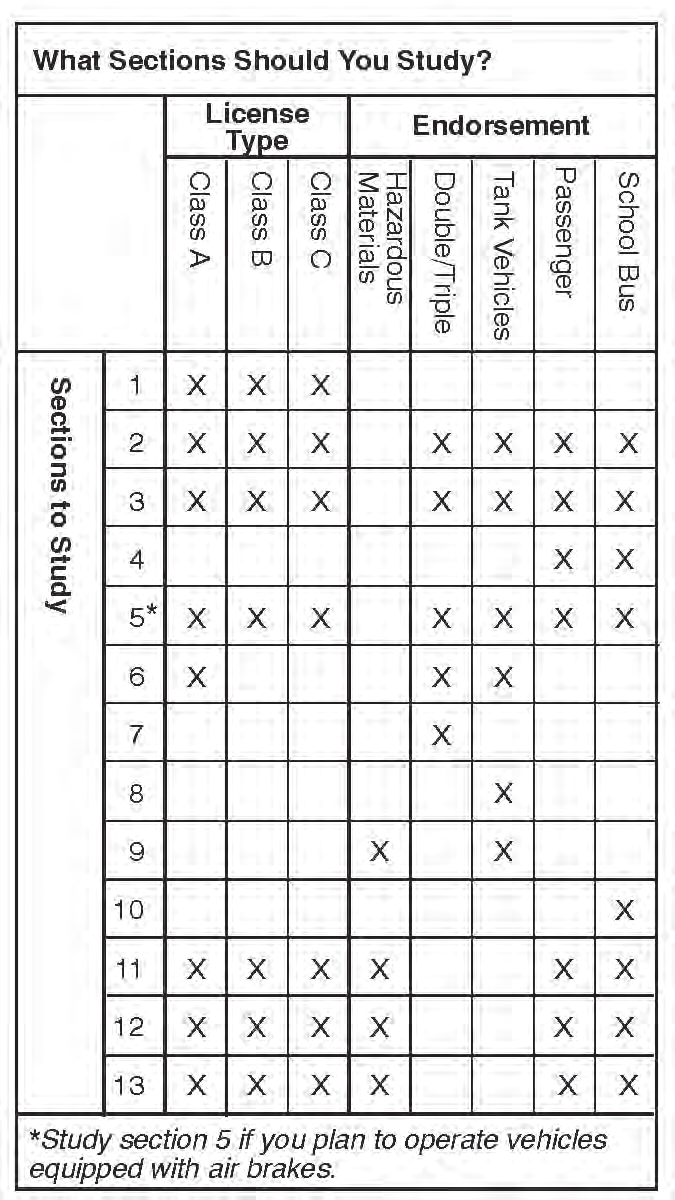
Figure 1.2 1.2 – CDL Disqualifications 1.2.1 – General You may not drive a commercial motor vehicle if you are disqualified for any reason. 1.2.2 – Alcohol, Leaving the Scene of an Accident, and Commission of a Felony It is illegal to operate a CMV if your blood alcohol con centration (BAC) is .04% or more. If you operate a CMV, you shall be deemed to have given your consent to alcohol testing. 1.1 – Commercial Driver License Tests Figure 1. 2 details which sections of this manual you should study for each particular class of license and for each endorsement. 1.1.1 – Knowledge Tests
On-Road Test. You will be tested on your skill to safely drive your vehicle in a variety of traffic situations. The situations may include left and right turns, intersec tions, railroad crossings, curves, up and down grades, single or multi-lane roads, streets, or highways. The examiner will tell you where to drive. You will lose your CDL for at least one year for a first offense for:
- • Driving a CMV under the influence of alcohol or drugs.
- • Refusing to undergo blood alcohol testing.
- • Driving a CMV while under the influence of a con trolled substance.
- • Leaving the scene of an accident involving a CMV.
- • Committing a felony involving the use of a CMV.
- • Driving a CMV when the CDL is suspended.
- • Causing a fatality through negligent operation of a CMV. You will lose your CDL for at least three years if the offense occurs while you are operating a CMV that is placarded for hazardous materials. You will lose your CDL for life for a second offense or subsequent major offense. You will lose your CDL for life if you use a CMV to com mit a felony involving controlled substances. You will be put out-of-service for 24 hours if you have any detectable amount of alcohol under . 04%. You will lose your CDL for at least 60 days for providing false information related to the issuance of a commer cial permit or commercial license. You will lose your CDL for at least one year if convicted of fraud related to the issuance of a commercial permit or commercial license. 1.2.3 – Serious Traffic Violations Serious traffic violations are excessive speeding (15 mph or more above the posted limit), reckless driving, improper or erratic lane changes, following a vehicle too closely, and traffic offenses committed in a CMV in connection with fatal traffic accidents, driving a CMV without obtaining a CDL or having a CDL in the driver’s possession, driving a CMV without the proper class of CDL and/or endorsements, texting while driving, and using a hand-held mobile telephone while driving. You will lose your CDL:
- • For at least 60 days if you have committed two seri ous traffic violations within a three-year period involv ing a CMV.
- • For at least 120 days for three serious traffic viola tions within a three-year period involving a CMV. 1.2.4 – Violation of Out-of-Service Orders You will lose your CDL:
- • For three years if you have committed three or more violations of an out-of-service order in a ten-year pe riod. 1.2.5 – Railroad-Highway Grade Crossing Violations You will lose your CDL:
- • For at least 60 days for your first violation.
- • For at least 120 days for your second violation within any three-year period.
- • For at least one year for your third violation within any three-year period. These violations include violation of a federal, state or local law or regulation pertaining to one of the following six offenses at a railroad-highway grade crossing:
- • For drivers who are not required to always stop, fail ing to stop before reaching the crossing if the tracks are not clear.
- • For drivers who are not required to always stop, fail ing to slow down and check that the tracks are clear of an approaching train.
- • For drivers who are always required to stop, failing to stop before driving onto the crossing.
- • For all drivers failing to have sufficient space to drive completely through the crossing without stopping.
- • For all drivers failing to obey a traffic control device or the directions of an enforcement official at the cross ing.
- • For all drivers failing to negotiate a crossing because of insufficient undercarriage clearance. 1.2.6 – Hazardous Materials Endorsement Background Check and Disqualifications If you require a hazardous materials endorsement you will be required to submit your fingerprints and be sub ject to a background check. You will be denied or you will lose your hazardous ma terials endorsement if you:
- • Are not a lawful permanent resident of the United States.
- • Renounce your United States citizenship.
- • Are wanted or under indictment for certain felonies.
- • Have a conviction in military or civilian court for cer tain felonies.
- • Driving a CMV if your blood alcohol concentration is . 04% or higher.
- • For two years if you have committed two violations of an out-of-service order in a ten-year period.
- • For 180 days if you have committed your first viola tion of an out-of-service order.
- • Have been adjudicated as a mental defective or committed to a mental institution. 1.2.7 – Traffic Violations in Your Personal Vehicle The Motor Carrier Safety Improvement Act (MCSIA) of 1999 requires a CDL holder to be disqualified from op erating a commercial motor vehicle if the CDL holder has been convicted of certain types of moving viola tions in their personal vehicle. If your privilege to operate your personal vehicle is revoked, cancelled, or suspended due to violations of traffic control laws (other than parking violations) you will also lose your CDL privileges. If your privilege to operate your personal vehicle is re voked, cancelled, or suspended due to alcohol, con trolled substance, or felony violations, you will lose your CDL for one year. If you are convicted of a second violation in your personal vehicle or CMV, you will lose your CDL for life. If your privilege to operate your personal vehicle is re voked, cancelled, or suspended, you may not obtain a “hardship” license to operate a CMV. 1.3 – Other CDL Rules There are other federal and state rules that affect driv ers operating CMVs in all states. Among them are:
- • You cannot have more than one license. If you break this rule, a court may fine you up to $5,000 or put you in jail and keep your home state license and return any others.
- • You must notify your employer within 30 days of con viction for any traffic violations (except parking). This is true no matter what type of vehicle you were driving.
- • You must notify your motor vehicle licensing agency within 30 days if you are convicted in any other juris diction of any traffic violation (except parking). This is true no matter what type of vehicle you were driving.
- • You must notify your employer if your license is sus pended, revoked, or canceled, or if you are disquali fied from driving.
- • You must give your employer information on all driv ing jobs you have held for the past 10 years. You must do this when you apply for a commercial driving job.
- • No one can drive a commercial motor vehicle without a CDL. A court may fine you up to $5,000 or put you in jail for breaking this rule.
- • Your employer may not let you drive a commercial motor vehicle if you have more than one license or if you’re CDL is suspended or revoked. A court may fine the employer up to $5,000 or put him/her in jail for breaking this rule.
- • All states are connected to one computerized system to share information about CDL drivers. The states will check on drivers’ accident records and be sure that drivers do not have more than one CDL.
- • You must be properly restrained by a seat belt at all times while operating a commercial motor vehicle. The seat belt design holds the driver securely behind the wheel during a crash, helping the driver to con trol the vehicle and reduces the chance of serious injury or death. If you do not wear a seat belt, you are four times more likely to be fatally injured if you are thrown from the vehicle. Your state may have additional rules that you must also obey. 1.4 – International Registration Plan International Fuel Tax Agreement If you operate a CDL required vehicle in interstate com merce, the vehicle, with few exceptions, is required to be registered under the International Registration Plan (IRP) and the International Fuel Tax Agreement (IFTA). These federally mandated programs provide for the equitable collection and distribution of vehicle license fees and motor fuels taxes for vehicles travel ing throughout the 48 contiguous United States and 10 Canadian provinces. Under the IRP, jurisdictions must register apportioned vehicles which includes issuing license plates and cab cards or proper credentials, calculate, collect and dis tribute IRP fees, audit carriers for accuracy of reported distance and fees and enforce IRP requirements. Registrant responsibilities under the Plan include ap plying for IRP registration with base jurisdiction, pro viding proper documentation for registration, paying appropriate IRP registration fees, properly displaying registration credentials, maintaining accurate distance records, and making records available for jurisdiction review. The basic concept behind IFTA is to allow a licensee (motor carrier) to license in a base jurisdiction for the reporting and payment of motor fuel use taxes.
- • Are considered to pose a security threat as deter mined by the Transportation Security Administration. by reason of insanity of a disqualifying crime listed in 49 CFR 1572. 103; who is adjudicated as a men tal defective or committed to a mental institution as specified in 49 CFR 1572.109; or who renounces his or her U. S. citizenship;
- • If you have a hazardous materials endorsement you must notify and surrender your hazardous materials endorsement to the state that issued your CDL within 24 hours of any conviction or indictment in any ju risdiction, civilian or military, for, or found not guilty Under the IFTA, a licensee is issued one set of creden tials which will authorize operations through all IFTA member jurisdictions. The fuel use taxes collected pur It is the base jurisdiction’s responsibility to remit the taxes collected to other member jurisdictions and to represent the other member jurisdictions in the tax col lection process, including the performance of audits. An IFTA licensee must retain records to support the information reported on the IFTA quarterly tax return. The IRP registrant and the IFTA licensee may be the vehicle owner or the vehicle operator. The requirement for acquiring IRP plates for a vehicle and IFTA license for a motor carrier is determined by the definitions from the IRP Plan and the IFTA for Qual ified Vehicle and Qualified Motor Vehicle: For purposes of IRP: A Qualified Vehicle is (except as provided below) any Power Unit that is used or intended for use in two or more Member Jurisdictions and that is used for the transportation of persons for hire or designed, used, or maintained primarily for the transportation of property, and:
- • Has two axles and a gross vehicle weight or reg istered gross vehicle weight in excess of 26,000 pounds (11,793. 401 kilograms), or
- • Has three or more axles, regardless of weight, or
- • Is used in combination, when the gross vehicle weight of such combination exceeds 26,000 pounds (11,793. 401 kilograms).
- • While similar, the Qualified Motor Vehicle in IFTA means a motor vehicle used, designed, or main tained for transportation of persons or property and:
- • Having two axles and a gross vehicle weight or regis tered gross vehicle weight exceeding 26,000 pounds or 11,797 kilograms; or
- • Having three or more axles regardless of weight; or
- • Is used in combination, when the weight of such combination exceeds 26,000 pounds or 11,797 ki lograms gross vehicle or registered gross vehicle weight. Qualified Motor Vehicle does not include rec reational vehicles. Although the actual format of the IVDR may vary, the information that is required for proper record keeping does not. In order to satisfy the requirements for Individual Vehi cle Distance Records, these documents must include the following information: Distance Per Article IV of the IRP Plan.
- • Date of trip (starting and ending)
- • Trip origin and destination – City and State or Prov ince
- • Route(s) of travel
- • Beginning and ending odometer or hubodometer reading of the trip
- • Total distance traveled
- • In-Jurisdiction distance
- • Power unit number or vehicle identification number. Fuel Per Section P560 of the IFTA Procedures Manual.
- • .300 An acceptable receipt or invoice must include, but shall not be limited to, the following:
- • .005 Date of purchase
- • .010 Seller’s name and address
- • .015 Number of gallons or liters purchased;
- • .020 Fuel type
- • .025 Price per gallon or liter or total amount of sale
- • .030 Unit number or other unique vehicle identifier
- • .035 Purchaser’s name An example of an IVDR that must be completed in its entirety for each trip can be found in Figure 1.3 below. Each individual IVDR should be filled out for only one vehicle. The rules to follow when trying to determine how and when to log an odometer reading are the following:
- • At the beginning of the day
- • When leaving the state or province
- • At the end of the trip/day suant to the IFTA are calculated based on the number of miles (kilometers) traveled and the number of gal lons (liters) consumed in the member jurisdictions. The licensee files one quarterly tax return with the base jurisdiction by which the licensee will report all opera tions through all IFTA member jurisdictions. Driver Trip Report. This document reflects the distance traveled and fuel purchased for a vehicle that operates interstate under apportioned (IRP) registration and IFTA fuel tax credentials. If the vehicle you operate is registered under IRP and you are a motor carrier licensed under IFTA, then you are required to comply with the mandatory record keeping requirements for operating the vehicle. A uni versally accepted method of capturing this informa tion is through the completion of an Individual Vehicle Distance Record (IVDR), sometimes referred to as a Not only do the trips need to be logged, but the fuel purchases need to be documented as well. You must obtain a receipt for all fueling and include it with your completed IVDR. In addition, these records are subject to audit by the taxing jurisdictions. Failure to maintain complete and accurate records could result in fines, penalties and suspension or revocation of IRP registrations and IFTA licenses. There are different routes that a driver may take, and most of the miles may be within one state or province. Whether or not the distance you travel is primarily in one jurisdiction or spread among several jurisdictions, all information for the trip must be recorded. This in cludes the dates, the routes, odometer readings and fuel purchases. For additional information on the IRP and the require ments related to the IRP, contact your base jurisdic tion motor vehicle department or IRP, Inc., the official repository for the IRP. Additional information can be found on the IRP, Inc. Web site at www. irponline. org. There is a training video on the website home page available in English, Spanish and French. By completing this document in full and keeping all re cords required by both the IRP and the IFTA, you will have ensured that you and your company are in com pliance with all State and Provincial laws surrounding fuel and distance record keeping requirements. For additional information on IFTA and the require ments related to IFTA, contact the appropriate agency in your base jurisdiction. You will also find useful infor mation about the Agreement at the official repository of IFTA at http://www. iftach. org/index. phpg The IVDR serves as the source document for the cal culation of fees and taxes that are payable to the ju risdictions in which the vehicle is operated, so these
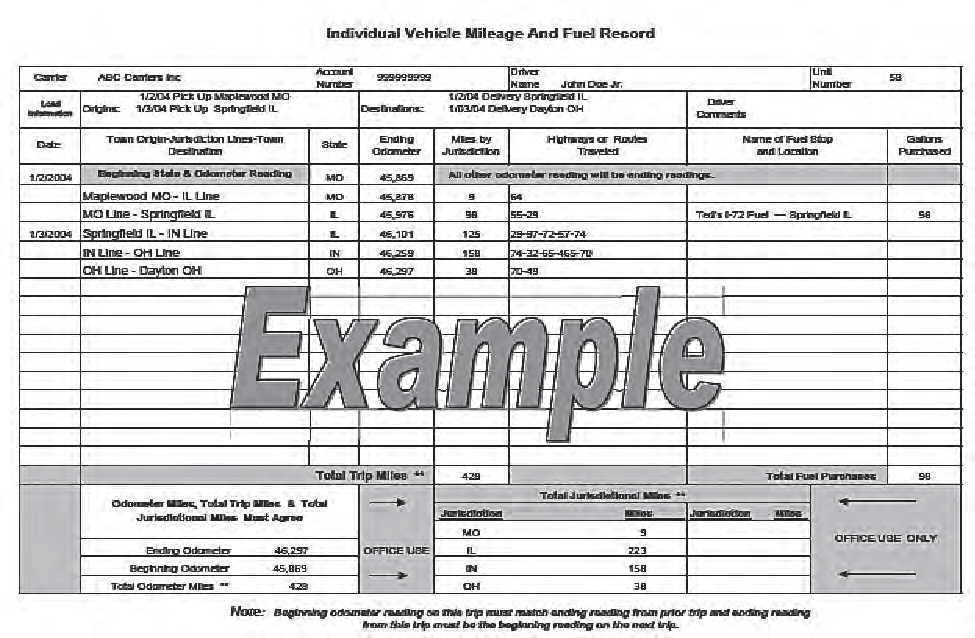
Figure 1.3 – Individual Vehicle Mileage and Fuel Record (Example) original records must be maintained for a minimum of four years. Make sure that any trips that you enter are always filled out in descending order and that your trips in clude all state/provinces that you traveled through on your route.