Section 1 of 13
Introduction
Introduction

Commercial





Driver License





Manual





















































2005 CDL Testing System (July 2014)
CDL Driver’s Manual COPYRIGHT © 2005 AAMVA All Rights Reserved This material is based upon work supported by the Federal Motor Carrier Safety Administration under Cooperative Agreement No. DTFH61-97-X- 00017. Any opinions, findings, conclusions or recommendations expressed in this publication are those of the Author(s) and do not necessarily reflect the view of the Federal Motor Carrier Safety Administration.
COPYRIGHT © 2005 AAMVA. All rights reserved This material has been created for and provided to State Driver License Agencies (SDLAs) by AAMVA for the purpose of educating Driver License applicants (Commercial or Non-Commercial). Permission to reproduce, use, distribute or sell this material has been granted to SDLAs only. No part of this book may be reproduced or transmitted in any form or by any means, electronic or mechanical, including photocopying, recording, or by any information storage and retrieval system without express written permission from the author / publisher. Any unauthorized reprint, use, distribution or sale of this material is prohibited. Human trafficking is modern-day slavery. Traffickers use force, fraud and coercion to control their victims. Any minor engaged in commercial sex is a victim of human trafficking. Trafficking can occur in many locations, including truck stops, restaurants, rest areas, brothels, strip clubs, private homes, etc. Truckers are the eyes and the ears of our nation’s highways. If you see a minor working any of those areas or suspect pimp control, call the National Hotline and report your tip: 1-888-3737-888 (US) 1-800-222-TIPS (Canada) For law enforcement to open an investigation on your tip, they need “actionable information.” Specific tips helpful when reporting to the hotline would include: Descriptions of cars (make, model, color, license plate number, etc.) and people (height, weight, hair color, eye color, age, etc.) Take a picture if you can. Specific times and dates (When did you see the event in question take place? What day was it?) Addresses and locations where suspicious activity took place
Trafficking Red Flags to Look for: Lack of knowledge of their community or whereabouts Not in control of own identification documents (ID/passport) Restricted or controlled communication--not allowed to speak for self Demeanor: fear, anxiety, depression, submissive, tense, nervous Questions to Ask: Are you being paid? Are you being watched or followed? Are you free to leave? Come and go as you please? Are you physically or sexually abused? Are you or your family threatened? What is the nature of the threats? Report by Email: Report@PolarisProject.org
Warning:Please do not approach traffickers. Call the hotline, and they will call the FBI and local police to deal with them and rescue the victims. Approaching traffickers is not only dangerous for you and their victims but could lead to problems in the eventual prosecution of traffickers. Go to www.truckersagainsttrafficking.org for more information.







On October 26, 1986, the United States Congress passed the Commercial Motor Vehicle Safety Act. This law requires each State to meet the same minimum standards for commercial driver licensing. The standards require commercial motor vehicle drivers to get a Commercial Driver’s License (CDL).
WHAT IS THE COMMERCIAL DRIVER’S LICENSE LAW?
New federal standards for testing and licensing heavy truck and bus operators are now law in Kentucky. These minimum standards will guarantee the fitness of commercial motor vehicle operators by requiring demonstrated ability to drive heavy vehicles before a license is issued. A new license, called the Commercial Driver License (CDL), has replaced what was known as a chauffeur license for many Kentucky drivers. The CDL laws and standards cover drivers in all 50 states, the District of Columbia, Mexico, and Canada. Motor Carriers will be held responsible if their drivers operate a commercial motor vehicle without a valid CDL.
Who Must Apply?
Operators of vehicles described below MUST apply for a CDL.
Class A CDL Any combination of vehicles with a gross combination weight rating (GCWR) of 26,001 pounds o more provided the GVWR of the vehicle(s) being towed is in excess of 10,000 pounds. GCWR – the value specified by the manufacturer as the loaded weight of a combination (articulated) vehicle. GVWR – the value specified by the manufacturer as the loaded weight of a single vehicle.
Note: Actual loaded weight (GCW and GVW) cannot be used to determine a representative vehicle for testing purposes. If your GCWR/GVWR is not listed on a sticker or plate located in the vehicle glove box or inside the driver side door, contact your vehicle’s manufacturer for this information.
Class B CDL
Any single vehicle with a GVWR of 26,001 pounds or more. Any vehicle with a GVWR of 26,001 pounds or more, pulling a vehicle with a GVWR of 10,000 pounds or less. A single vehicle designed to transport 16 or more passengers (including the driver) if the GVWR is 26,001 pounds or more.
Class C CDL
Any vehicle with a GVWR of less than 26,001 pounds transporting hazardous materials for which placarding is required. Any vehicle transporting 16 or more passengers, including the driver, with a GVWR of less than 26,001 pounds.
Page 1 - 1 EXEMPTIONS
The following groups are exempt from the CDL requirements, provided they meet all the criteria.
Drivers of vehicles that are: Used exclusively in farm-to-market agricultural transportation, operated in private carriage, owned and/or operated by the farmer or his employees, and used within the Commonwealth of Kentucky or one-hundred-fifty (150) highway miles of the point of origin if crossing state lines.
Drivers of firefighting and other emergency equipment.
Drivers of military vehicles if those persons are: Military personnel in uniform, operating the vehicles in pursuit of a military purpose, and properly licensed by the military.
Drivers of vehicles that are designed as temporary living quarters for recreational, camping, or travel use, and operate on their own motor power or are mounted on or drawn by another vehicle.
HOWTO APPLY FOR A CDL / Renewing a CDL Effective January 30, 2012, a CDL permit/license cannot be issued until the applicant has provided a copy of the CDL application, copy of current medical certificate, and a Self-Certification form certifying as to what type driving they are operating in or expect to operate in. The above information must be forwarded to the Division of Driver Licensing and posted to the driver’s CDLIS record prior to applying for issuance of the CLP/ CDL at the circuit court clerk’s office. The Division of Driver Licensing has 10 days from the date of receipt to post this information to the CDLIS record. Under 49 CFR 384.206(b)(1)(i), a driver applying for an original, renewal, upgrade/add-on or transfer CDL must provide a list of all states where the driver has held a license to operate any type of motor vehicle in the last ten (10) years. The Ten (10) Year History Survey Request must be initiated prior to a CDL permit/license being issued. This is a one-time process. If the driver has already provided the information and has not transferred out of state since completing the process, he/she will not be required to submit the information again. Per 49 CFR 383.73 (g) if a driver fails to disclose any state in which a license was issued, that driver will be subject to a minimum suspension of sixty (60) days for falsifying an application. In an attempt to make the new process user friendly, the CDL application and Self-Certification can be completed and submitted at MY CDL/Kentucky CDL Document Portal, http://mycdl.ky.gov or by printing a copy at the Division of Driver Licensing website at http://drive.ky.gov Click on Driver Services, then select Commercial Driver’s License. The forms are listed under the Useful CDL Resources heading. You can submit a copy of your certified medical examiner’s certificate at http://mycdl.ky.gov by completing the form and uploading a copy. If you complete your documents through the Kentucky CDL Document Portal, http://mycdl.ky.gov you will receive an email when your documents are received and when your documents are updated to your CDLIS driving record. You will also receive an immediate email should your document be rejected. You may mail your forms and copy of your medical certificate to Division of Driver Licensing, 200 Mero ST. Frankfort, KY 40622. You may drop them off at one of the field offices or at the One Stop Shop at the Transportation Cabinet. If you submit your documents by mail or drop off, you will receive a letter in a few days. Once a driver/applicant has received notice that the information has posted to their CDLIS record, they can proceed to the circuit court clerk’s office to begin/complete the issuance process.
Page 1 - 2 All applicants will be required to successfully pass a knowledge test, either in written or oral form (no oral test for Hazardous Material endorsement), and a vision test. A CDL instruction permit will then be issued which is valid for six (6) months. The permit must be held for 14 days prior to a skills test being administered. You may schedule a road skills test with Kentucky State Police by calling 800-542-5990. A permit may only be renewed once. If you do not successfully pass the road skills test by the expiration of your CDL instruction permit renewal, you will need to reapply. All fees and written tests will be required prior to a new permit being issued. If your permit or CDL license has been expired for over a year, all fees and written tests will be required prior to a new permit being issued.
WHAT’S ON THE KNOWLEDGE TEST?
The Kentucky State Police will give the knowledge test at one of the local exam stations. Please check with your local Circuit Court Clerk regarding the days and times the examiner will be available. The knowledge test consists of 50 questions covering a broad range of subjects, including vehicle operations under all kinds of conditions, cargo handling, and vehicle inspection.
Additional knowledge must be shown in the following areas:
Applicants for class A license – 20 questions on Combination Vehicles. Applicants driving vehicles with air brakes – 25 questions on Air Brakes.
Endorsements are required for the following vehicles:
Doubles/Triples Trailers – 20 questions Tankers – 20 questions Passenger Transport – 20 questions Hazardous Materials – 30 questions School Bus -- 20 questions
School bus drivers must also have a School Bus Endorsement in addition to a passenger endorsement on their commercial driver’s license. To get a school bus endorsement, you must pass a knowledge test on sections 2, 4, and 10 of this manual. You will also be required to pass all three portions of the skills test in the class of school bus you intend to drive before the endorsement can be added to your CDL license.
For each test, 80 percent of the questions must be answered correctly to pass. Failure to show basic knowledge of an air brake system will result in a license restriction limiting the driver to operating a vehicle without an air brake system. Applicants may take the general knowledge test indefinitely without paying retest fees. However, if he/she fails, an applicant must wait 24 hours prior to retesting. Skills tests can be taken indefinitely as long as the CDL instruction permit is valid and skills test fees are current. The combination, air brake, and endorsement tests require a $5 re-test fee for each time taken after the initial failure.
RETESTING
Applicants must retest for the hazardous materials endorsement at renewal of the CDL. If transferring into Kentucky, an applicant must retest in order to keep a hazardous material endorsement. If a CDL driver surrenders his commercial driving privileges, he has a year to return to the Circuit Court Clerk’s office and be reissued the CDL without retesting. If the CDL is expired for more than one (1) year but less than five (5), the written tests must be taken prior to a new license being issued. Written and skills testing is required if the CDL is expired or at a non-valid status for five (5) years or more. An application fee will be charged. If applying for a CDL reinstatement and the commercial privilege has been suspended for one (1) year or more, ALL tests are required.
Page 1 - 3 WHAT DOES THE ROAD TEST COVER?
Drivers will be required to take this test in the class of vehicle they intend to drive. The test includes a pre-trip inspection, basic control skills maneuvering, and road skills driving tests. THE APPLICANT WILL BE REQUIRED TO FURNISH A VEHICLE FOR TESTING AND BE ACCOMPANIED BY A LICENSED DRIVER FOR THAT VEHICLE.
After the CDL permit is issued, the applicant must hold the permit for 14 days before getting a skills test. If you passed the written test for air brakes, you will need to take the skills test in an air brake equipped vehicle; otherwise, you will receive an “L” restriction.
Pre-Trip Inspection
Purpose – To see if you know the vehicle is safe to drive.
Test Procedure – You may be asked to do a pre-trip inspection of your vehicle or to explain to the examiner what you would inspect and why. The examiner will mark on a scoring form each time that you correctly inspect or explain. This manual tells you what you need to inspect.
Basic Control Skills Test
Purpose – To evaluate your basic skills in controlling the vehicle.
Setup – The test setup consists of various exercises marked out by lines, traffic cones, or something similar. The exercises may include moving the vehicle forward, backward, and turning maneuvers. The examiner will explain to you how each exercise is to be done. You will be scored on how well you stay within the exercise boundaries and how many pull-ups you make.
Road Skills Test
Purpose – To evaluate your ability to drive safely in a variety of on-the-road situations.
Test Procedures – The test drive is taken over a route specified by the examiner. It may include left and right turns, intersections, railway crossings, curves, up and down grades, rural or semi-rural roads, city and multi-lane streets, and expressway driving.
You will drive over the test route following instructions given by the examiner. The examiner will score specific tasks such as turns, merging into traffic, lane changes, and speed control, at specific places along the route. The examiner will also score whether you correctly do the tasks such as signaling, searching for hazards, controlling speed, and lane positioning.
WHAT DOES THE CDL COST?
CDL application - $24
CDL instruction permit - $11 (plus + $50.00 skills testing fee applied to applicants that have held a Kentucky operators license for over 30 days. Or $150.00 to applicants that have not held Kentucky operators license for over 30 days.)
Original CDL – up to $40 (prorated fees according to current operator’s expiration)
Renewal CDL - $47
Transfer CDL - $63 unexpired; $87 expired; with motorcycle - $73
Page 1 - 4 Upgrades in class
Class B or C to A – application, permit, and license fees, and a skills test in a Class A vehicle.
Class C to B – application, permit, and license fees, and a skills test in a Class B vehicle.
Endorsement test fees are $5 for tanker, doubles/triples, passenger, school bus and hazardous materials. The following license actions will require an application fee, CDL instruction permit fee, and new license fee: Add passenger endorsement, add a School Bus endorsement, drop “L” or “Z” restriction, drop “M” restriction, drop “N” restriction, drop “O” restriction, and drop Auto Transmission Only restriction “E”.
RESTRICTIONS AND ENDORSEMENTS
Endorsements:
H Hazardous Materials N Tank P Passenger T Double/Triple Trailer X Tank/Hazardous Materials combined S School Bus
Restrictions:
L No Air Brake Equipped CMV Z No Full Air Brake Equipped CMV E No Manual Transmission Equipped CMV O No Tractor-trailer CMV M NoClass A Passenger Vehicle N No Class A and B Passenger Vehicle K Intrastate Only V Medical Variance P No Passengers in CMV Bus X No Cargo in CMV Tank Vehicle 8Other (special restrictions)
Adding of a Passenger endorsement will require a complete skills test in a passenger vehicle meeting the classification of the license being applied for.
Adding of a School Bus endorsement will require qualification for a passenger vehicle and a complete skills test in a school bus of the same vehicle group as the school bus driver will drive.
To remove an “L” or a “Z” restriction, the applicant must perform a pre-trip inspection.
Class A can use a class A or B vehicle. Class B can only use a class B vehicle. Class C can only use a class C vehicle.
To remove an O restriction, the applicant must retake all three skills tests in a representative tractor-trailer.
To remove an “E” Automatic Transmission restriction, the applicant must retake the on-road driving portion of the skills test in a Class A or Class B manual transmission vehicle.
Page 1 - 5 A WORD ABOUT ALCOHOL AND DRIVING
It is against the law to operate a commercial vehicle with any amount of alcohol or controlled substance in the blood, breath, or urine. If a driver tests from .01% BAC to .039% BAC, that driver shall be put out of service for 24 hours. Drivers testing at .04% BAC or higher will be disqualified for one year. A second conviction carries a penalty of disqualifying a commercial driver for life. Penalties apply to the commercial driving privileges only.
WHAT OFFENSES COULD RESULT IN DISQUALIFICATION?
Below is a list of violations which could result in the loss of commercial driving privileges for time periods ranging from 24 hours to life.
24 hours – Driving a commercial vehicle with any measurable amount of alcohol or controlled substance in the blood, breath, or urine; or operate a commercial motor vehicle while in possession of a controlled substance and/or intoxicating beverage, regardless of its alcohol content.
Note: Does not apply when manifested and transported as part of a shipment.
60 days – Two serious moving violations in three years. Any person who knowingly falsifies information or certification required to obtain a commercial driver’s license, permit, or duplicate commercial driver’s license, will be subject to an administrative hearing and disqualified for a period of at least 60 consecutive days.
120 days – Three serious moving violations in three years.
A serious violation is defined as speeding 15 M.P.H. or more, improper lane usage/changes, following too closely, reckless driving, and any violation showing a wanton disregard for the safety of any person or property.
1 year – First conviction of any of the following:
Driving a commercial vehicle with a blood alcohol concentration of .04% or more or under the influence of a controlled substance.
Leaving the scene of a traffic accident.
Using the commercial vehicle in the commission of a felony.
Refusing to submit to a blood, breath, or urine test when stopped for probable cause by a police officer.
3 years – Violating any law above while transporting hazardous materials.
For life – A person shall be disqualified from driving a commercial motor vehicle for life who uses a commercial motor vehicle in the commission of any felony involving the manufacture, distribution, or dispensing of a controlled substance, or possession with the intent to manufacture, distribute, or dispense a controlled substance.
For life – A second conviction of any of the following:
Driving a commercial motor vehicle under the influence of alcohol or other drugs. Leaving the scene of a traffic accident while driving a commercial motor vehicle. Using a commercial motor vehicle in the commission of a felony. Refusing to submit to a blood, breath, or urine test when stopped for reasonable cause by a police officer. Page 1 - 6 IMPLIED CONSENT
A person who holds a Commercial Driver License (CDL) within this state shall be deemed to have given his consent to take a test or tests of his blood, breath, or urine for the purpose of determining alcohol concentration or the presence of other drugs.
A test or tests may be administered at the direction of a law enforcement officer who, after stopping or detaining the commercial motor vehicle driver, has reasonable cause to believe that driver was driving a commercial motor vehicle while having alcohol or drugs in his system.
INTRASTATE MEDICAL WAIVERS
601 KAR 11:040 sets forth the procedure for obtaining an Intrastate Medical Waiver. If a commercial driver does not meet the federal medical guidelines outlined in 49 CFR 391, sub-part E, he may apply for this Intrastate Medical Waiver.
To apply for this waiver, the driver may contact either his local Circuit Court Clerk’s office or the Division of Driver Licensing in Frankfort. At that time the driver will be sent a medical waiver “packet.” Contained in this packet will be a form, “Request for Medical Waiver.” Also in the packet are the following supplemental medical report forms: Cardiovascular Conditions, Neurological Conditions, Musculoskeletal Conditions, Metabolic Conditions, Alcohol or Drug Dependence, Mental and Emotional Condition, and Visual Conditions. A licensed physician shall determine which of these forms are applicable to the medical condition of the applicant and complete these forms. If the vision form is applicable, an optometrist or ophthalmologist must complete the form. Along with the request for waiver and pertinent medical report forms, the Division of Driver Licensing must receive along form copy of the driver’s last DOT physical examination.
The Division of Driver Licensing will base its decision on granting the requested waiver from the information obtained from the medical report forms, the DOT physical, and the driving history of the applicant. If the Intrastate Medical Waiver request is granted, the applicant will receive a letter of approval, along with a medical examiner’s certificate stamped “Intrastate Medical Waiver Granted, Transportation Cabinet.” This certificate will indicate Intrastate Travel Only and will be the only medical card in the driver’s possession. The CDL license will indicate the “K” restriction (Intrastate Only).
After being granted a medical waiver, the driver must submit periodic medical updates. The proper forms will be computer generated and automatically mailed to the driver. If the Division of Driver Licensing does not receive the updated information within 45 days, the Intrastate Medical Waiver, along with the driver’s commercial driving privileges, will be cancelled and remain cancelled until the information is received.
INTERSTATE MEDICAL WAIVERS Applications for interstate medical waivers can be downloaded from the federal website www.fmcsa.dot.gov/rules-regulations/topics/medical/spepackage.htm.
FARM RELATED SERVICES RESTRICTED CDL
This restricted CDL may be issued to employees of farm retail outlets and suppliers, agri-chemical businesses, custom harvesters, and livestock feeders. The license is valid for 60, 120, or 180 days in any 12-month period. The license is only valid within 150 miles of the land being serviced. It does NOT apply to any Class A vehicles. See your Circuit Court Clerk for more details.
Page 1 - 7 INDIVIDUAL EIGHTEEN (18) YEARS OF AGE DRIVING INTRASTATE
A commercial driver’s license may be issued to an individual eighteen (18) years of age who holds a valid automobile Class D driver’s license, who has passed the vision and knowledge tests required for a commercial driver’s license of the class vehicle to be driven, if the individual only drives a commercial motor vehicle in intrastate commerce and does not drive a school bus or a vehicle hauling hazardous material. The license shall be class specific and shall contain a “K” restriction noting that the commercial driver is limited to Kentucky intrastate commerce.
HOW DOES THE SYSTEM PREVENT MULTIPLE LICENSES?
Kentucky has joined an information system called the Commercial Driver License Information System (CDLIS) that will serve as a clearinghouse of information on commercial drivers nationwide. CDLIS will be used to eliminate drivers from holding multiple licenses and obtaining fraudulent licenses. For information regarding skills test appointments or test date availability, call Kentucky State Police at 1-800-542-5990. For information or questions regarding licensing of commercial drivers, call the Division of Driver Licensing at (502) 564-6800.
GENERAL RULES
You cannot have more than one license. If you break this rule, a court may fine you up to $5,000 or place you in jail. You must be licensed in your home state.
You must notify your employer within 30 days of a conviction for any traffic violation (except parking). This is true no matter what type of vehicle you were driving.
You must notify your motor vehicle license agency within 30 days if you are convicted in any other state of any traffic violation (except parking). This is true no matter what type of vehicle you were driving.
You must notify your employer if your license is suspended, revoked, cancelled, or if you are disqualified from driving.
You must give your employer information on all driving jobs that you have held for the past 10 years. You must do this when you apply for a commercial driving job.
No one can drive a commercial motor vehicle after April 1992, without a CDL. A state may fine you up to $5,000 or place you in jail for breaking this law.
Your employer may not let you drive a commercial motor vehicle if you have more than one license or if your CDL is suspended or revoked. A court may fine the employer up to $10,000 or place him/her in jail for breaking this rule.
When calling to make an appointment for the Skills (Driving) Tests: Along with the fee for the Commercial Learners Permit (CLP) you will pay a skill test fee of $50.00 or $150.00 depending on the length of time you have held your Kentucky operator license. The skill test fee allows one (1) attempt at the skill tests. If you are not successful on your first (1st) attempt, you will be required to pay an additional $50.00 skill test fee for each attempt until a passing score is obtained. (KRS 281A.160 (6) (e) )
Page 1 - 8 Failures of the skills test could result from: • A failing score.(49 CFR 383.113) • Failure to call at least 48 hours in advance to cancel an appointment. (KRS 281A.160 (6) (d) ) • Arriving for an appointment without having in possession all required documents (driver’s license, CLP, FMCSA/Kentucky Medical Variance if required. KRS 281A.160 (2) (d) ) • Arriving for an appointment in a non-representative vehicle (Representative vehicle means a motor vehicle which represents the type of CMV the driver applicant operates or expects to operate, KRS 281A.160 (2) (d)/49 CFR 383.5) Payment Options If you wish to pay your retest fee online with a credit/debit card the link is http://kentuckystatepolice.org/ drivers-testing/ Scroll down and chose the option ONLINE CDL SKILLS RETEST PAYMENT. Please make note of the confirmation/transaction number when your online payment is complete as you will need that number when you call to reschedule your CDL skill tests. Payment may be mailed to the Kentucky State Police Driver Testing Office in Frankfort, however, this may delay the rescheduling of your skill tests. For further information you may call 1-800-542-5990
HAZARDOUS MATERIAL ENDORSEMENT Applicants who currently hold or would like to add a Hazardous Material Endorsement to their Kentucky CDL License are required to undergo a criminal background check before renewing or adding the endorsement.
To qualify for a Hazardous Material Endorsement, applicants must have a Kentucky CDL license or a Kentucky CDL permit. Applicants will call the Kentucky State Police Driver Testing Branch at 888-655-9655 to schedule an appointment for fingerprinting and application processing. Applicants must pay $115.00 in a CERTIFIED CHECK, CASHIER’S CHECK OR MONEY ORDER MADE PAYABLE TO KENTUCKY STATE TREASURER before fingerprints/application can be processed. Non-certified personal checks, credit/debit cards, and/or cash will not be accepted. Once the appointment is made, applicants will show up at the scheduled location with their Kentucky CDL license/permit, current DOT physical card, one other form of ID and the $115.00 payment. The applicant will be fingerprinted and the application and fingerprints will be sent to the FBI and Transportation Security Administration for processing. After the criminal background check is completed, the applicant will be notified by mail of eligibility to take the test. If eligible, the applicant will then go to their local circuit clerk’s office to complete the written test requirement.
FOR INFORMATION REGARDING TRANSFERRING A CDL FROM ANOTHER STATE PLEASE CALL 888-655-9655.
FINGERPRINT LOCATIONS:
Lexington, Louisville, Independence, Paducah, Madisonville, Bowling Green, London, and Paintsville.
All questions regarding this program should be directed to Kentucky State Police Driver Testing Branch at 888-655-9655.
Page 1 - 9
Table of Contents
Introduction ......................................................................................................................................... 1-1
Driving Safely ................................................................................................................................... 2-1
Transporting Cargo Safely ............................................................................................... 3-1
Transporting Passengers Safely ............................................................................... 4-1
Air Brakes ............................................................................................................................................. 5-1
Combination Vehicles ............................................................................................................ 6-1
Doubles and Triples ................................................................................................................. 7-1
Tank Vehicles .................................................................................................................................. 8-1
Hazardous Materials ................................................................................................................ 9-1
School Bus ........................................................................................................................................ 10-1
Vehicle Vehicle Inspection ............................................................................................. 11-1
Basic Vehicle Control Skills Test ............................................................................ 12-1
On-Road Driving ......................................................................................................................... 13-1
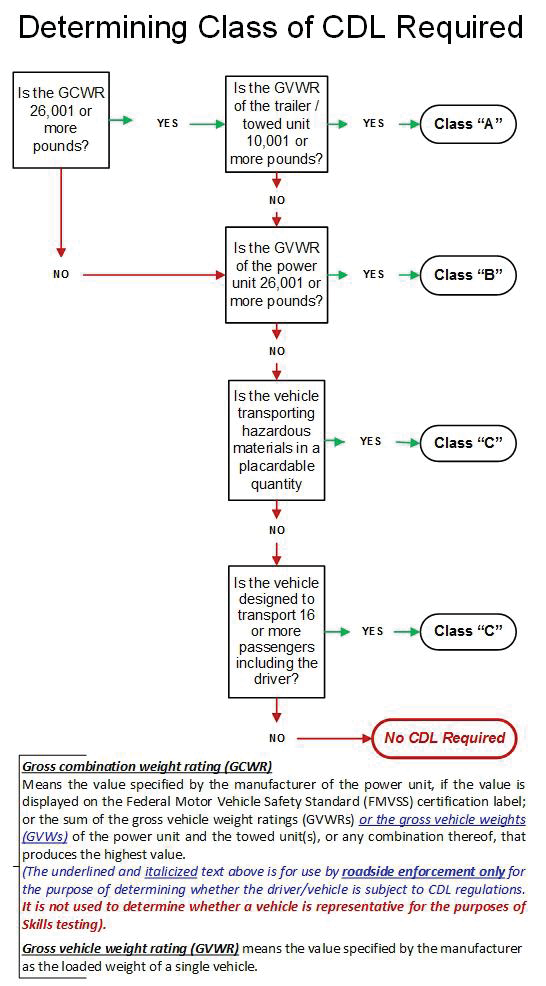
xCommercial Driver License Tests xMedical Requirements xDriver Disqualifications xOther Safety Rules xInternational Registration Program There is a federal requirement that each state have minimum standards for the licensing of commercial drivers. This manual provides driver license testing information for drivers who wish to have a commercial driver license (CDL). This manual does NOT provide information on all the federal and state requirements needed before you can drive a commercial motor vehicle (CMV). You may have to contact your state driver licensing authority for additional information. You must have a CDL to operate: Any single vehicle with a gross vehicle weight rating (GVWR) of 26,001 pounds or more. A combination vehicle with a gross combination weight rating (GCWR) of 26,001 or more pounds, provided the GVWR of the vehicle(s) being towed is in excess of 10,000 pounds. A vehicle designed to transport 16 or more passengers (including the driver). Any size vehicle which requires hazardous material placards or is carrying material listed as a select agent or toxin in 42 CFR part 73. Federal regulations through the Department of Homeland Security require a background check and fingerprinting for the Hazardous Materials endorsement. Contact your local department of driver licensing for more information. (Your state may have additional definitions of CMVs.) To get a CDL, you must pass knowledge and skills tests. This manual will help you pass the tests, however, it is not a substitute for a truck driver training class or program. Formal training is the most reliable way to learn the many special skills required for safely driving a large commercial vehicle and becoming a professional driver in the trucking industry. Figure 1.1 helps you determine if you need a CDL Figure 1.1
NOTE: A bus may be Class A, B, or C depending on whether the GVWR is over 26,001 pounds or is a combination vehicle.
INTRODUCTION
This Section Covers 1.1.1 – Knowledge Tests
You will have to take one or more knowledge tests, depending on what class of license and what endorsements you need. The CDL knowledge tests include: The general knowledge test, taken by all applicants. The passenger transport test, taken by all bus driver applicants. The air brakes test, which you must take if your vehicle has air brakes, including air over hydraulic brakes. The combination vehicles test, which is required if you want to drive combination vehicles. The hazardous materials test, required if you want to haul hazardous materials as defined in 49 CFR 383.5. In order to obtain this endorsement you are also required to pass a Transportation Security Administration (TSA) background check. The tank vehicle test, required if you want to haul any liquid or gaseous materials in a tank or tanks having an individual rated capacity of more than 119 gallons and an aggregate rated capacity of 1,000 gallons or more that is either permanently or temporarily attached to the vehicle or chassis The doubles/triples test, required if you want to pull double or triple trailers. The School Bus test, required if you want to drive a school bus. 1.1.2 – Skills Tests If you pass the required knowledge test(s), you can take the CDL skills tests. There are three types of general skills that will be tested: Vehicle inspection, basic vehicle control, and on-road driving. You must take these tests in the type of vehicle for which you wish to be licensed. Any vehicle that has components marked or labeled cannot be used for the Vehicle Inspection Test. Vehicle Inspection. You will be tested to see if you know whether your vehicle is safe to drive. You will be asked to do a Vehicle inspection of your vehicle and explain to the examiner what you would inspect and why. Basic Vehicle Control. You will be tested on your skill to control the vehicle. You will be asked to move your vehicle forward, backward, and turn it within a defined area. These areas may be marked with traffic lanes, cones, barriers, or something similar. On-road Test. You will be tested on your skill to safely drive your vehicle in a variety of traffic situations. The situations may include left and right turns, intersections, railroad crossings, curves, up and down grades, single or multi-lane roads, streets, or highways. The examiner will tell you where to drive. Figure 1.2 details which sections of this manual you should study for each particular class of license and for each endorsement.
| What Sections Should You Study? | | | | | | | | | |
| | | LICENSE TYPE | | | ENDORSEMENT | | | | |
| | | Class A | Class B | Materials Class C | Hazardous | Double / Triple | Tank Vehicles | Passenger | School Bus |
Sections to Study | | 1 | X | X | X | | | | | |
| | 2 | X | X | X | | X | X | X | |
| | 3 | X | X | X | | | | | |
| | 4 | | | | | | | X | |
| | 5* | X | X | X | | X | | | |
| | 6 | X | | | | X | X | | |
| | 7 | | | | | X | | | |
| | 8 | | | | | | X | | |
| | 9 | | | | X | | X | | |
| | 10 | | | | | | | | X |
| | 11 | X | X | X | | | | X | X |
| | 12 | X | X | X | | | | X | X |
| | 13 | X | X | X | | | | X | X |
*Study section 5 if you plan to operate vehicles equipped with air brakes. | | | | | | | | | | |
Figure 1.2 – What to Study The examiner will tell you how each control test is to be done. 1.1 – Commercial Driver License Tests
Starting January 30, 2012 and no later than January 30, 2014, if you are applying for a CDL Permit; or are renewing, upgrading, adding endorsements to a CDL; or transferring a CDL from another state, you are required to provide information to your State Driver’s License Agency (SDLA) regarding the type of commercial motor vehicle operation you drive in or expect to drive in with your CDL. Drivers operating in certain types of commerce will be required to submit a current medical examiner’s certificate and/or any medical variance documents that you have been issued (i.e. Vision, Skills Performance or Diabetic waivers, or other exemptions) to your SDLA to obtain a “certified” medical status as part of your driving record. You must contact your State Driver Licensing Agency (SDLA) to obtain information regarding the requirement for submitting these documents. If you are required to have a ”certified” medical status and fail to provide and keep up-to-date your medical examiner’s certificate you become ”not-certified” and may lose your CDL. For the purpose of complying with the new requirements for medical certification, it is important to know how you are using the CMV. The following information will help you decide how to self-certify: 1.2.1 – Interstate or Intrastate Commerce Do you, or will you, use a CDL to operate a CMV in interstate or intrastate commerce? Interstate commerce is when you drive a CMV: From one State to another State or a foreign country; Between two places within a State, but during part of the trip, the CMV crosses into another State or foreign country; or Between two places within a State, but the cargo or passengers are part of a trip that began or will end in another State or foreign country. Intrastate commerce is when you drive a CMV within a State and you do not meet any of the descriptions above for interstate commerce. If you operate in both intrastate commerce and interstate commerce, you must choose interstate commerce. Once you decide whether you will operate in interstate commerce or intrastate commerce, you must decide whether you will operate (or expect to operate) in a non-excepted or excepted status. This decision will tell you to which of the four types of commerce you must self-certify. Interstate Commerce: You operate in excepted interstate commerce when you drive a CMV in interstate commerce only for the following excepted activities: To transport school children and/or school staff between home and school; As Federal, State or local government employees; To transport human corpses or sick or injured persons; Fire truck or rescue vehicle drivers during emergencies and other related activities; Primarily in the transportation of propane winter heating fuel when responding to an emergency condition requiring immediate response such as damage to a propane gas system after a storm or flooding; In Response to a pipeline emergency condition requiring immediate response such as a pipeline leak or rupture; In custom harvesting on a farm or to transport farm machinery and supplies used in the custom harvesting operation to and from a farm or to transport custom harvested crops to storage or market; Beekeeper in the seasonal transportation of bees; Controlled and operated by a farmer, but is not a combination vehicle (power unit and towed unit), and is used to transport agricultural products, farm machinery or farm supplies (no placardable hazardous materials) to and from a farm and within 150 air-miles of the farm; As a private motor carrier of passengers for non-business purposes ; or To transport migrant workers. If you answered yes to one or more of the above activities as the only operation in which you drive, you operate in excepted interstate commerce and do not need a Federal medical examiner’s certificate. 1.2 – Medical Documentation Requirements 1.2.2 – Inter/Intrastate Commerce: Status Non-excepted or Excepted?
If you operate in both excepted interstate commerce and non-excepted interstate commerce, you must choose non-excepted interstate commerce to be qualified to operate in both types of interstate commerce. Intrastate Commerce: You operate in excepted Intrastate commerce when you drive a CMV only in intrastate commerce activities for which your State of licensure has determined do not require you to meet the State’s medical certification requirements. (contact your SDLA about their requirements). You operate in non-excepted intrastate commerce when you drive a CMV only in intrastate commerce and are required to meet your State of licensure’s medical certification requirements (contact your SDLA about their requirements). If you operate in both excepted intrastate commerce and non-excepted intrastate commerce, you must choose non-excepted intrastate commerce. 1.2.3 – Self-Certification Statements When completing an application for your CDL, you will be required to check the box next to the statement that describes your status. The actual statements on your application may vary from those shown below:
Interstate non-excepted: I certify that I operate or expect to operate in interstate commerce, that I am subject to and meet the Federal DOT medical card requirements under 49 CFR part 391; and that I am required to obtain a medical examiner’s certificate. Interstate excepted: I certify that I operate or expect to operate in interstate commerce, but engage exclusively in transportation or operations excepted under 49 CFR §§390.3(f), 391.2, 391.68 or 398.3 from all or parts of the qualification requirements of 49 CFR part 391; and that I am not required to obtain a medical examiner’s certificate. Intrastate excepted: I certify that I operate or expect to operate entirely in intrastate commerce, that I am not subject to the medical requirements for my State; and that I am not required to obtain a medical examiner’s certificate.
1.3 - CDL Disqualifications
1.3.1 – General
You may not drive a commercial motor vehicle if you are disqualified for any reason. 1.3.2 – Alcohol, Leaving the Scene of an Accident, and Commission of a Felony
It is illegal to operate a CMV if your blood alcohol concentration (BAC) is .04% or more. If you operate a CMV, you shall be deemed to have given your consent to alcohol testing. You will lose your CDL for at least one year for a first offense for: Driving a CMV if your blood alcohol concentration is .04% or higher. Driving a CMV under the influence of alcohol. Refusing to undergo blood alcohol testing. Driving a CMV while under the influence of a controlled substance. Leaving the scene of an accident involving a CMV. Committing a felony involving the use of a CMV. Driving a CMV when the CDL is suspended. Causing a fatality through negligent operation of a CMV. You will lose your CDL for at least three years if the offense occurs while you are operating a CMV that is placarded for hazardous materials. You will lose your CDL for life for a second offense. You will lose your CDL for life if you use a CMV to commit a felony involving controlled substances. If you answered no to all of the above activities, you operate in non-excepted interstate commerce and are required to provide a current medical examiner’s certificate (49 CFR 391.45),commonly referred to as a medical certificate or DOT card, to your State Driver Licensing Agency (SDLA). Most CDL holders who drive CMVs in interstate commerce are non-excepted interstate commerce drivers. Intrastate non-excepted: I certify that I operate or expect to operate entirely in intrastate commerce, that I am subject to and meet the medical requirements for my State; and that I am required to obtain a medical examiner’s certificate. 1.3.3 – Serious Traffic Violations
Serious traffic violations are excessive speeding (15 mph or more above the posted limit), reckless driving, improper or erratic lane changes, following a vehicle too closely, traffic offenses committed in a CMV in connection with fatal traffic accidents, driving a CMV without obtaining a CDL or having a CDL in the driver’s possession, and driving a CMV without the proper class of CDL and/or endorsements. You will lose your CDL: For at least 60 days if you have committed two serious traffic violations within a three-year period involving a CMV. For at least 120 days for three or more serious traffic violations within a three-year period involving a CMV. 1.3.4 – Violation of Out-of-Service Orders
You will lose your CDL: [For at least 90 days if you have committed your first violation of an out-of-service order. For at least one year if you have committed two violations of an out-of-service order in a ten-year period. For at least three years if you have committed three or more violations of an out-of-service order in a ten-year period]. 1.3.5 – Railroad-highway Grade Crossing Violations
You will lose your CDL: For at least 60 days for your first violation. For at least 120 days for your second violation within a three-year period. For at least one year for your third violation within a three-year period. These violations include violation of a federal, state or local law or regulation pertaining to one of the following six offenses at a railroad-highway grade crossing: For drivers who are not required to always stop, failing to stop before reaching the crossing if the tracks are not clear. For drivers who are always required to stop, failing to stop before driving onto the crossing. For all drivers failing to have sufficient space to drive completely through the crossing without stopping. For all drivers failing to obey a traffic control device or the directions of an enforcement official at the crossing. For all drivers failing to negotiate a crossing because of insufficient undercarriage clearance. 1.3.6 – Hazardous Materials Endorsement Background Check and Disqualifications
If you require a hazardous materials endorsement you will be required to submit your fingerprints and be subject to a background check. You will be denied or you will lose your hazardous materials endorsement if you: Are not a lawful permanent resident of the United States. Renounce your United States citizenship. Are wanted or under indictment for certain felonies. Have a conviction in military or civilian court for certain felonies. Have been adjudicated as a mental defective or committed to a mental institution. Are considered to pose a security threat as determined by the Transportation Security Administration. The background check procedures vary from jurisdiction to jurisdiction. Your licensing agency will provide you with all the information you need to complete the required TSA background check procedures.
1.3.7 – Traffic Violations in Your Personal
Vehicle The Motor Carrier Safety Improvement Act (MCSIA) of 1999 requires a CDL holder to be disqualified from operating a commercial motor vehicle if the CDL holder has been convicted of certain types of moving violations in their personal vehicle. You will be put out-of-service for 24 hours if you have any detectable amount of alcohol under .04%. For drivers who are not required to always stop, failing to slow down and check that the tracks are clear of an approaching train.
If your privilege to operate your personal vehicle is revoked, cancelled, or suspended due to alcohol, controlled substance or felony violations, you will lose your CDL for 1 year. If you are convicted of a second violation in your personal vehicle or CMV you will lose your CDL for life. If your license to operate your personal vehicle is revoked, cancelled, or suspended you may not obtain a “hardship” license to operate a CMV.
1.4 – Other CDL Rules
There are other federal and state rules that affect drivers operating CMVs in all states. Among them are: You cannot have more than one license. If you break this rule, a court may fine you up to $5,000 or put you in jail and keep your home state license and return any others. You must notify your employer within 30 days of conviction for any traffic violations (except parking). This is true no matter what type of vehicle you were driving. You must notify your motor vehicle licensing agency within 30 days if you are convicted in any other jurisdiction of any traffic violation (except parking). This is true no matter what type of vehicle you were driving. You must notify your employer within two business days if your license is suspended, revoked, or canceled, or if you are disqualified from driving. You must give your employer information on all driving jobs you have held for the past 10 years. You must do this when you apply for a commercial driving job. No one can drive a commercial motor vehicle without a CDL. A court may fine you up to $5,000 or put you in jail for breaking this rule. If you have a hazardous materials endorsement you must notify and surrender your hazardous materials endorsement to the state that issued your CDL within 24 hours of any conviction or indictment in any jurisdiction, civilian or military, for, or found not guilty by reason of insanity of a disqualifying crime listed in 49 CFR 1572.103; who is adjudicated as a mental defective or committed to a mental institution as specified in 49 CFR 1572.109; or who renounces his or her U. S. citizenship; All states are connected to one computerized system to share information about CDL drivers. The states will check on drivers' accident records to be sure that drivers do not have more than one CDL. You are not allowed to hold a mobile telephone to conduct a voice communication or dial a mobile telephone by pressing more than a single button when driving. You are not allowed to send or read text messages while driving. You must be properly restrained by a safety belt at all times while operating a commercial motor vehicle. The safety belt design holds the driver securely behind the wheel during a crash, helping the driver to control the vehicle and reduces the chance of serious injury or death. If you do not wear a safety belt, you are four times more likely to be fatally injured if you are thrown from the vehicle. Your state may have additional rules that you must also obey.
1.5 – International Registration Plan
International Fuel Tax Agreement
If you operate a CDL required vehicle in interstate commerce, the vehicle, with few exceptions, is required to be registered under the International Registration Plan (IRP) and the International Fuel Tax Agreement (IFTA). These federally mandated programs provide for the equitable collection and distribution of vehicle license fees and motor fuels taxes for vehicles traveling throughout the 48 contiguous United States and 10 Canadian provinces. Under the IRP, jurisdictions must register apportioned vehicles which includes issuing license plates and cab cards or proper credentials, calculate, collect and distribute IRP fees, audit carriers for accuracy of reported distance and fees and enforce IRP requirements. If your privilege to operate your personal vehicle is revoked, cancelled, or suspended due to violations of traffic control laws (other than parking violations) you will also lose your CDL driving privileges. Your employer may not let you drive a commercial motor vehicle if you have more than one license or if you’re CDL is suspended or revoked. A court may fine the employer up to $5,000 or put him/her in jail for breaking this rule.
The basic concept behind IFTA is to allow a licensee (motor carrier) to license in a base jurisdiction for the reporting and payment of motor fuel use taxes. Under the IFTA, a licensee is issued one set of credentials which will authorize operations through all IFTA member jurisdictions. The fuel use taxes collected pursuant to the IFTA are calculated based on the number of miles (kilometers) traveled and the number of gallons (liters) consumed in the member jurisdictions. The licensee files one quarterly tax return with the base jurisdiction by which the licensee will report all operations through all IFTA member jurisdictions. It is the base jurisdiction's responsibility to remit the taxes collected to other member jurisdictions and to represent the other member jurisdictions in the tax collection process, including the performance of audits. An IFTA licensee must retain records to support the information reported on the IFTA quarterly tax return The IRP registrant and the IFTA licensee may be the vehicle owner or the vehicle operator.
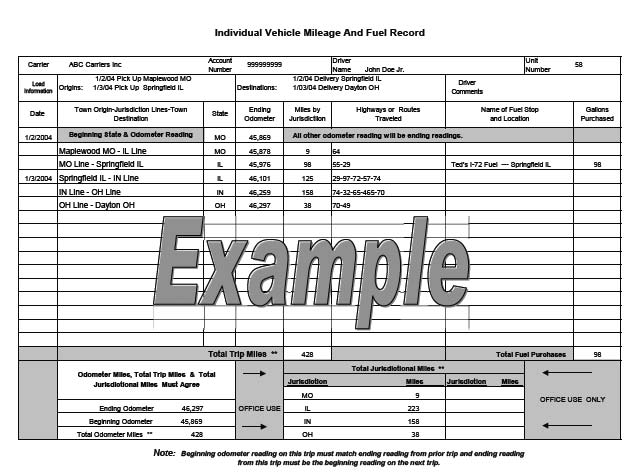
The requirement for acquiring IRP plates for a vehicle and IFTA license for a motor carrier is determined by the definitions from the IRP Plan and the IFTA for Qualified Vehicle and Qualified Motor Vehicle: For purposes of IRP: A Qualified Vehicle is (except as provided below) any Power Unit that is used or intended for use in two or more Member Jurisdictions and that is used for the transportation of persons for hire or designed, used, or maintained primarily for the transportation of property, and: (i) has two Axles and a gross Vehicle weight or registered gross Vehicle weight in (ii)excess of 26,000 pounds (11,793.401 kilograms), or (iii)has three or more Axles, regardless of weight, or (iv)is used in combination, when the gross Vehicle weight of such combination exceeds 26,000 pounds (11,793.401 kilograms). 1) Having two axles and a gross vehicle weight or registered gross vehicle weight exceeding 26,000 pounds or 11,797 kilograms; or 2) Is used in combination, when the weight of such combination exceeds 26,000 pounds or 11,797 kilograms gross vehicle or registered gross vehicle weight. Qualified Motor Vehicle does not include recreational vehicles. If the vehicle you operate is registered under IRP and you are a motor carrier licensed under IFTA, then you are required to comply with the mandatory record keeping requirements for operating the vehicle. A universally accepted method of capturing this information is through the completion of an Individual Vehicle Distance Record (IVDR), sometimes times referred to as a Driver Trip Report. This document reflects the distance traveled and fuel purchased for a vehicle that operates interstate under apportioned (IRP) registration and IFTA fuel tax credentials. Although the actual format of the IVDR may vary, the information that is required for proper record keeping does not.
In order to satisfy the requirements for Individual Vehicle Distance Records, these documents must include the following information: Distance Per Article IV of the IRP Plan (i) Date of trip (starting and ending) (ii)Trip origin and destination – City and State or Province (iii) Route(s) of travel (iv) Beginning and ending odometer or hubometer reading of the trip (v) Total distance traveled (vi) In-Jurisdiction distance (vii) Power unit number or vehicle identification number. Fuel Per Section P560 of the IFTA Procedures Manual .300 An acceptable receipt or invoice must include, but shall not be limited to, the following: .005 Date of purchase .010 Seller's name and address .015 Number of gallons or liters purchased; .020 Fuel type .025 Price per gallon or liter or total amount of sale .030 Unit number or other unique vehicle identifier Registrant responsibilities under the Plan include applying for IRP registration with base jurisdiction, providing proper documentation for registration, paying appropriate IRP registration fees, properly displaying registration credentials, maintaining accurate distance records, and making records available for jurisdiction review. While similar, the Qualified Motor Vehicle in IFTA means a motor vehicle used, designed, or maintained for transportation of persons or property and: An example of an IVDR that must be completed in its entirety for each trip can be found in Figure 1 below. Each individual IVDR should be filled out for only one vehicle. The rules to follow when trying to determine how and when to log an odometer reading are the following: The IVDR serves as the source document for the calculation of fees and taxes that are payable to the jurisdictions in which the vehicle is operated, so these original records must be maintained for a minimum of four years. At the beginning of the day When leaving the state or province At the end of the trip/day Not only do the trips need to be logged, but the fuel purchases need to be documented as well. You must obtain a receipt for all fueling and include it with your completed IVDR. In addition, these records are subject to audit by the taxing jurisdictions. Failure to maintain complete and accurate records could result in fines, penalties and suspension or revocation of IRP registrations and IFTA licenses. Make sure that any trips that you enter are always filled out in descending order and that your trips include all state/provinces that you traveled through on your route. For additional information on the IRP and the requirements related to the IRP, contact your base jurisdiction motor vehicle department or IRP, Inc. the official repository for the IRP. Additional information can be found on the IRP, Inc. website at www.irponline.org. There is a training video on the website home page available in English, Spanish and French There are different routes that a driver may take, and most of the miles may be within one state or province. Whether or not the distance you travel is primarily in one jurisdiction or spread among several jurisdictions, all information for the trip must be recorded. This includes the dates, the routes, odometer readings and fuel purchases. For additional information on IFTA and the requirements related to IFTA, contact the appropriate agency in your base jurisdiction. You will also find useful information about the Agreement at the official repository of IFTA at http://www.iftach.org/index.php.
Figure 1 – Individual Vehicle Mileage & Fuel Record (Example)
.035 Purchaser's name By completing this document in full and keeping all records required by both the IRP and the IFTA, you will have ensured that you and your company are in compliance with all State and Provincial laws surrounding fuel and distance record keeping requirements.