Section 1 of 13
Introduction
Introduction











COMMERCIAL DRIVER’S LICENSE










































































































ALEXI GIANNOULIAS Secretary of State

























CDL STUDY GUIDE
Illinois







The commercial motor vehicle industry is the backbone of our transportation system to ensuring goods are transported safely through out Illinois and the entire country. Truck drivers are integral to the process and growth of our state’s economy. Illinois’ Commercial Driver’s License (CDL) program is credited as one of the best in the nation by the U.S. Department of Transpor -tation. The CDL program, including Commercial Learner’s Permits (CLPs), has been overhauled to ensure that truck drivers licensed in Illinois are held to the highest possible standards. Federal law requires any person applying for a CLP/CDL or current CDL holders to certify their commercial driving medical status. All CLP/CDL holders who operate in non-excepted interstate commerce are also required to keep a current DOT medical certificate on file with the Secretary of State’s office. The law strengthens the CDL program by requiring truckers meet minimum health and safety standards before getting behind the wheel. For details on CDL/CLP medical certification (see Section 15). The Secretary of State’s office initiated a law allowing for an exemption from the CDL written knowledge test for qualified current or former military personnel who participated in military heavy-vehicle programs. I am pleased to help make it easier for our military veterans to find employment based on their previous military driving service. CDL applicants may schedule pre-trip, skills and on-road exams online at ilsos.gov. The Illinois Fast Pass program allows applicants to schedule appointments online in minutes for CDL testing purposes at the CDL facility of their choice. Illinois Fast Pass can be accessed 24 hours a day, seven days a w eek and makes scheduling CDL appointments quick and convenient. CDL applicants may also schedule appointments by calling 217-785-3013 from 8 a.m. to 4:30 p.m., Monday-Friday. I encourage you to study this CDL Study Guide thoroughly before scheduling and taking the required exams. As Secretary of State, my goal is to ensure that our roads are the safest and that we license safe, qualified drivers to operate commercial vehicles in Illinois . Sincerely, Alexi Giannoulias Secretary of State ilsos gov ilsos.gov
ILLINOIS
CDL/CLP
GUIDE
TABLE OF CONTENTS Section 1: Introduction to Illinois’ CDL............................................................................................................2-18 Section 2: Driving Safely..................................................................................................................................19-63 Section 3: Transporting Cargo Safely............................................................................................................64-67 Section 4: Transporting Passengers Safely..................................................................................................68-71 Section 5: Air Brakes ......................................................................................................................................72-81 Section 6: Combination Vehicles ....................................................................................................................82-93 Section 7: Doubles and Triples ......................................................................................................................94-98 Section 8: Tank Vehicles ..............................................................................................................................99-101 Section 9: Hazardous Materials ..................................................................................................................102-124 Section 10: School Bus ................................................................................................................................125-138 Section 11: Charter Bus ......................................................................................................................................139 Section 12: Pre-Trip Vehicle Inspection Test ..............................................................................................140-149 Section 13: Basic Vehicle Control Skills Test ............................................................................................150-152 Section 14: On-Road Driving Test ................................................................................................................153-157 Section 15: Special CDL/CLP Information & Programs ............................................................................158-171

Printed by authority of the State of Illinois. January 2023 — 1 — CDL 10.25 • Commercial Motor Vehicle (CMV) • CDL/CLP Classifications, Endorsements and Restrictions • CDL/CLP Standards and Requirements • Commercial Driver’s License Tests • CDL/CLP Disqualifications • Other CDL/CLP Rules • Mechanical Safety Tests • Electronic Devices • Vehicle Size Limitations • Special Lighting Equipment • Vehicle Registration • IRP/International Fuel Tax Agreement
Illinois’ Commercial Driver’s License (CDL) program is designed to improve safety on our roads by meeting federal requirements for testing and licensing commercial drivers. On October 26, 1986, Congress passed the Commercial Motor Vehicle Safety Act of 1986. This law sets minimum standards for the licensing of drivers of commercial motor vehicles (CMV).
To obtain a CDL, you must pass all necessary knowledge and skills tests. This manual will help you pass the tests; however, it is not a substitute for a truck driver training class or program. Formal training is the most reliable way to learn the many special skills required for safely driving a large commercial vehicle and becoming a professional driver in the trucking industry.
1.1 — Commercial Motor Vehicle (CMV)
You must obtain a Commercial Driver’s License (CDL) to operate any of the following CMVs (unless you are driving these vehicles for exempted uses as noted in Subsection 1.1.2 below):




INTRODUCTION TO ILLINOIS’ CDL
This Section Covers:
• Any combination of vehicles with a gross combination weight rating (GCWR)** of 26,001 or more pounds, provided the gross vehicle weight rating (GVWR)* of the vehicle being towed is in excess of 10,000 pounds. • Any single vehicle with a GVWR of 26,001 or more pounds or any such vehicle towing another not in excess of 10,000 pounds. • Any vehicle, regardless of size, designed to transport 16 or more persons, including the driver. • Any vehicle required by federal regulations to be placarded while transporting hazardous materials.
*GVWR — Value specified by the manufacturer as the maximum loaded weight of a single vehicle or combination of vehicles. **GCWR — Value specified by the manufacturer as the GVWR of the power unit plus the GVWR of the towed unit or units.
Note: For testing purposes only, the GCWR/GVWR means the value specified by the manufacturer as the maximum loaded weight of a single vehicle or combination of vehicles. The GVWR/GCWR tags must be present and legible on the pulling unit (truck) and the trailer (if combination testing). For the skills/drive testing, a proper class representative vehicle is required. Truck-tractors of a tractor and trailer combination are not allowed for Class B testing. When appearing for the skills/drive testing, please bring all documentation for the vehicle, such as the insurance card/certificate and registration documents, into the facility.
1.1.2 — Exemptions
Under state and federal law, certain drivers are not subject to the requirements of the CDL program. The Federal Motor Carrier Safety Administration has determined that these exemptions will not diminish the safe operation of commercial vehicles on the highways. However, these drivers are still required to possess the proper class license for the vehicle they are operating. aqua cultures);
- — Used within 150 air miles of the farm; and
- — Not used in the operations of a common or contract carrier or for other commercial purposes. Note: Operators of Class A, truck-tractor and semi-trailer combination vehicles used expressly for farming purposes and who meet the above criteria are also exempted from holding a CDL. These drivers must still possess a Class A non-CDL with a J50 or J51 restriction. Drivers must be of qualifying age and must be qualified as a Farm Vehicle Driver (FVD) or the vehicle(s) must meet the Covered Farm Vehicle (CFV) designation. Drivers are still required to take the appropriate CDL written and skills/drive testing. For more information and definition, visit ilsos.gov, Commercial section. • Emergency Equipment/Vehicle. Because most emergency organizations have extensive initial training and retraining requirements for their equipment operators, Illinois waives CDL requirements for operators of emergency equipment vehicles when responding to or returning from an emergency necessary to preserve life and property. • Military Vehicle. Military vehicles operated by active duty military personnel. • Recreational Vehicle. Recreational vehicles operated primarily for personal use. 1.1.3 — Special Requirements for Certain Vehicles To operate the following vehicles, a driver must meet special requirements established by the Illinois Secretary of State and/or other governmental agencies: • School buses and other vehicles transporting school children for curriculum-related activities: Requires an Illinois School Bus Permit (SBP) and may require a CDL with P and S endorsements. Contact the local school district/bus company for which you plan to drive. • Religious organization vehicles: Requires a J02, J03 or J04 restriction. • Vehicles exclusively for transporting senior citizens: Requires a J05, J06 or J07 restriction. • Non-profit ride sharing or child care vehicles. These vehicles may or may not require a CDL, depending on the number of passengers the vehicle is designed to transport or the GVWR of the vehicle. For more information on operating these types of vehicles, drivers should check with their employer or a local Driver Services facility or call the Safe Ride Section at 217-785-2543. 1.2 — Commercial Driver’s License (CDL) and Commercial Learner’s Permit (CLP) Classifications, Endorsements and Restrictions CDL and CLP classifications, endorsements and restrictions are based on the type of CMV driven. The type of CMV is determined by the manufacturer’s GVWR/GCWR, construction or use. 1.2.1 — Driver’s License Classifications (CDL and NON-CDL) • Class A — Combination vehicles with a GCWR** of 26,001 or more pounds, provided the GVWR* of the vehicle being towed is in excess of 10,000 pounds. • Class B — Single vehicle with a GVWR* of 26,001 or more pounds or any such vehicle towing another not in excess of 10,000 pounds. • Class C — Single vehicle with a GVWR* of at least 16,001 pounds but less than 26,001 pounds. • Class D — Single vehicle with a GVWR* of less than 16,001 pounds. GCWR** —Gross Combination Weight Rating GVWR* — Gross Vehicle Weight Rating Drivers of the following vehicles are exempt from the CDL requirement: • Farm Vehicle/Equipment. This exemption covers farming operations (as noted below) and does not apply to commercial grain haulers or other types of non-farm use. This exemption only applies when farm vehicles are:
- — Controlled and operated by a farmer, the farmer’s family or an employee;
- — Used to transport farm products, equipment or supplies to or from a farm (including nurseries and 1.2.2 — CLP and CDL Endorsements • P — Passenger Vehicles: CLP & CDL. • N — Tank Vehicles: CLP & CDL. • S — School Bus: CLP & CDL. • H — Hazardous Materials: CDL only. • X — Combined Hazardous Materials & Tank Vehicle: CDL only. • T — Double & Triple Trailers: CDL Class A only. • C — Charter Bus: Illinois CDL only. 1.2.3 — CLP and CDL Type Restrictions • B — Corrective lenses required (CLP & CDL). • E — Automatic Transmission only in CDL/CMV (CDL only). • F — Outside Mirrors and/or hearing aid (CLP & CDL). • K — CDL Intrastate Only (CLP & CDL). • L — Air Brakes not allowed (CLP & CDL). • M — Class B or C Passenger vehicles only (CDL only). • N — Class C Passenger vehicles only (CDL only). • O — No Tractor Trailer CDL/CMV (CDL only). • P — No Passengers in CDL/CMV bus (CLP only). • V — FMCSA (federal) medical variance (CLP & CDL). • X — No cargo in a CDL/CMV Tank vehicle (CLP only). • Z — No full Air Brakes equipped CDL/CMV vehicles (CDL only). • J10 — CDL vehicles with GVWR 16,000 lbs or less (Illinois Class C CDL only). • J50/J51 — Farm waived truck tractor-semi trailer vehicles (visit ilsos.gov for definition and eligibility – Illinois Non-CDL Class A only). A driver’s DL, CLP or CDL may contain other restrictions not listed above based on specific conditions for each driver. 1.3 — CDL and CLP Standards and Requirements To get an Illinois CDL or CLP, you must comply with the following standards and requirements. 1.3.1 — Documentation Required for a CLP/CDL As is required for any driver’s license, all new or transferring CDL applicants are required to show documentation verifying their identity, date of birth, Illinois residency, signature and Social Security number. For the most up-to-date list of acceptable documents, please visit ilsos.gov. Effective July 1, 2015, federal law requires all new CDL and CLP applicants to provide proof of citizenship or lawful presence. Existing CDL holders wishing to renew or upgrade their CDL will also be required to provide proof of citizenship or lawful presence to the driver facility staff to be able to renew or upgrade. Refer to the above website for acceptable citizenship (certified birth certificate or valid passport) and lawful presence documents. 1.3.2 — CDL/CMV Medical Program Requirements Most operators of commercial vehicles with a gross motor vehicle weight of 10,001 pounds or more are required to carry a Medical Examiner’s Certificate at all times while operating a second division vehicle. All non-excepted interstate drivers are required to submit their medical examiner’s certificate to the Secretary of State. For additional medical examiner reporting requirements and information, please refer to Section 15. Do I Need a DOT Medical Card? Yes, if you are a non-excepted driver who will: • Operate a commercial vehicle with a gross vehicle weight rating (GVWR) or a gross combination weight rating (GCWR) of 10,001 pounds or more in the furtherance of a commercial enterprise (private or for hire). • Operate a passenger carrying vehicle designed to transport eight or more passengers, including the driver. • Operate any vehicle transporting hazardous materials of a quantity that would require placarding. J.J. Keller & Associates, Inc. Illinois Trucking Association 3003 W. Breezewood 932 S. Spring St. Neenah, WI 54956 Springfield, IL 62704 800-327-6868 217-789-6017 Mid-West Truckers Association Illinois Trucking Association 2727 N. Dirksen Pkwy. 7000 S. Adams, Ste. 130 Springfield, IL 62702 Willowbrook, IL 60527 217-525-0310 630-654-0884 1.3.3 — Additional Requirements In addition, commercial vehicle drivers must: • Maintain and have in their possession a file that contains their written exam verification, driving exam verification and other records. • Be at least age 21 to drive a commercial motor vehicle involved in interstate commerce or transport passengers. • Be at least age 18 to obtain a CLP/CDL and/or to transport hazardous materials intrastate (within Illinois only). • Certify that they do not have more than one driver’s license and that their driving privileges are not suspended, revoked, canceled or disqualified. • Certify that they meet the medical requirements of the Federal Motor Carrier Safety Regulations or that they are not subject to the regulations. For more information regarding the Motor Carrier Safety Regulations, see Table C in Section 15, visit fmcsa.dot.gov or contact: CDL Medical Certification Initial medical certification with the Secretary of State’s office can only be processed at one of the 47 CDL Driver Services facilities (see Pages 8 and 9). After your original certification in person, you may visit any Driver Services facility to obtain a duplicate/corrected CDL or renew your license when only a vision test is required. If you are a non-excepted interstate (NI) driver, upon expiration of your current medical examiner’s certificate, you must present an updated certificate at a CDL facility or mail it to the CDL Medical Unit in Springfield. A reminder letter is sent to all NI drivers 90 days prior to the expiration of the current medical examiner’s certificate. If the certificate is presented to a CDL facility, your medical status will be updated immediately. If mailing the new certificate, please do so 30 days prior to the expiration of your current certificate. If you allow your medical examiner’s certificate to expire and have not changed your medical certification category status with the Secretary of State, your CDL driving privileges will be canceled. If you have any questions involving the CDL Medical Program, please call 217-785-3002. The Secretary of State’s office is not responsible for regulating or enforcing these federal or state medical program regulations (other than recording the self-certification of CLP/CDL holders and the medical information for NI drivers) and may not have the forms necessary for compliance with these regulations. Enforcement is the responsibility of the Illinois State Police and/or IDOT. All required medical forms and informational material are available at ilsos.gov or FMCSA.gov or the following organizations: Illinois Department of Transportation Commercial Vehicle Safety Section Motor Carrier Safety Unit 3215 Executive Park Dr. Springfield, IL 62703 217-785-1181 Figure 1.2 WHAT SECTIONS SHOULD YOU STUDY? *Study Section 5 if you plan to operate vehicles equipped with air brakes. 1.3.4 — CDL Transfer and CLP Requirements • CDL applicants who transfer their CDL to Illinois from another state must pass all applicable CDL knowledge and skills/drive tests to obtain an Illinois CDL and any endorsements, regardless if they held an Illinois CDL previously. • An initial Commercial Learner’s Permit (CLP) must be held for at least 14 days before skills/drive testing can be conducted. Any changes to the initial CLP will require a new 14-day waiting period. • A CLP issued to an applicant to upgrade to a higher class CDL, remove the air brakes restriction, or add a passenger endorsement or a School Bus endorsement must be held for at least 14 days before the skills/drive testing can be conducted. • A CLP expires 180 days from the date of initial issuance or renewal. A CLP can be renewed for an additional 180 days without additional written testing if renewed within five calendar days from the date of expi ra tion. A CLP can be renewed up to 30 days in advance of expiration for an additional 180 days. All CLP renewals will require the full CLP fee. • Upon renewal of a CLP, any completed skills/drive testing must be re-taken. • A CLP may not be renewed a second time. An applicant who wishes to retain a CLP more than 360 days after initial issuance is required to pay a new CLP fee and complete all applicable testing. 1.3.5 — MCSIA Rule All CDL holders are required by federal law to submit to a one-time 10-year driving history check on renewal or surrender of an out-of-state license to obtain an Illinois CDL. CDL holders applying for a corrected or duplicate license also are required to submit to a one-time 10-year driving history check. 1.3.6 — CDL/CLP Fees • The renewal and out-of-state transfer fee (18-69 years of age) for a CDL is $60. This includes $10 for the basic driver’s license, $24 for the CDL, $6 to cover the cost of the nationwide CDLIS program and $20 for the Motor Carrier Safety Inspection Fund. After age 69, CDL holder renewal fees decrease due the driver’s age. • The fee for a CLP is $50 for all non-CDL license holders or to renew an initial CLP. • The fee to upgrade an existing CLP/CDL class or to add/remove any endorsement/restriction is $5. 1.4 — Commercial Driver’s License Tests 1.4.1 — Computerized Written Knowledge Testing You will have to take one or more computerized knowledge tests, depending on the class of license and endorse ments you want. Figure 1.2 shows the sections of this manual you should study for each class of license and each endorsement.
Section to Study | License Type | | | Endorsement | | | | |
| Class A | Class B | Class C | Hazardous Materials | Double Triple | Tank Vehicles | Passenger | School Bus | Charter Bus
1 | ✓ | ✓ | ✓ | | | | | |
2 | ✓ | ✓ | ✓ | ✓ | ✓ | ✓ | ✓ | |
3 | ✓ | ✓ | ✓ | | | | | |
4 | | | | | | | ✓ | ✓ | ✓
5* | ✓ | ✓ | ✓ | | ✓ | | | |
6 | ✓ | | | | ✓ | ✓ | | |
7 | | | | | ✓ | | | |
8 | | | | | | ✓ | | |
9** | | | | ✓ | | | | |
10 | | | | | | | | ✓ |
11 | | | | | | | | | ✓
12 | ✓ | ✓ | ✓ | | | | ✓ | ✓ |
13 | ✓ | ✓ | ✓ | | | | ✓ | ✓ |
14 | ✓ | ✓ | ✓ | | | | ✓ | ✓ |
**TSA Hazardous Material Endorsement approval is also required prior to testing. All CDL applicants are required to pass the general CDL (core) knowledge written test, with a minimum score of 80%. This exam consists of 30 standardized multiple-choice questions. Written knowledge tests are valid for the maximum of one year.
Additional knowledge and endorsement exams include: • Combination: Required for applicants to operate a Class A combination/articulated vehicle (20 questions). • Air Brakes: Required for applicants to operate a vehicle equipped with a full or partial air brakes (air-over-hydraulic) system (25 questions). • Passenger endorsement (P): Required for applicants to operate a vehicle that is designed to transport 16 people or more (20 questions). • Tank Vehicle endorsement (N): Required for applicants to operate any commercial motor vehicle that is designed to transport any liquid or gaseous material within a tank(s) that is/are either permanently or temporarily attached to the vehicle or the chassis, where each tank has an individual rating capacity in excess of 119 gallons, and where all tanks have an aggregate total of 1,000 gallons or more (20 questions). • School Bus endorsement (S): Required for applicants to operate a yellow school bus in any state to transport school children grades 12 and under in any state for school-sponsored activities (20 questions). Note: This test is also required for a driver to obtain a School Bus Permit (SBP), which is required for a driver to operate any vehicle on behalf of a school transporting Illinois school children grades 12 and under for curriculum-related activities. If the driver requires both the S endorsement and the SBP, then only one school bus knowledge test will be required. Note: Neither the S endorsement nor the SBP is required to operate an empty yellow school bus, but a P endorsement is required for any bus designed to transport 16 or more people. • Hazardous Materials endorsement (H): Required for applicants to operate a vehicle transporting hazardous materials requiring placards, as defined in 49 CFR 383.5 (30 questions). Prior to this test, the applicant must submit to a Transportation Security Administration (TSA) background check (separate/additional fee required) and receive an approval letter. For more information, contact 855-DHS-UES1 (855-347-8371) or visit https:// universalenroll.dhs.gov/#hme-home. • Doubles/Triples endorsement (T): Required for drivers to operate a vehicle pulling double or triple trailers (20 questions). • Charter Bus endorsement (C): Required for Illinois applicants to operate a charter-type bus when transporting school children grades 12 and under on behalf of an Illinois school district for school activities of any type. If the driver already holds both an S endorsement and an SBP for the same class as the charter bus, no C endorsement is required (20 questions).
1.4.2 — Skills/Drive Testing
After successfully passing the required written test(s), most applicants will be required to pass the skills/drive testing. There are three general skills that will be tested: pre-trip vehicle inspection, basic vehicle control and on-road driving. An applicant who has successfully passed one part but then fails a subsequent part is not required to retake the part passed. For example, a driver who successfully completes the pre-trip inspection, but then fails the basic control skills is not required to retake the pre-trip inspection. If applicants fail a part of the skills/drive testing (ex: pre-trip inspection), they must perform the entire pre-trip inspection during their next exam.
- 1) The pre-trip inspection test is conducted to determine whether the applicant knows how to properly inspect the vehicle to determine if it is safe to drive. Applicants will be asked to conduct a pre-trip inspection of a representative vehicle they will operate on the job. The examiner will inquire about a certain area on the vehicle(s), and the applicant must explain what is to be inspected and why. Applicants will be scored section by section of the vehicle, and an applicant who accumulates a predetermined amount of points for a particular section will fail the pre-trip inspection. Applicants will not be tested on any component or area that is not present on the vehicle used for the test nor will they be required to get under the vehicle to examine any components; however, they must point out these components and explain why it is necessary to inspect those components. If a component of the vehicle examined during the pre-trip inspection fails to work properly through no fault of the applicant, the test may be discontinued, but the vehicle component failure will not be scored against the applicant. If the driver will be operating a vehicle with air brakes while on the job, the test vehicle must be equipped with air brakes. See Sections 2.1 and 12 of this study guide for additional information regarding the pre-trip inspection. Written/knowledge and skills/drive testing is available at the following facilities:
- 2) The basic vehicle control skills test is conducted to evaluate an applicant’s ability to use basic skills to control the vehicle. All applicants must complete three exercises on the facility course/road marked by lines, traffic cones or similar boundaries. These exercises test the applicant’s ability to move the vehicle forward, park the vehicle, move backward and reverse dock the vehicle. Applicants are scored on how well they stay within the boundaries outlined by the examiner, how many pull-ups and looks are used and how well they maneuver the vehicle into its final position. Applicants should avoid contact with any cones or boundary lines and should not cause a dangerous action within the testing area or exceed the accumulated overall point limit.
- 3) The on-road driving test is conducted to evaluate the applicant’s ability to drive safely in a variety of on-road situations. The road test route will include left and right turns, intersections, railway crossings, curves, upgrades, downgrades, rural or semi-rural routes, multilane city streets and/or expressway driving. Applicants will be scored on each of these driving maneuvers and conditions and must not exceed a predetermined number of points assigned to the driving exam, cause any dangerous action or violate any laws during the exam. Any driver who fails the road test six times will be required to submit an Illinois medical report before attempting any additional road exams. Three-time Fail Rule. CDL applicants who fail any particular CDL test three times are required to wait 30 days from the date of the third failed test before taking the particular test again. Three additional failures (six total failures) of the same exam will result in a 90-day waiting period. Three more additional failures (nine total failures) of the same test after the 90-day waiting period will result in a one-year waiting period from the date of the last failed test. The waiting periods apply only to the particular exam failed three times. Applicants are allowed three attempts to pass each required exam per fee paid. If an applicant fails any particular test three times, the original fee paid to start the testing will be required to be repaid to resume testing if the applicant needs to pass the failed test to have the CDL issued. Cheating/Unauthorized Items in the Testing Area/Bribery. Any person found cheating on any portion of a written exam will be given an automatic fail for that exam. In addition, the person will be prohibited from retaking the particular test for a period of 30 days. “Cheating” is defined as receiving or using unauthorized assistance in the taking of any portion of a test, including, but not limited to, the use of technology, notes, books or written information. Cellphones or other electronic devices are not permitted to be powered on nor are any written items to be present within the testing area. Anyone who does not adhere to this testing policy will be considered attempting to utilize unauthorized assistance, and the penalties will apply. Any person convicted of offering a bribe to any examiner or anyone authorized by law to provide driving instructions or administer driver’s license exams may have his/her driving privileges suspended or withheld for 120 days. The offense is a Class 2 felony, which carries a three- to seven-year prison sentence and fines of up to $25,000. 1.4.3 — Illinois Fast Pass Applicants can schedule CDL exams online 24 hours a day, seven days a week at ilsos.gov. Applicants who need to cancel a CDL appointment are asked to provide a 24-hour notice by calling 217-785-3013. 1.4.4 — Secretary of State CDL Facilities - Facility services and locations are subject to change at any time. Please refer to ilsos.gov for updates or changes. Olney 1302 S. West St. Olney, IL 62450 618-395-1702 Peoria 3311 N. Sterling Ave., #12 Peoria, IL 61604 309-686-6040 Princeton 225 Backbone Rd. East Princeton, IL 61356 815-875-2617 Marion 1905 Rendleman St. Marion, IL 62959 618-993-2587 Mascoutah/Lebanon 9221 Beller Dr., Route 4 Mascoutah, IL 62258 618-808-7002 Moline/Silvis 2001 Fifth St., Ste. #10 Silvis, IL 61282 309-796-0934 Danville/Tilton #5 Southgate Tilton, IL 61833 217-442-1564 DeKalb 1360 Oakwood St. DeKalb, IL 60115 815-756-7781 Elk Grove Village 650 Roppolo Dr. Elk Grove Village, IL 60007 847-981-7447 Bradley 111 Village Square Shopping Plaza Bradley, IL 60915 815-933-1713 Charleston 1010 E. St. Charleston, IL 61920 217-345-7401 * Class B and C CDL drives only. Written/knowledge testing is available at the following facilities: Belleville 400 W. Main St. Belleville, IL 62220 618-236-8450 Bethalto 20 Terminal Dr., Ste #103 East Alton, IL 62024 618-258-0600 Bloomington 1510 W. Market St. Bloomington, IL 61701 309-827-3531 Carbondale 2516 W. Murphysboro Rd. Carbondale, IL 62901 618-457-0488 Carmi 1128 W. Oak St. Carmi, IL 62821 618-383-8349 Champaign 2012 Round Barn Rd. Champaign, IL 61821 217-278-3344 Decatur 3149 N. Woodford St. Decatur, IL 62526 217-875-1650 East St. Louis 1468 State St. East St. Louis, IL 62203 618-397-9488 Edwardsville 1502A Troy Rd. Edwardsville, IL 62025 618-656-8956 Effingham 444 S. Willow St. Effingham, IL 62401 217-347-7728 Fairfield 307 N. Market Ave. Fairfield, IL 62837 618-842-9548 Freeport 1054 N. Riverside Dr. Freeport, IL 61032 815-235-4164 Galesburg 1066 E. Losey St. Galesburg, IL 61401 309-342-1154 Hillsboro 2010 N. School St. Hillsboro, IL 62049 217-532-5823 Jacksonville 901 W. Morton, Ste. 13 Lincoln Square Shopping Center Jacksonville, IL 62650 217-243-4327 Jerseyville 710 County Rd. Jerseyville, IL 62052 618-498-5751 Lake Zurich 951 S. Rand Rd. Lake Zurich, IL 60047 847-847-0247 Macomb 466 Deer Rd. Macomb, IL 61455 309-833-5661 Mattoon 2020 Charleston Ave. Mattoon, IL 61938 217-234-4040 Metropolis 1112 W. 10th St. Metropolis, IL 62960 318-524-7451 Morris 425 E. Route 6 Morris, IL 60450 815-705-9022 Nashville 480 N. Kaskaskia St. Nashville, IL 62263 618-327-4184 Pekin 200 S. Second St. Pekin, IL 61554 309-346-6186 Plano 236 Mitchell Dr. Plano, IL 60545 312-793-1010 Pontiac 507 Crane St. Pontiac, IL 61764 815-844-5766 Roanoke 102A N. 6th St. Roanoke, IL 61561 309-923-6381 Robinson 1321 E. Main St. Robinson, IL 62454 618-544-8118 Rockford Central 3720 E. State St. Rockford, IL 61108 815-394-0179 Sparta 202 W. Jackson St. Sparta, IL 62286 618-443-3834 Springfield – Klein & Mason 316 N. Klein St. Springfield, IL 62702 217-782-4850 Sterling 1224 W. 4th St. Sterling, IL 61081 815-626-2825 1.5 — CDL/CLP Disqualifications You may not drive a commercial motor vehicle if you are disqualified for any reason. 1.5.1 — Alcohol/Drug Regulations and Disqualifications Illinois law provides that drivers operating a commercial motor vehicle (CMV) or a non-commercial motor vehicle (non-CMV) on highways have impliedly consented to submit to chemical tests to determine blood-alcohol concentration (BAC). A school bus driver may not operate a school bus with a BAC of more than .00%. A CDL holder may not operate a commercial vehicle with a BAC of .04% or more. A school bus driver or a CDL holder may not drive any other vehicle with a BAC of .08% or more. The following offenses will lead to disqualification: West Chicago 721 Kress Rd. West Chicago, IL 60185 630-293-1320 South Holland 41 W. 162nd St. South Holland, IL 60473 708-210-3540 Springfield 2701 S. Dirksen Pkwy. Springfield, IL 62723 217-782-6030 Rockford 4734 Baxter Rd. Rockford, IL 61109 815-873-0134 Salem 1375 W. Whittaker St. Salem, IL 62881 618-548-2381 Quincy 2512 Locust St. Quincy, IL 62301 217-222-4550 Rantoul* 421 S. Murray Rd. Rantoul, IL 61866 217-892-8773 • Any driver operating a CMV or non-CMV who refuses to submit to chemical testing or submits to a test with results in excess of the legal limit is disqualified for a minimum of 12 months. • Any driver convicted of DUI (regardless of BAC) is disqualified for a minimum of 12 months. • Knowingly and willfully leaving the scene of an accident while operating a CMV or non-CMV results in disqualification for a minimum of 12 months. • Committing a felony while operating a CMV or non-CMV results in disqualification for a minimum of 12 months. • A conviction for either offense above while carrying placarded hazardous materials results in disqualification for a minimum of three years. • The use of a CMV or non-CMV in the commission of any felony involving manufacturing, distributing or dispensing a controlled substance, or possession with intent to manufacture, distribute or disperse a controlled substance results in a lifetime disqualification. • Any driver providing fraudulent documentation for the issuance of a CLP or a CDL will lead to disqualification. • Operating a commercial motor vehicle in violation of regulations pertaining to railroad-highway grade crossings: first conviction — 60-day disqualification; second conviction within a three-year period —120-day disqualification; and third and subsequent conviction within a three-year period — one-year disqualification. These violations include violation of a federal, state or local law or regulation pertaining to one of the following six offenses at a railroad-highway grade crossing:
- — For drivers who are not required to always stop, failing to stop before reaching the crossing if the tracks are not clear.
- — For drivers who are not required to always stop, failing to slow down and check that the tracks are clear of an approaching train.
- — For drivers who are always required to stop, failing to stop before driving onto the crossing.
- — For all drivers failing to have sufficient space to drive completely through the crossing without stopping.
- — For all drivers failing to obey a traffic control device or the directions of an enforcement official at the crossing.
- — For all drivers failing to negotiate a crossing because of insufficient undercarriage clearance. 1.5.3 — Serious Traffic Violations Two serious traffic violations within a three-year period will result in a 60-day disqualification. Three serious traffic violations in the same period will result in a 120-day disqualification. These include the following. Excessive Speeding. Excessive speeding involving any single offense for any speed of 15 mph or more above the posted speed limit. • Failure to reduce speed to avoid an accident. • Driving too fast for conditions. • Exceeding the speed limit in a school zone. Reckless Driving. Operating a CMV or non-CMV in a manner that exhibits a willful, wanton or reckless disregard of the safety of persons or property. • Passing a vehicle stopped for a pedestrian in a crosswalk. • Driving on a sidewalk. • Passing a school bus receiving or discharging passengers or displaying a warning not to pass. No Valid CDL. Operating a CMV without a valid CDL. • If either violation directly above takes place while transporting placarded hazardous materials, the driver is disqualified for a minimum of three years. • Any driver who commits two of the above violations, arising from two or more incidents, is disqualified for life. • Any CDL holder operating a CMV who is found to have any alcohol in his/her system is placed out of service for a minimum of 24 hours. • Any driver convicted of driving a commercial motor vehicle with any amount of drug, substance or compound resulting from unlawful use or consumption of cannabis (marijuana) listed in the Cannabis Control Act or controlled substance listed in the Controlled Substance Act is disqualified for a minimum of 12 months. 1.5.2 — Additional Offenses Leading to Disqualification The following offenses will also lead to CDL/CLP disqualification: • Operating a CMV with an improper classification or restriction. • Violation of a learner’s permit. Following Too Closely. Following the vehicle ahead too closely. • Failure of a truck to leave sufficient distance for being overtaken by another vehicle. • For at least 90 days if you have committed your first violation of an out-of-service order. • For at least one year if you have committed two violations of an out-of-service order within a 10-year period. • For at least three years if you have committed three or more violations of an out-of-service order within a 10-year period. 1.5.5 — Hazardous Materials Endorsement Background Check and Disqualifications Applicants who need a hazardous materials endorsement will be required to submit to a fingerprint-based nationwide background check. Applicants will be denied or have the hazardous materials endorsement canceled if they: Improper Lane Usage. Improper or erratic traffic lane changes. • Improper lane changing, lane usage and/or center lane usage. • Improper passing. • Passing on a hill or curve or when prohibited. • Passing on wrong side of the road. • Improper passing on shoulder, left or right. • Driving wrong way on a one-way street or highway. • Driving on the left side of the roadway. • Passing in a school zone. Conviction Involving a Fatal Accident. A violation of any state law or local ordinance relating to motor vehicle traffic control (other than parking violations) arising in connection with a fatal traffic accident will result in a minimum 12-month disqualification. Multiple Licenses. A violation relating to a CMV driver having multiple driver’s licenses. Cellphone and Communication Device Use. A violation relating to a CMV driver texting or using a hand-held cellphone while driving a CMV. 1.5.4 — Violation of Out-of-Service Orders You will lose your CDL: • Are not a permanent resident of the United States or are unable to provide proof of lawful status. • Renounce their United States citizenship. • Are wanted or under indictment for certain felonies. • Have a conviction in military or civilian court for certain felonies. • Have been adjudicated as mentally incompetent or involuntarily committed to a mental institution. • Are deemed to pose a security threat as determined by the Transportation Security Administration. Any CDL holder or CLP applicant who wishes to obtain a Hazardous Materials Endorsement (HME/H) must call 855-DHS-UES1 (855-347-8371) or visit https://universalenroll.dhs.gov/#hme-home to enroll with the Transportation Security Administration for a background check. The Secretary of State must receive TSA approval prior to any testing for this endorsement. This process must be completed at every CDL renewal if the driver needs to maintain the Hazardous Materials endorsement. 1.5.6 — Traffic Violations in a Personal Vehicle • The Motor Carrier Safety Improvement Act (MCSIA) of 1999 requires CDL holders to be disqualified from operating a commercial motor vehicle if they have been convicted of certain types of moving violations in their personal vehicle. • If a CDL holder’s privilege to operate a non-CMV is revoked, canceled or suspended due to violations of traffic control laws (other than parking violations), the CDL will also be disqualified. • If a CDL holder’s privilege to operate a non-CMV is revoked, canceled or suspended due to alcohol, controlled substance or felony violations, the CDL will be disqualified for one year. If a CDL holder’s privilege to operate a non-CMV is revoked, canceled or suspended due to a second alcohol, controlled substance or felony violation, the CDL will be disqualified for life. • If a CDL holder’s privilege operate a non-CMV is revoked, canceled or suspended, no “hardship” license, such as a restricted driving permit or monitoring device driving permit, may be issued to operate a CMV. • Drivers cannot have more than one license. If this rule is broken, a court may impose a fine of up to $5,000 or jail time and keep the home state license and return any others. • Drivers must notify their employer within 30 days of conviction for any traffic violations (except parking). This is true no matter what type of vehicle was driven.
- • Drivers must notify their employer within two business days if their license is suspended, revoked or canceled, or disqualified.
- • When applying for a commercial driving job, drivers must provide employer information on all driving jobs held in the past 10 years.
- • No one can drive a commercial motor vehicle without a CDL. A court may impose a fine up to $5,000 or jail time for breaking this rule.
- • Drivers with a hazardous materials endorsement must notify and surrender their Hazardous Materials endorsement to the state that issued the CDL within 24 hours if they are convicted or indicted in any jurisdiction, civilian or military, or found not guilty by reason of insanity of a disqualifying crime listed in 49 CFR 1572.103; they are adjudicated as mentally incompetent or committed to a mental institution as specified in 49 CFR 1572.109; or they renounce their U.S. citizenship.
- • Employers may not let an employee drive a commercial motor vehicle if the employee has more than one license or if the CDL is suspended or revoked. A court may fine the employer up to $5,000 or impose jail time for breaking this rule.
- • All states are connected to one computerized system to share information about CDL drivers. The states will check on drivers' accident records to be sure that drivers do not have more than one CDL.
- • Drivers must be properly restrained by a safety belt at all times while operating a commercial motor vehicle. The safety belt design holds the driver securely behind the wheel during a crash, helping the driver to control the vehicle, and reduces the chance of serious injury or death. Drivers who do not wear a safety belt are four times more likely to be fatally injured if thrown from the vehicle.
- • CDL holders must notify the Secretary of State’s office within 10 days of a name/address change and must obtain a corrected driver’s license within 30 days of a name/address change. 1.7 — Mechanical Safety Tests Most second division and medical transport vehicles must have a Certificate of Safety before being driven on Illinois highways. Safety inspections are required every six (6) or twelve (12) months depending on the type of commercial vehicle. The following vehicles are subject to safety inspection semi-annually: • Trucks registered with a gross weight of more than 8,000 pounds; trucks that pull a trailer with a gross weight of more than 8,000 pounds; trailers with a gross weight of more than 5,000 pounds; motor buses; and religious organization buses. • Buses registered as charitable vehicles; senior citizen transport vehicles; school buses; medical transport vehicles; tow trucks; and limousines. A valid CVSA decal or a federal annual decal per 49 CFR 396.17 and 49 CFR 396.23 is acceptable in lieu of the Illinois six-month Safety Sticker. Garages or service stations licensed by IDOT may make safety inspections. Second division vehicles not required to pass safety inspections include: 1.6 — Other CDL/CLP Rules There are other federal and state rules that affect drivers operating CMVs in all states. Among them are: • Vehicles with a gross weight of 8,000 pounds or less. • Farm tractors, machinery and other implements. • Vehicles owned or operated by the city of Chicago, which display proof of ownership. • Vehicles owned or operated by the federal government, which display proof of ownership. • Vehicles registered as recreational vehicles, which display proper plates. • Properly licensed antique vehicles. • Specialized vehicles as defined by statute. • Vehicles properly registered in another state. • Reporting an emergency situation. • Using the device hands-free or in voice-activated mode. • Parked on the shoulder of a highway. • Stopped due to normal traffic being obstructed and the vehicle is in neutral or park. DRIVERS WHO ARE IN A CRASH RESULTING FROM DISTRACTED DRIVING MAY FACE CRIMINAL PENALTIES AND JAIL TIME. 1.8.2 — Radar Detectors Illinois law prohibits CMVs from being equipped with any instrument designed to detect the presence of, or interfere with, microwaves at frequencies used by police radar for monitoring vehicle speed. The term “equipped” means and includes possession or use within a CMV. A motorist shall not be in violation if the device is contained in a locked, opaque box or similar container or the device is not in the passenger compartment of the vehicle and in operation. Violation of this law is a petty offense with a minimum fine of $50 for a first offense and a minimum of $100 for a second or subsequent offense. 1.8.3 — GPS Devices Commercial vehicle drivers using GPS (Global Position Services) devices for assistance with routing and navigation should employ a device designed specifically for truck navigation. A truck-enabled GPS device contains information about truck-restricted roadways and designated routes, as well as takes into consideration the size of the truck (length, weight, height and load types) as it routes. Unlike regular car GPS devices, truck-enabled GPS units provide a safer tool for ensuring that commercial vehicles are not mistakenly routed on non-truck roads, through low bridges or other hazards. Traffic and safety laws, road conditions and street signs always take priority when navigating. 1.9 — Vehicle Size Limitations Drivers must obey all posted signs regarding maximum truck width, length, height and weight limits. They must be aware that some highways prohibit truck travel entirely. Others allow truck travel on a limited basis. For example, only very small trucks may cross certain township bridges as well as the highways leading to and from these bridges. Higher limits are allowed on state highways designated by the Illinois Department of Transportation (IDOT) and on local streets and highways designated by local government officials. Maps showing state highways on which these vehicles may operate from are available from IDOT at www.gettingaroundillinois.com/gai.htm?mt=dtr. For additional size and weight information, see IDOT form OPER 753 at www.dot.il.gov/Forms/oper%20753.pdf. Width. The maximum width for all vehicles is 8 feet, 6 inches. Exemptions to maximum widths are: When a vehicle passes inspection, the driver is issued a Certificate of Safety windshield decal and an inspection report. The decal must be displayed on any vehicle using public roadways. 1.8 — Electronic Devices 1.8.1 — Cellphone and Communication Devices Illinois law prohibits the use of hand-held cellphones, texting or using other communication devices while operating a motor vehicle. Hands-free devices or Bluetooth technology is allowed for persons over age 18. Even using hands-free technology is considered a distraction while driving and can be dangerous. If you must make a phone call, even with hands-free technology, it is recommended that you pull off to the side of the road before making the call. Illinois drivers are exempt from using a cellphone or text messaging while driving only when: • Loads of farm products or implements of husbandry being transported during the period from a half-hour after sunrise to a half-hour before sunset in times of good visibility. See IDOT form OPER 2279 at www.dot.state.il.us/ Forms/OPER%202279.pdf. • On Class I and Class II designated state and local highways there is no overall length limit. However, for semitrailers more than 48 feet in length, the maximum allowable distance from the kingpin to the rear axle is 45 feet, 6 inches. The maximum length of either the semitrailer or trailer in a truck tractor-semitrailer-trailer (double-bottom) combination is 28 feet, 6 inches. • On Class III designated state and local highways, including other non-designated state highways, the maximum allowable length for tractor-semitrailer combinations is 65 feet overall length (bumper to bumper). However, for semitrailers more than 48 feet in length, the maximum allowable distance from the kingpin to the rear axle is 42 feet, 6 inches. All other types of vehicle combinations are limited to an overall length of 60 feet, including load. • On non-designated local streets including preferred truck routes, the maximum overall length is 55 feet (bumper to bumper), including loads for truck tractor-semitrailer combinations, and 60 feet for all other types of vehicle combinations, including load. Exceptions to LENGTH requirements: • Length limits do not apply to vehicles operating in the daytime except on Saturdays, Sundays or legal holidays when transporting poles, pipes, machinery or other objects of structural nature which cannot be readily dismembered, provided the length of the object being transported does not exceed 80 feet and the overall length of vehicle and load does not exceed 100 feet. • Stinger-steered vehicles specifically designed to transport motor vehicles or boats may have an overall length of 80 feet plus overhang of 4 feet in front and 6 feet in the rear on Class I and II highways. • Conventional auto transporters are vehicles specifically designed to transport motor vehicles or boats and may have an overall length of 65 feet plus overhang on these highways. The maximum overall length on all other streets and highways is 60 feet. General exceptions to LENGTH requirements: • All large vehicles operating on Class I highways shall have access for a distance of 1 mile on any street or highway to points of loading and unloading, and facilities for food, fuel, rest and repair. • Large vehicles operating on designated state highways shall have access for a distance of 5 highway miles on any other state highway and on designated local streets and highways, to points of loading and unloading, and facilities for food, fuel, rest and repair. (This applies only on local streets and highways specifically designated and posted by local officials.) • Streets or highways are designated by the Department of Transportation or local officials having jurisdiction. Height. The maximum height for all vehicles on all highways is 13 feet, 6 inches, including load from the underside of the tire to the top of the vehicle. Weight. The maximum weight limits on both designated and non-designated state and local streets and highways are: • Buses operating within the limits of cities and villages located in counties with populations of 500,000 or more. Maximum widths may be up to 9 feet. However, no vehicle wider than 8 feet, 8 inches may be operated on the interstate highways in those counties. Length. No vehicle with or without a load, other than a semitrailer, shall exceed a length of 42 feet. Semitrailers may have an overall length of 53 feet, including the load being carried. • 20,000 pounds on a single axle; • 34,000 pounds on a tandem; and • up to 80,000 pounds on a five-axle combination, depending upon axle spacing. However, any single axle of a two-axle motor vehicle weighing 36,000 pounds or less and not a part of a combination of vehicles may carry an axle load of up to 20,000 pounds. Exceptions for certain vehicles are allowed by the statutes and by local city ordinances. 1.10 — Special Lighting Equipment Second division or combination vehicles longer than 25 feet or wider than 80 inches (excluding mirrors, bumpers and other safety devices) must have special lighting equipment. The following lighting equipment is required on vehicles operated outside the limits of cities, towns or villages between sunset and sunrise: • Two amber reflectors on each side of the vehicle, not more than 5 feet above the road and placed at approximately one-third the length of the side of the vehicle. • One amber reflector on each side of the vehicle not more than 12 inches from the front and not more than 5 feet above the road. • One red reflector on each side of the vehicle not more than 12 inches from the rear and not more than 5 feet above the road. Special lighting equipment required on trailers and semitrailers with a gross weight of 3,000 pounds or less include: APPORTIONED ILLINOIS 20 15 1234 21 P • Two yellow or amber lights on the front of the vehicle. One light must be on each upper-front corner and visible for 500 feet. • Three red lights on the rear of the vehicle in a horizontal line and visible for 500 feet. • Two yellow or amber reflectors on the front of the vehicle. One reflector must be on each lower corner. • Two red reflectors on the rear of the vehicle. One reflector must be not more than 12 inches from each lower corner. Second division or combination vehicles longer than 20 feet and weighing more than 3,000 gross pounds must have special reflectors when operated outside the limits of cities, villages or towns between sunset and sunrise. The required reflectors, which must be approved by IDOT include:
- • Two red reflectors on the rear of the vehicle. Reflectors must not be more than 12 inches from each lower corner and visible for 300 feet in headlight beams. • Electric turn signals. Vehicles must have right and left signals on the front and rear. They must be visible from 300 feet. 1.11 — Vehicle Registration Registration ID Cards. Registration identification cards for second division vehicles, except pole trailers or semitrailers, must be in the vehicle, carried by the driver or carried by the person in control of the vehicle at all times. Vehicles weighing over 12,000 pounds that are registered in another state must carry an Illinois Fleet Reciprocity ID Permit, Apportionment ID Card or Prorate ID Card (for Prorate Decals) in place of the registration ID card. Motor Fuel Tax ID Card. When required by the Motor Fuel Tax Law, a valid Motor Fuel Tax Identification Card or an authorized reproduction must be carried in the cab of the vehicle or carried by the driver. The driver must display or surrender the card upon request of a police officer or other agent of the Department of Revenue. Second division registration fees are based on the type of operation and the gross weight of the vehicle and load. The fee schedule is printed on the application, which may be obtained from the Secretary of State’s office. License Plates. All vehicles except motorcycles, motorized pedal cycles, trailers, semitrailers, truck tractors and vehicles registered under the International Registration Plan (IRP) must display two license plates (front and rear) on the vehicle. Trailers must display one on the rear, and truck tractors must display one on the front. Buses registered under the IRP must display one apportioned plate on the rear of the bus. The IRP is a reciprocity agreement between the states and the Canadian provinces, providing for the payment of license fees to a specific jurisdiction based on the number of fleet-miles driven in that jurisdiction. A license plate and an Illinois Apportionment Identification Card listing the jurisdictions for which the fees have been paid are issued for each vehicle by the base state of the applicant. The gross weight at which the vehicle has been registered also is listed. Vehicles with a maximum gross weight over 26,000 pounds are required to display IRP plates. Lighter vehicles that conduct interstate commerce may choose to display these plates, while those that conduct intrastate commerce must have IRP plates. Apportioned Plates. Specific kinds of license plates are issued for second division vehicles. License plates for second division vehicles are issued for the fiscal year beginning July 1 and ending June 30. Apportioned plates are issued for the registration year beginning April 1 and ending March 31. Semitrailer plates are permanent plates. Intrastate carriers may not operate any motor vehicle on Illinois highways unless there is a sign painted on or affixed to both sides of the vehicle. The trade name, permit number and registration number of the carrier must be shown. • The vehicle’s point of origin and destination and its cargo or passengers. • Whether the trip is for-hire or not-for-hire. • Whether the trip is interstate or intrastate as defined by the Illinois Vehicle Code. 1.12 — International Registration Plan/International Fuel Tax Agreement If you operate a vehicle that requires a CDL in interstate commerce, the vehicle, with few exceptions, is required to be registered under the International Registration Plan (IRP) and the International Fuel Tax Agreement (IFTA). These federally mandated programs provide for the equitable collection and distribution of vehicle license fees and motor fuels taxes for vehicles traveling throughout the 48 contiguous United States and 10 Canadian provinces. Under the IRP, jurisdictions must register apportioned vehicles, which include issuing license plates and cab cards or proper credentials; calculating, collecting and distributing IRP fees; auditing carriers for accuracy of reported distance and fees; and enforcing IRP requirements. Registrant responsibilities under the plan include applying for IRP registration with base jurisdiction, providing proper documentation for registration, paying appropriate IRP registration fees, properly displaying registration credentials, maintaining accurate distance records and making records available for jurisdiction review. The basic concept behind IFTA is to allow a licensee (motor carrier) to license in a base jurisdiction for the reporting and payment of motor fuel use taxes. Under the IFTA, a licensee is issued one set of credentials that will authorize operations through all IFTA member jurisdictions. The fuel use taxes collected pursuant to the IFTA are calculated based on the number of miles (kilometers) traveled and the number of gallons (liters) consumed in the member jurisdictions. The licensee files one quarterly tax return with the base jurisdiction by which the licensee will report all operations through all IFTA member jurisdictions. It is the base jurisdiction's responsibility to remit the taxes collected to other member jurisdictions and to represent the other member jurisdictions in the tax collection process, including the performance of audits. An IFTA licensee must retain records to support the information reported on the IFTA quarterly tax return. The IRP registrant and the IFTA licensee may be the vehicle owner or the vehicle operator. The requirement for acquiring IRP plates for a vehicle and IFTA license for a motor carrier is determined by the definitions from the IRP and the IFTA for Qualified Vehicle and Qualified Motor Vehicle. For purposes of IRP: A Qualified Vehicle is (except as provided below) any Power Unit that is used or intended for use in two or more Member Jurisdictions and that is used for the transportation of persons for hire or designed, used or maintained primarily for the transportation of property and: (i) Has two axles and a gross vehicle weight or registered gross vehicle weight in excess of 26,000 pounds (11,793.401 kilograms); or (ii) Has three or more Axles, regardless of weight; or (iii) Is used in combination, when the gross vehicle weight of such combination exceeds 26,000 pounds The letters on the sign must be a minimum of 2-inches high with a 1/2-inch brush stroke. Interstate carrier vehicles must show the registration or authority number of the carrier on both sides of the unit. All tow trucks except those owned by governmental agencies must display a sign on each side. The sign must have letters not less than 2-inches high, which contrast with the background. The sign must state the name, address and telephone number of the owner or operator. Movement Documents. A movement document ensures that only vehicles in Illinois do intrastate business within the boundaries of Illinois. All trucks, truck tractors and buses registered in another state must carry one or more movement documents that show: (11,793.401 kilograms). (i) Having two axles and a gross vehicle weight or registered gross vehicle weight exceeding 26,000 pounds or 11,797 kilograms; or (ii) Having three or more axles regardless of weight; or (iii) Is used in combination, when the weight of such combination exceeds 26,000 pounds or 11,797 kilograms gross vehicle or registered gross vehicle weight. Qualified Motor Vehicle does not include recreational vehicles. If the vehicle you operate is registered under IRP and you are a motor carrier licensed under IFTA, then you are required to comply with the mandatory record-keeping requirements for operating the vehicle. A universally accepted method of capturing this information is through the completion of an Individual Vehicle Distance Record (IVDR), or Driver Trip Report. This document reflects the distance traveled and fuel purchased for a vehicle that operates interstate under apportioned (IRP) registration and IFTA fuel tax credentials. Although the actual format of the IVDR may vary, the information that is required for proper record-keeping does not. In order to satisfy the requirements for Individual Vehicle Distance Records, these documents must include the following information: Distance Per Article IV of the IRP Plan: (i) Date of trip (starting and ending). (ii) Trip origin and destination – city and state or province. (iii) Route(s) of travel. (iv) Beginning and ending odometer or hub odometer reading of the trip. (v) Total distance traveled. (vi) In-Jurisdiction distance. (vii) Power unit number or vehicle identification number. Fuel Per Section P560 of the IFTA Procedures Manual: .300 An acceptable receipt or invoice must in clude, but shall not be limited to, the following: .005 Date of purchase. .010 Seller's name and address. .015 Number of gallons or liters purchased. .020 Fuel type. .025 Price per gallon or liter or total amount of sale. .030 Unit number or other unique vehicle identifier. .035 Purchaser's name. An example of an IVDR that must be completed in its entirety for each trip can be found in example right. Each individual IVDR should be filled out for only one vehicle. The rules to follow when trying to determine how and when to log an odometer reading are the following: While similar, the Qualified Motor Vehicle in IFTA means a motor vehicle used, designed or maintained for transportation of persons or property and:
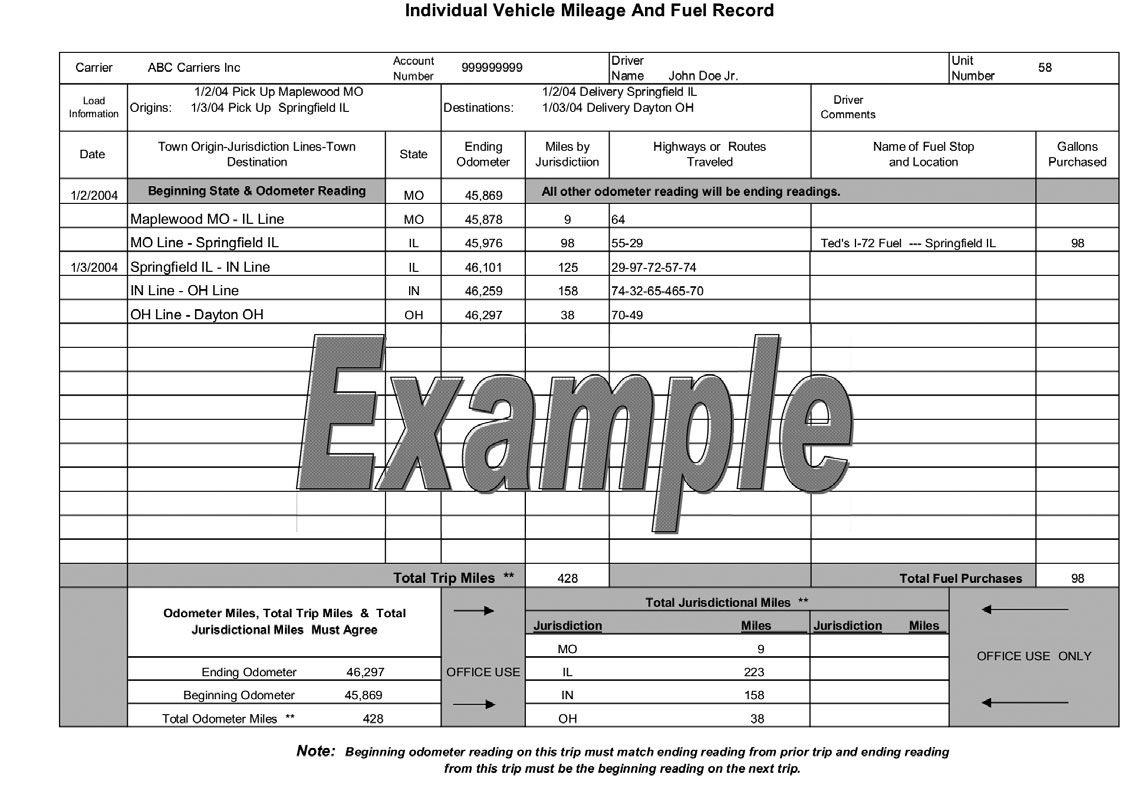
• At the beginning of the day. • When leaving the state or province. • At the end of the trip/day.
Not only do the trips need to be logged, but the fuel purchases need to be documented as well. You must obtain a receipt for all fueling and include it with your completed IVDR.
Make sure that any trips that you enter are always filled out in descending order and that your trips include all state/provinces that you traveled through on your route.
There are different routes that a driver may take, and most of the miles may be within one state or province. Whether or not the distance you travel is primarily in one jurisdiction or spread among several jurisdictions, all information for the trip must be recorded. This includes the dates, the routes, odometer readings and fuel purchases.
By completing this document in full and keeping all records required by both the IRP and the IFTA, you will have ensured that you and your company are in compliance with all state and provincial laws surrounding fuel and distance record-keeping requirements.
The IVDR serves as the source document for the calculation of fees and taxes that are payable to the jurisdictions in which the vehicle is operated, so these original records must be maintained for a minimum of four years.
In addition, these records are subject to audit by the taxing jurisdictions. Failure to maintain complete and accurate records could result in fines, penalties, and suspension or revocation of IRP registrations and IFTA licenses.
For additional information on the IRP and the requirements related to the IRP, contact your base jurisdiction motor vehicle department or IRP, Inc., the official repository for the IRP. Additional information can be found on the IRP, Inc. website at www.irponline.org. There is a training video on the website’s home page available in English, Spanish and French.
For additional information on IFTA and the requirements related to IFTA, contact the appropriate agency in your base jurisdiction. You will also find useful information about the agreement at the official repository of IFTA at http://www. iftach.org/index.php.